
研究孕期不同类型高血压的母婴结局。
Examining maternal and fetal outcomes across various subtypes of hypertension during pregnancy.
作者信息
Alhuneafat Laith, Ghanem Fares, Nandy Sneha, Khan Sana, Puttur Anushree, Jabri Ahmad, Haddad Alaq, Ramu Bhavadharini, Sabol Bethany, Schultz Jessica, Carlson Selma
机构信息
Division of Cardiovascular Disease, University of Minnesota, Minneapolis, MN, USA.
Department of Cardiovascular Medicine, Southern Illinois University, Springfield, IL, USA.
出版信息
Int J Cardiol Cardiovasc Risk Prev. 2025 Apr 22;25:200413. doi: 10.1016/j.ijcrp.2025.200413. eCollection 2025 Jun.
INTRODUCTION
Hypertensive disorders of pregnancy (HDP) are a leading cause of maternal morbidity and mortality worldwide. It includes chronic hypertension (CH), gestational hypertension (GH), preeclampsia (PRE), and CH with superimposed preeclampsia (SPE).We aim to assess in-hospital maternal and fetal outcomes of women in each of these groups in comparison to normotensive controls.
METHODS
Study sample included women in the National Inpatient Sample dataset from 2016 to 2020 who were categorized into the 4 groups of HDP as described above. They were compared to normotensive pregnancies for maternal and fetal outcomes using regression analysis after adjusting for age, race, C-section status, and comorbidities.
RESULTS
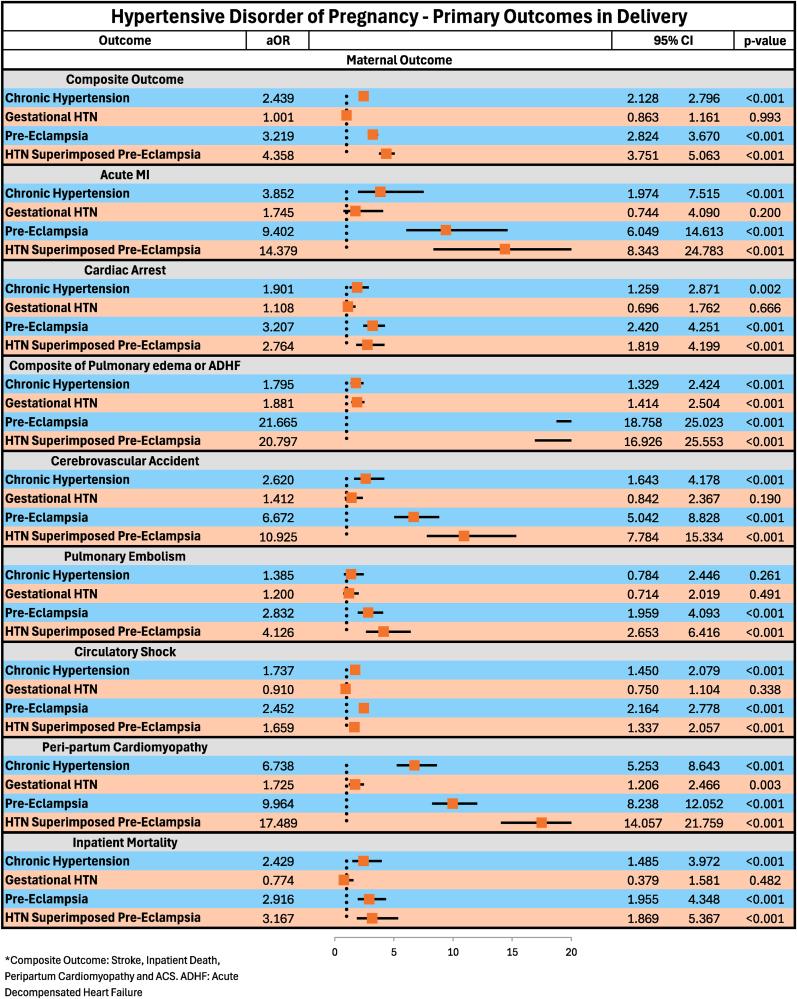
The study dataset from October 2015-December 2020 included 19,089,780 delivery admissions with 2,771,809 (14.5 %) of patients affected by HDP. The HDP groups were distributed as follows: GH - 38 %, PRE - 32 %, SPE - 11 %, and CH - 19 %. Women with PRE, SPE, and CH had significantly higher rates of mortality, circulatory shock, peripartum cardiomyopathy, acute kidney injury, preterm labor, stillbirth, and cerebrovascular events as compared to normotensive patients, while GH did not. Specifically, maternal mortality was highest in the SPE group (adjusted odds ratio [aOR] 3.16), followed by PRE (aOR 2.91) and CH (aOR 2.42). Additionally, all HDP groups had higher rates of small for gestational age and significant bleeding as compared to normotensive patients.
CONCLUSIONS
Pregnant patients with CH, PRE, and SPE experience higher rates of adverse maternal and fetal outcomes during their delivery admission when compared to normotensive patients. Understanding the graded risk differences across HDP subtypes may enable more tailored interventions, optimizing maternal and fetal outcomes for those at highest risk.
引言
妊娠高血压疾病(HDP)是全球孕产妇发病和死亡的主要原因。它包括慢性高血压(CH)、妊娠期高血压(GH)、子痫前期(PRE)以及慢性高血压合并子痫前期(SPE)。我们旨在评估这些组中的女性与血压正常的对照组相比在医院内的母婴结局。
方法
研究样本包括2016年至2020年国家住院患者样本数据集中被分类为上述4种HDP组的女性。在对年龄、种族、剖宫产状态和合并症进行调整后,使用回归分析将她们与血压正常的妊娠女性进行母婴结局比较。
结果
2015年10月至2020年12月的研究数据集包括19,089,780例分娩入院病例,其中2,771,809例(14.5%)患者患有HDP。HDP组的分布如下:GH - 38%,PRE - 32%,SPE - 11%,CH - 19%。与血压正常的患者相比,患有PRE、SPE和CH的女性在死亡率、循环性休克、围产期心肌病、急性肾损伤、早产、死产和脑血管事件方面的发生率显著更高,而GH组则没有。具体而言,SPE组的孕产妇死亡率最高(调整后的优势比[aOR]为3.16),其次是PRE组(aOR为2.91)和CH组(aOR为2.42)。此外,与血压正常的患者相比,所有HDP组的小于胎龄儿发生率和大出血发生率都更高。
结论
与血压正常的患者相比,患有CH、PRE和SPE的孕妇在分娩入院期间经历不良母婴结局的发生率更高。了解HDP各亚型之间的分级风险差异可能有助于采取更具针对性的干预措施,为风险最高的人群优化母婴结局。



 Zotero 插件