Zeng Jin, Wang Dong, Tong ZhaoChen, Li ZiXin, Wang GuoWei, Du YuMeng, Li Jinsong, Miao Jinglei, Chen Shijie
Department of Spine Surgery, The Third Xiangya Hospital of Central South University, 138 Tongzipo Rd, Changsha, 410013, Hunan, China.
Shanghai Key Laboratory of Regulatory Biology, Institute of Biomedical Sciences and School of Life Sciences, East China Normal University, Shanghai, 200241, China.
Clin Exp Med. 2025 May 9;25(1):146. doi: 10.1007/s10238-024-01530-w.
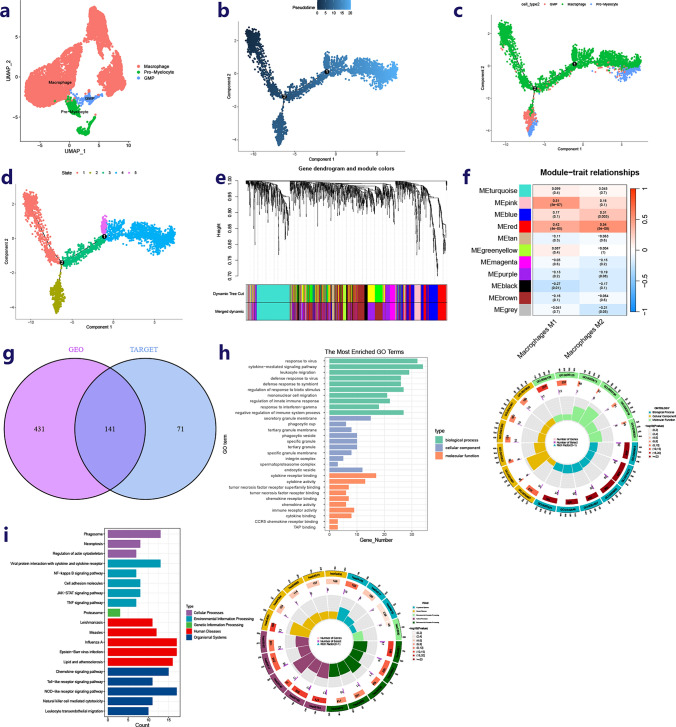
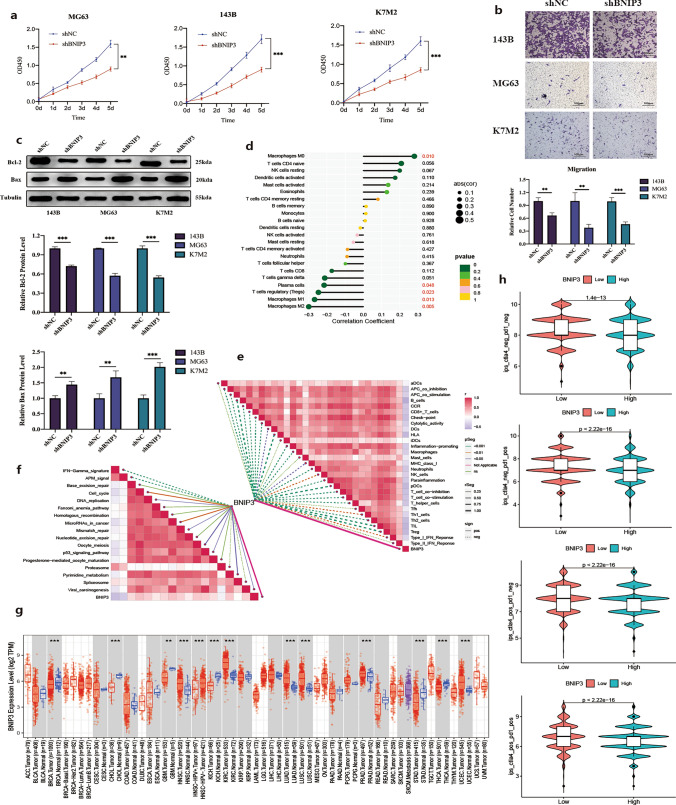
While neoadjuvant chemotherapy combined with surgical resection has improved the prognosis for patients with osteosarcoma, its impact on metastatic and recurrent cases remains limited. Immunotherapy is emerging as a promising alternative. However, the relationship between the phenotype of tumor-associated macrophages and the prognosis of osteosarcoma remains unclear. Differentially expressed gene during macrophage polarization were identified using the Monocle package. Weighted gene co-expression network analysis was conducted to select genes regulating macrophage polarization. The least absolute shrinkage and selection operator algorithm and multivariate Cox regression were used to construct long-term survival predictive strategies. Multiple machine learning algorithms identified target genes for pan-cancer analysis. Lentiviral transfection created stable strains with target gene knockdown, and CCK-8 and transwell migration assays verified the target gene's effects. Western blot and flow cytometry assessed the impact of target genes on macrophage polarization. A total of 141 genes regulating macrophage polarization were identified, from which eight genes were selected to construct prognostic models. Significant differences between high-risk and low-risk groups were observed in immune cell activation, immune-related signaling pathways, and immune function. The prognostic model and target gene were validated to provide more precise immunotherapy options for osteosarcoma and other tumors. BNIP3 knockdown decreased osteosarcoma cell proliferation and migration and promoted macrophage polarization to the M2 phenotype. The constructed prognostic model offers precise immunotherapy regimens and valuable insights into mechanisms underlying current studies. Furthermore, BNIP3 may serve as a potential immunotherapeutic target for osteosarcoma and other tumors.
虽然新辅助化疗联合手术切除改善了骨肉瘤患者的预后,但其对转移性和复发性病例的影响仍然有限。免疫疗法正成为一种有前景的替代方案。然而,肿瘤相关巨噬细胞的表型与骨肉瘤预后之间的关系仍不清楚。使用Monocle软件包鉴定巨噬细胞极化过程中差异表达的基因。进行加权基因共表达网络分析以选择调节巨噬细胞极化的基因。使用最小绝对收缩和选择算子算法以及多变量Cox回归构建长期生存预测策略。多种机器学习算法鉴定用于泛癌分析的靶基因。慢病毒转染创建了具有靶基因敲低的稳定菌株,CCK-8和Transwell迁移试验验证了靶基因的作用。蛋白质免疫印迹法和流式细胞术评估了靶基因对巨噬细胞极化的影响。共鉴定出141个调节巨噬细胞极化的基因,从中选择8个基因构建预后模型。在免疫细胞激活、免疫相关信号通路和免疫功能方面,高风险组和低风险组之间存在显著差异。对预后模型和靶基因进行验证,为骨肉瘤和其他肿瘤提供更精确的免疫治疗选择。BNIP3敲低可降低骨肉瘤细胞的增殖和迁移,并促进巨噬细胞向M2表型极化。构建的预后模型提供了精确的免疫治疗方案,并对当前研究的潜在机制提供了有价值的见解。此外,BNIP3可能作为骨肉瘤和其他肿瘤潜在的免疫治疗靶点。