
CD8 T 细胞相关基因特征在骨肉瘤预后和免疫学中的重要性。
Importance of CD8 Tex cell-associated gene signatures in the prognosis and immunology of osteosarcoma.
机构信息
Department of Orthopedic Research Center, The Third Hospital of Hebei Medical University, Shijiazhuang, Hebei, People's Republic of China.
Department of Orthopedic Oncology, The Third Hospital of Hebei Medical University, Shijiazhuang, Hebei, People's Republic of China.
出版信息
Sci Rep. 2024 Apr 29;14(1):9769. doi: 10.1038/s41598-024-60539-z.
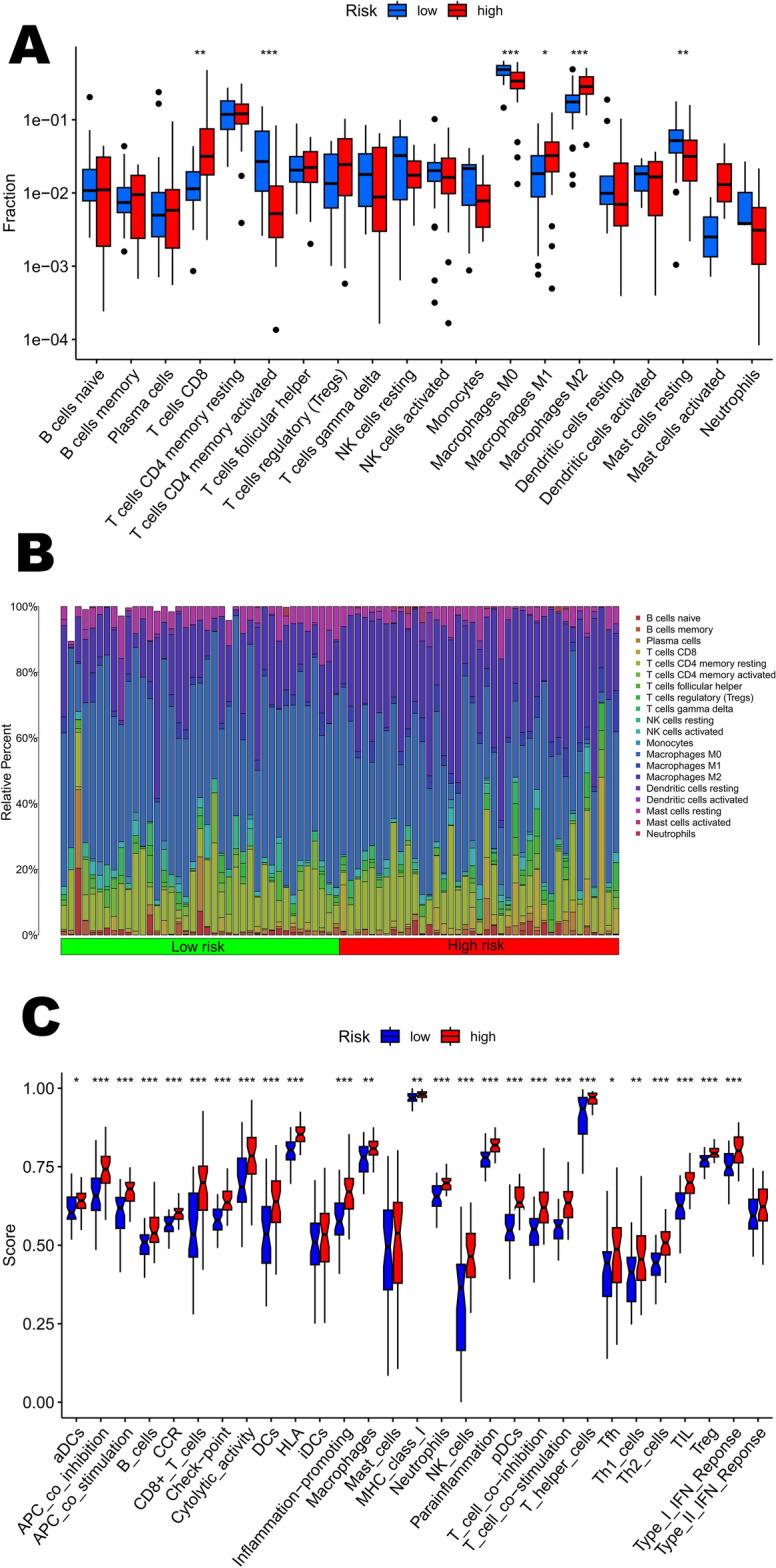
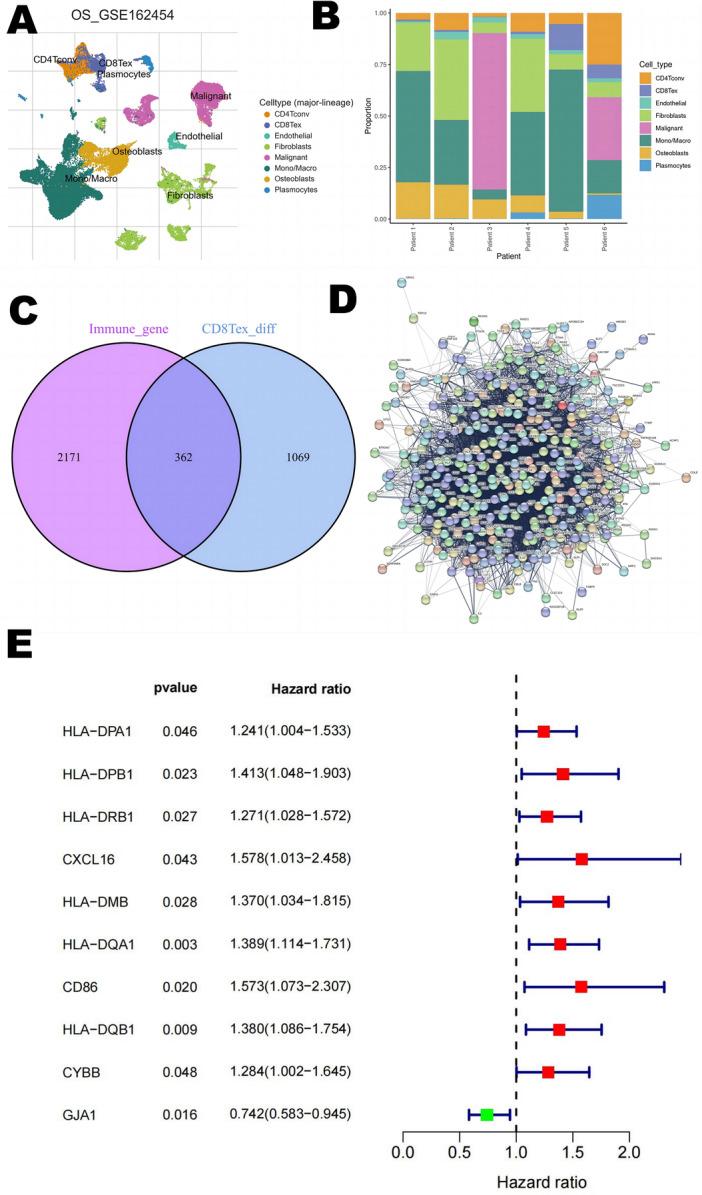
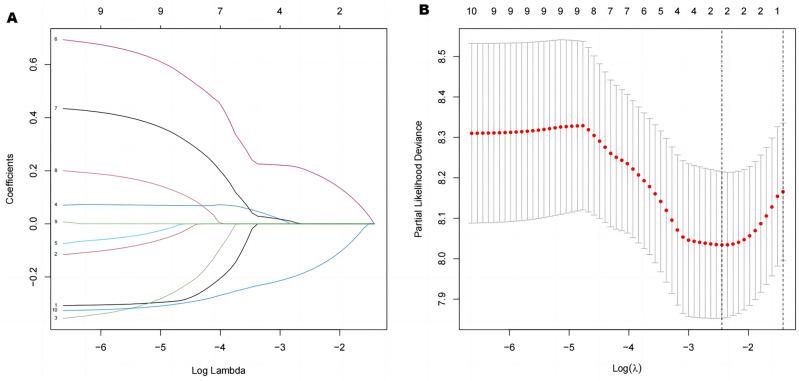
As a highly aggressive bone malignancy, osteosarcoma poses a significant therapeutic challenge, especially in the setting of metastasis or recurrence. This study aimed to investigate the potential of CD8-Tex cell-associated genes as prognostic biomarkers to reveal the immunogenomic profile of osteosarcoma and guide therapeutic decisions. mRNA expression data and clinical details of osteosarcoma patients were obtained from the TCGA database (TARGET-OS dataset). The GSE21257 dataset (from the GEO database) was used as an external validation set to provide additional information on osteosarcoma specimens. 84 samples from the TARGET-OS dataset were used as the training set, and 53 samples from the GSE21257 dataset served as the external validation cohort. Univariate Cox regression analysis was utilized to identify CD8 Tex cell genes associated with prognosis. The LASSO algorithm was performed for 1000 iterations to select the best subset to form the CD8 Tex cell gene signature (TRS). Final genes were identified using the multivariate Cox regression model of the LASSO algorithm. Risk scores were calculated to categorize patients into high- and low-risk groups, and clinical differences were explored by Kaplan-Meier survival analysis to assess model performance. Prediction maps were constructed to estimate 1-, 3-, and 5 year survival rates for osteosarcoma patients, including risk scores for CD8 Texcell gene markers and clinicopathologic factors. The ssGSEA algorithm was used to assess the differences in immune function between TRS-defined high- and low-risk groups. TME and immune cell infiltration were further assessed using the ESTIMATE and CIBERSORT algorithms. To explore the relationship between immune checkpoint gene expression levels and the two risk-defined groups. A CD8 Tex cell-associated gene signature was extracted from the TISCH database and prognostic markers including two genes were developed. The high-risk group showed lower survival, and model performance was validated by ROC curves and C-index. Predictive plots were constructed to demonstrate survival estimates, combining CD8 Tex cell gene markers and clinical factors. This study provides valuable insights into the molecular and immune characteristics of osteosarcoma and offers potential avenues for advances in therapeutic approaches.
作为一种高度侵袭性的骨恶性肿瘤,骨肉瘤的治疗极具挑战性,尤其是在转移或复发的情况下。本研究旨在探讨 CD8-Tex 细胞相关基因作为预后生物标志物的潜力,以揭示骨肉瘤的免疫基因组特征,并指导治疗决策。从 TCGA 数据库(TARGET-OS 数据集)获取骨肉瘤患者的 mRNA 表达数据和临床详细信息。GEO 数据库中的 GSE21257 数据集被用作外部验证集,以提供更多骨肉瘤标本的信息。TARGET-OS 数据集的 84 个样本被用作训练集,GSE21257 数据集的 53 个样本作为外部验证队列。采用单因素 Cox 回归分析鉴定与预后相关的 CD8 Tex 细胞基因。进行 LASSO 算法 1000 次迭代,以选择最佳子集形成 CD8 Tex 细胞基因特征(TRS)。使用 LASSO 算法的多因素 Cox 回归模型确定最终基因。计算风险评分,将患者分为高风险和低风险组,并通过 Kaplan-Meier 生存分析探讨临床差异,以评估模型性能。构建预测图,估计骨肉瘤患者 1、3 和 5 年的生存率,包括 CD8 Texcell 基因标志物和临床病理因素的风险评分。使用 ssGSEA 算法评估 TRS 定义的高风险和低风险组之间免疫功能的差异。使用 ESTIMATE 和 CIBERSORT 算法进一步评估 TME 和免疫细胞浸润。探讨免疫检查点基因表达水平与两个风险定义组之间的关系。从 TISCH 数据库提取 CD8 Tex 细胞相关基因特征,并开发包括两个基因在内的预后标志物。高风险组的生存率较低,通过 ROC 曲线和 C 指数验证模型性能。构建预测图以展示生存估计,结合 CD8 Tex 细胞基因标志物和临床因素。本研究为骨肉瘤的分子和免疫特征提供了有价值的见解,并为治疗方法的进展提供了潜在途径。


 Zotero 插件