Sax Anna, May Peter, Enssle Stefan, Soliman Nardine, Nedelko Tatiana, Mandracci Giada, Stögbauer Fabian, Joachim Laura, Winter Christof, Bassermann Florian, Steiger Katja, El Khawanky Nadia, Poeck Hendrik, Heidegger Simon
Department of Medicine III, Technical University of Munich, TUM School of Medicine and Health, Munich, Germany.
Center for Translational Cancer Research (TranslaTUM), Technical University of Munich, TUM School of Medicine and Health, Munich, Germany.
J Immunother Cancer. 2025 May 8;13(5):e010433. doi: 10.1136/jitc-2024-010433.
Immune checkpoint inhibitors (ICIs) of programmed cell death protein-1 (PD-1) or cytotoxic T-lymphocytes-associated protein 4 (CTLA-4) reinvigorate strong polyclonal T-cell immune responses against tumor cells. For many patients, these therapies fail because the development of spontaneous immune responses is often compromised, as the tumor microenvironment (TME) lacks proinflammatory signals resulting in suboptimal activation of antigen-presenting cells (APCs). Necroptosis is a special form of programmed cell death associated with leakage of inflammatory factors that can lead to APC maturation. However, it is unclear to which extent functional necroptosis in tumor cells contributes to ICI immunotherapy.
With genetically engineered tumor cell lines that lack specific components of the necroptosis machinery (mixed lineage kinase domain-like pseudokinase (MLKL), receptor interacting protein kinase 3 (RIPK3)), we addressed the importance of necroptotic tumor cell death for the efficacy of ICI immunotherapy in murine models. Preclinical data were aligned with genome-wide transcriptional programs in patient tumor samples at diagnosis and during ICI treatment for the activity of these pathways and association with treatment outcome.
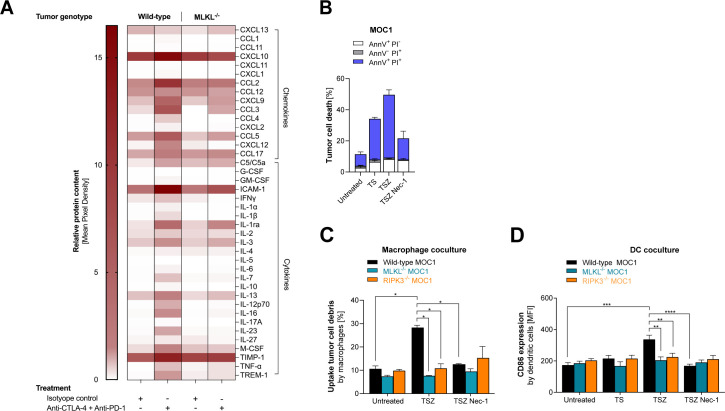
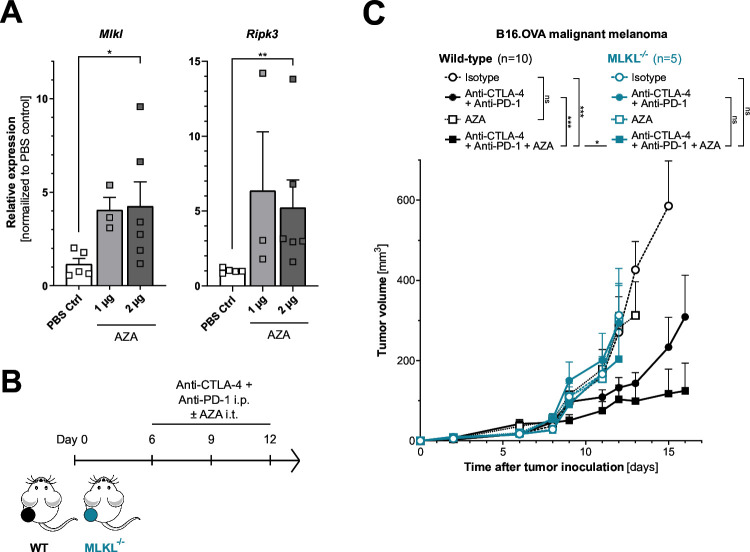
Mice bearing MLKL-deficient or RIPK3-deficient tumors failed to control tumor growth in response to anti-PD-1/anti-CTLA-4 immunotherapy. Mechanistically, defects in the necroptosis pathway resulted in reduced tumor antigen cross-presentation by type 1 conventional dendritic cells (DCs) in tumor-draining lymph nodes, and subsequently impaired immunotherapy-induced expansion of circulating tumor antigen-specific CD8 T cells and their accumulation and activation in the TME. In vitro, co-culture of tumor cells undergoing necroptotic but not apoptotic programmed cell death resulted in increased uptake by phagocytic cells, associated with maturation and activation of DCs. Treatment of tumors with the epigenetic modulator azacytidine enhanced intrinsic transcriptional activity of the necroptosis machinery, and hence their susceptibility to ICI immunotherapy. In humans, transcriptome analysis of melanoma samples revealed a strong association between high expression of and prolonged overall survival and durable clinical response to immunotherapy with anti-PD-1 and/or anti-CTLA-4 checkpoint inhibitors.
Defective necroptosis signaling in tumor cells is a cancer resistance mechanism to ICI immunotherapy. Reversion of epigenetic silencing of the necroptosis pathway can render tumors susceptible to checkpoint inhibition.
程序性细胞死亡蛋白1(PD-1)或细胞毒性T淋巴细胞相关蛋白4(CTLA-4)的免疫检查点抑制剂可重振针对肿瘤细胞的强烈多克隆T细胞免疫反应。对许多患者而言,这些疗法会失败,因为自发免疫反应的发展常常受到损害,这是由于肿瘤微环境(TME)缺乏促炎信号,导致抗原呈递细胞(APC)的激活不理想。坏死性凋亡是一种特殊形式的程序性细胞死亡,与可导致APC成熟的炎症因子泄漏有关。然而,尚不清楚肿瘤细胞中的功能性坏死性凋亡在多大程度上有助于ICI免疫治疗。
利用缺乏坏死性凋亡机制特定成分(混合系激酶结构域样假激酶(MLKL)、受体相互作用蛋白激酶3(RIPK3))的基因工程肿瘤细胞系,我们在小鼠模型中探讨了坏死性肿瘤细胞死亡对ICI免疫治疗疗效的重要性。临床前数据与患者肿瘤样本在诊断时和ICI治疗期间的全基因组转录程序进行比对,以了解这些途径的活性及其与治疗结果的关联。
携带MLKL缺陷或RIPK3缺陷肿瘤的小鼠在接受抗PD-1/抗CTLA-4免疫治疗时无法控制肿瘤生长。从机制上讲,坏死性凋亡途径的缺陷导致肿瘤引流淋巴结中1型常规树突状细胞(DC)对肿瘤抗原的交叉呈递减少,随后损害了免疫治疗诱导的循环肿瘤抗原特异性CD8 T细胞的扩增及其在TME中的积累和激活。在体外,经历坏死性凋亡而非凋亡性程序性细胞死亡的肿瘤细胞共培养导致吞噬细胞摄取增加,这与DC的成熟和激活相关。用表观遗传调节剂氮杂胞苷治疗肿瘤可增强坏死性凋亡机制的内在转录活性,从而增强其对ICI免疫治疗的敏感性。在人类中,黑色素瘤样本的转录组分析显示,[具体基因名称]的高表达与总生存期延长以及对抗PD-1和/或抗CTLA-4检查点抑制剂免疫治疗的持久临床反应之间存在强烈关联。
肿瘤细胞中坏死性凋亡信号缺陷是对ICI免疫治疗的一种癌症抵抗机制。逆转坏死性凋亡途径的表观遗传沉默可使肿瘤对检查点抑制敏感。