Alba Riccardo, Marcolin Fabio, Assandri Giacomo, Ilahiane Luca, Cochis Francesca, Brambilla Mattia, Rubolini Diego, Chamberlain Dan
Department of Life Sciences and System Biology, University of Turin, Via Accademia Albertina 13, 10123, Turin, Italy.
NBFC, National Biodiversity Future Center, 90133, Palermo, Italy.
Sci Rep. 2025 May 9;15(1):16181. doi: 10.1038/s41598-025-00350-6.
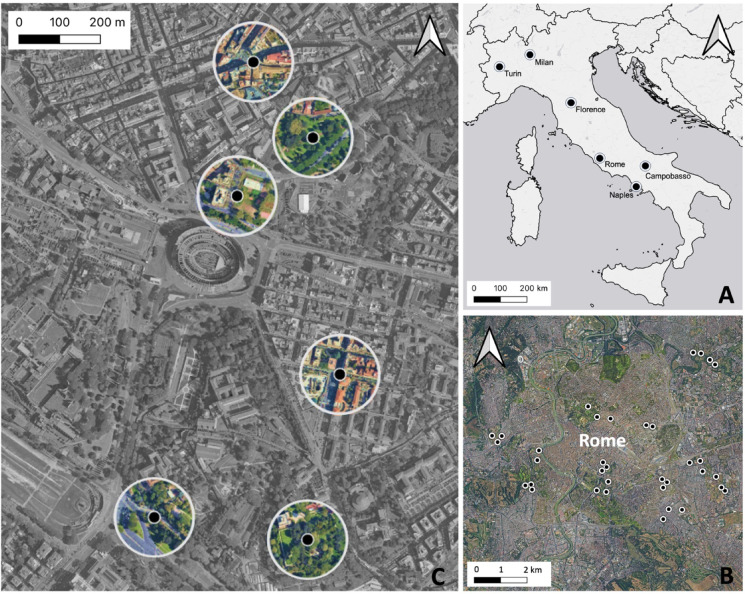
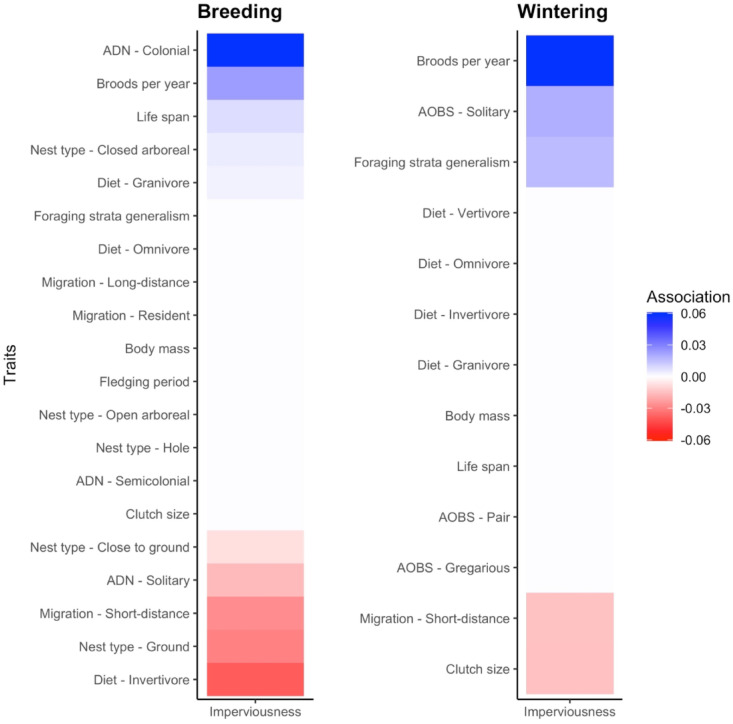
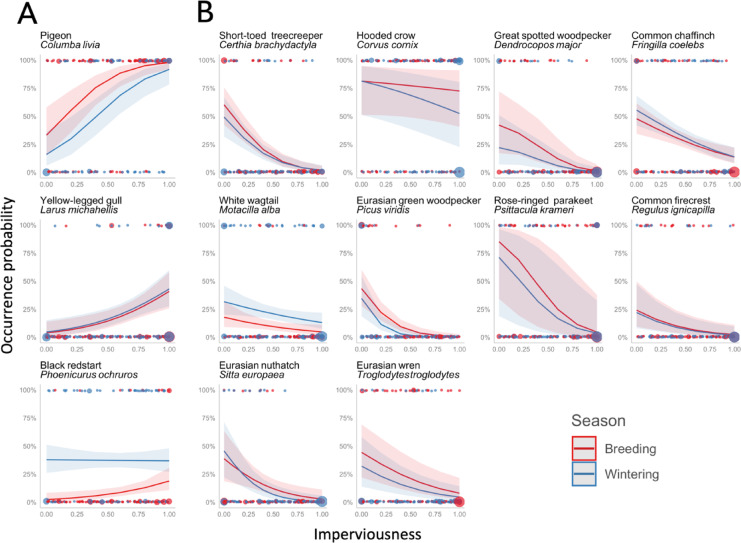
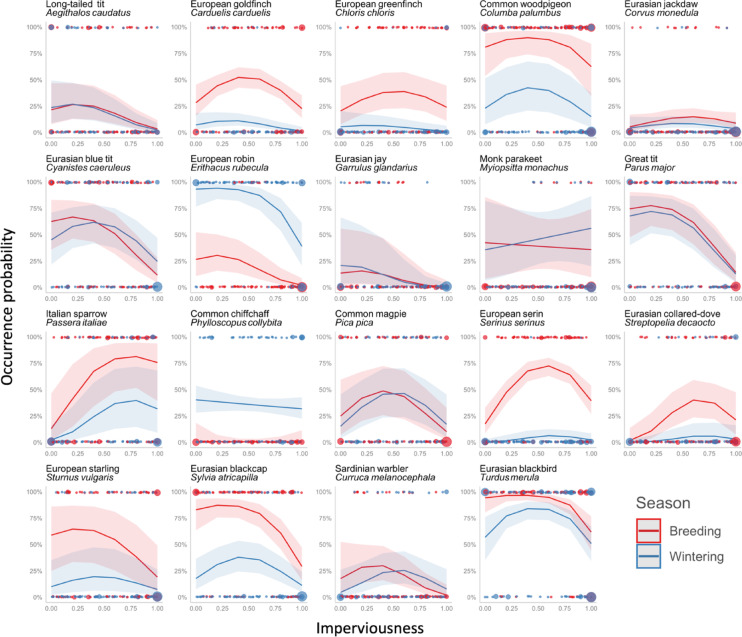
Urbanisation is a major driver of global biodiversity decline, profoundly affecting animal communities. While most studies on bird communities have primarily focused on the breeding season, we aimed to identify species responses and their associated traits by adopting a stratified design and using a multi-season approach considering a gradient from highly urbanised city centres to the urban-rural fringe across six Italian cities. We found that bird assemblages exhibited different responses to urbanisation according to season. Winners (i.e. species positively affected by urbanisation) were characterised by traits such as colonial nesting, high productivity and longevity. In winter, these species displayed generalist foraging strategies and solitary behaviour. Losers (i.e. species negatively affected by urbanisation) tended to be insectivorous, ground-nesting and short-distance migratory species. Interestingly, intra-specific variations emerged, with wintering populations of some species exploiting highly urbanised areas despite not breeding there. Urban adapters, although not strictly winners, displayed resilience by navigating a range of urban conditions, effectively exploiting intermediate levels of urbanisation. This study provides novel insights into the complex ecological dynamics occurring within the urban matrix in different seasons. Our findings emphasise the importance of adopting a multi-season approach in research and urban planning to better understand species responses and develop more effective, sustainable strategies for biodiversity conservation in urban environments.
城市化是全球生物多样性下降的主要驱动因素,对动物群落产生深远影响。虽然大多数关于鸟类群落的研究主要集中在繁殖季节,但我们旨在通过采用分层设计,并使用多季节方法,考虑从高度城市化的市中心到六个意大利城市城乡边缘的梯度,来确定物种的反应及其相关特征。我们发现,鸟类群落根据季节对城市化表现出不同的反应。赢家(即受到城市化积极影响的物种)的特征是集群筑巢、高繁殖力和长寿等特性。在冬季,这些物种表现出通才觅食策略和独居行为。输家(即受到城市化负面影响的物种)往往是食虫性、地面筑巢和短距离迁徙的物种。有趣的是,出现了种内差异,一些物种的越冬种群尽管不在高度城市化地区繁殖,但却在那里觅食。城市适应者虽然并非严格意义上的赢家,但通过在一系列城市条件下生存,有效利用中等城市化水平,展现出了适应能力。这项研究为不同季节城市环境中发生的复杂生态动态提供了新的见解。我们的研究结果强调了在研究和城市规划中采用多季节方法的重要性,以便更好地了解物种反应,并为城市环境中的生物多样性保护制定更有效、可持续的策略。