Haley Andreana P, Knight-Scott Jack, Caillaud Marie, Gallagher Isabelle, Park Jessica, Li Yanrong, Wang Tianyu, Tanaka Hirofumi, Browning Jeffrey D
Department of Psychology, The University of Texas at Austin, 108 E Dean Keeton, Austin, TX, USA.
Biomedical Imaging Center, The University of Texas at Austin, Austin, TX, USA.
Metab Brain Dis. 2025 May 10;40(5):199. doi: 10.1007/s11011-025-01624-8.
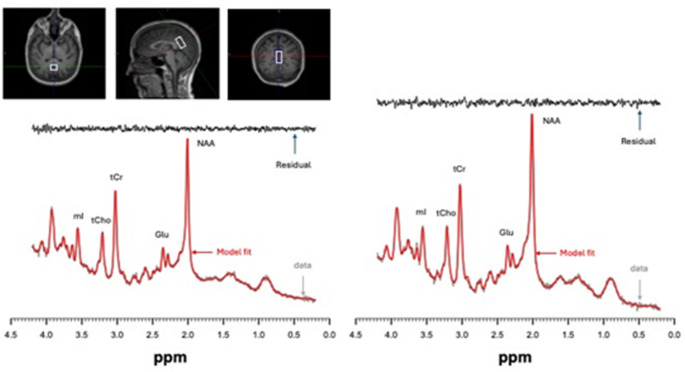
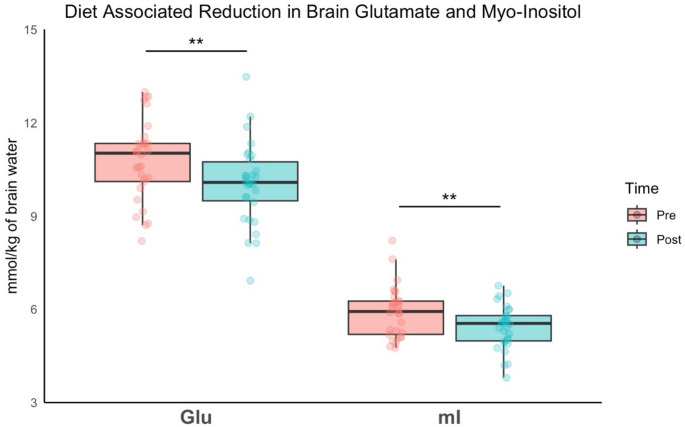
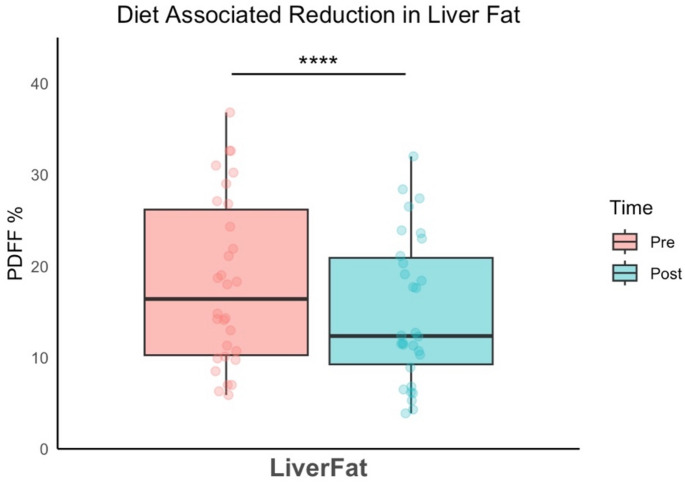
In a longitudinal cohort study with intervention (NCT05216796), we utilized multiorgan imaging to determine if metabolic dysfunction-associated steatotic liver disease (MASLD) is associated with elevated cerebral glutamate and myo-inositol and to determine their sensitivity to dietary intervention. Fifty-five adults with self-reported MASLD or high MASLD risk (3 + metabolic risk factors) received liver and brain magnetic resonance spectroscopy scans pre and post two-week low carbohydrate (≤30 g/d) or low-calorie (women ~ 1200 kcal/d; men ~ 1500 kcal/d) diet, both known for their ability to reduce liver fat. Forty-four adults completed the study (36 female, average age 54 years). Thirty out of 44 met clinical criterion for MASLD based on neuroimaging (≥ 5% hepatic triglycerides). Intervention was associated with significant decreases in liver fat fraction (mean difference = 3.101, 95% CI 2.104-4.099, p < 0.0001), glutamate (mean difference = 0.753, 95% CI 0.274-1.233, p = 0.0032) and myo-inositol (mean difference = 0.478, 95% CI 0.180-0.775, p = 0.0027) in patients with confirmed MASLD. Thus, MASLD may be a source of glutamate neurotoxicity and neuroinflammation and diet is an effective strategy for supporting brain as well as liver health.
在一项有干预措施的纵向队列研究(NCT05216796)中,我们利用多器官成像来确定代谢功能障碍相关脂肪性肝病(MASLD)是否与脑内谷氨酸和肌醇水平升高有关,并确定它们对饮食干预的敏感性。55名自我报告患有MASLD或MASLD高风险(3种及以上代谢风险因素)的成年人在接受为期两周的低碳水化合物(≤30克/天)或低热量(女性约1200千卡/天;男性约1500千卡/天)饮食前后接受了肝脏和脑磁共振波谱扫描,这两种饮食都以能够减少肝脏脂肪而闻名。44名成年人完成了该研究(36名女性,平均年龄54岁)。44名中有30名基于神经成像符合MASLD的临床标准(肝脏甘油三酯≥5%)。干预与确诊为MASLD的患者肝脏脂肪分数显著降低(平均差异=3.101,95%可信区间2.104-4.099,p<0.0001)、谷氨酸(平均差异=0.753,95%可信区间0.274-1.233,p=0.0032)和肌醇(平均差异=0.478,95%可信区间0.180-0.775,p=0.0027)有关。因此,MASLD可能是谷氨酸神经毒性和神经炎症的一个来源,饮食是支持脑和肝脏健康的有效策略。