Zhang Jingying, Yuan Peng, Nichols Colin G, Maksaev Grigory
Department of Pharmacological Sciences, Icahn School of Medicine at Mount Sinai, New York, NY, USA.
Department of Neuroscience, Icahn School of Medicine at Mount Sinai, New York, NY, USA.
Commun Biol. 2025 May 10;8(1):727. doi: 10.1038/s42003-025-08103-x.
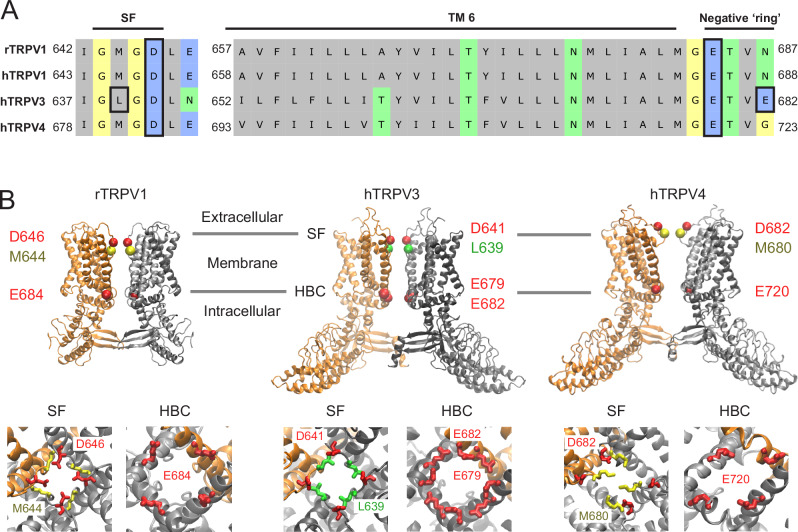
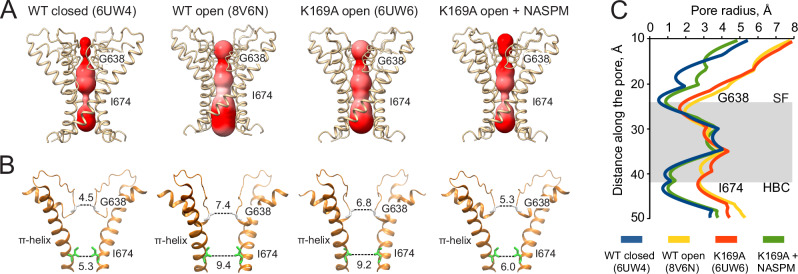
ThermoTRPV1-4 channels are involved in the regulation of multiple physiological processes, including thermo- and pain perception, thermoregulation, itch, and nociception and therefore tight control of their activity is a critical requirement for correct perception of noxious stimuli and pain. We previously reported a voltage-dependent inhibition of TRPV1-4 channels by intracellular polyamines that could be explained by high affinity spermine binding in, and passage through, the permeation path. Here, using electrophysiology and cryo-electron microscopy, we elucidate molecular details of TRPV3 blockade by endogenous spermine and its analog NASPM. We identify a high-affinity polyamine interaction site at the intracellular side of the pore, formed by residues E679 and E682, with no significant contribution of residues at the channel selectivity filter. A cryo-EM structure of TRPV3 in the presence of NASPM reveals conformational changes coupled to polyamine blockade. Paradoxically, although the TRPV3 'gating switch' is in the 'activated' configuration, the pore is closed at both gates. A modified blocking model, in which spermine interacts with the cytoplasmic entrance to the channel, from which spermine may permeate, or cause closure of the channel, provides a unifying explanation for electrophysiological and structural data and furnishes the essential background for further exploitation of this regulatory process.
热TRPV1 - 4通道参与多种生理过程的调节,包括热觉和痛觉、体温调节、瘙痒和伤害感受,因此严格控制它们的活性是正确感知有害刺激和疼痛的关键要求。我们之前报道了细胞内多胺对TRPV1 - 4通道的电压依赖性抑制,这可以通过高亲和力的精胺在渗透路径中的结合和通过来解释。在这里,我们使用电生理学和冷冻电子显微镜,阐明了内源性精胺及其类似物NASPM对TRPV3的阻断的分子细节。我们在孔的细胞内侧鉴定出一个由E679和E682残基形成的高亲和力多胺相互作用位点,通道选择性过滤器处的残基没有显著贡献。NASPM存在下TRPV3的冷冻电镜结构揭示了与多胺阻断相关的构象变化。矛盾的是,尽管TRPV3的“门控开关”处于“激活”构型,但两个门处的孔都是关闭的。一种改进的阻断模型,即精胺与通道的细胞质入口相互作用,精胺可能从该入口渗透或导致通道关闭,为电生理学和结构数据提供了统一的解释,并为进一步探索这一调节过程提供了必要的背景。