Department of Microbiology and Immunology, University of Rochester Medical Center, Rochester, NY, United States.
Center for Musculoskeletal Research, University of Rochester Medical Center, Rochester, NY, United States.
Front Endocrinol (Lausanne). 2023 Jan 13;13:1094258. doi: 10.3389/fendo.2022.1094258. eCollection 2022.
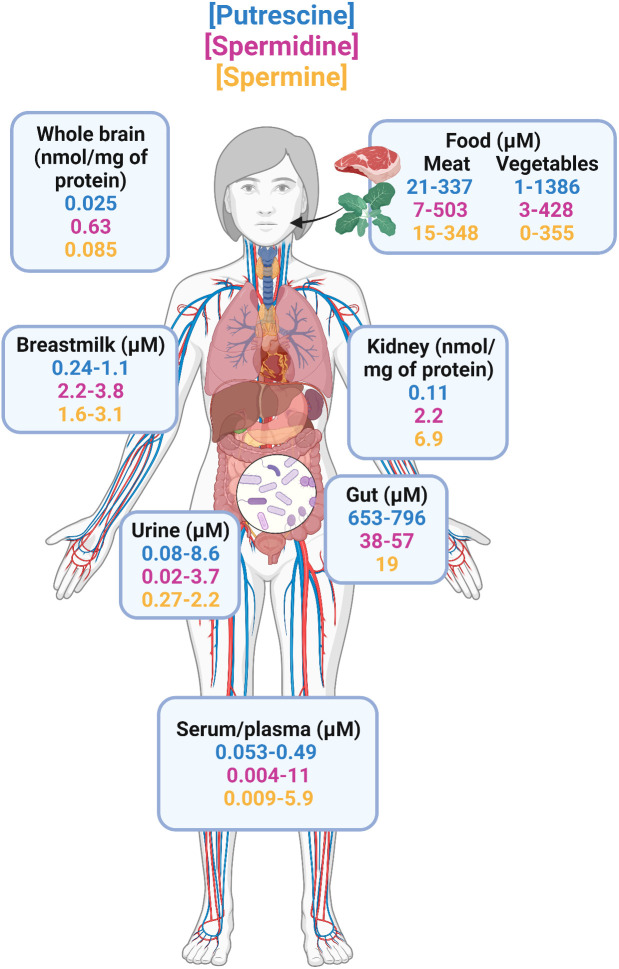
The gut microbiota regulates multiple facets of host metabolism and immunity through the production of signaling metabolites, such as polyamines which are small organic compounds that are essential to host cell growth and lymphocyte activation. Polyamines are most abundant in the intestinal lumen, where their synthesis by the gut microbiota is influenced by microbiome composition and host diet. Disruption of the host gut microbiome in metabolic syndrome and obesity-related type 2 diabetes (obesity/T2D) results in potential dysregulation of polyamine synthesis. A growing body of evidence suggests that restoration of the dysbiotic gut microbiota and polyamine synthesis is effective in ameliorating metabolic syndrome and strengthening the impaired immune responses of obesity/T2D. In this review, we discuss existing studies on gut microbiome determinants of polyamine synthesis, polyamine production in obesity/T2D, and evidence that demonstrates the potential of polyamines as a nutraceutical in obesity/T2D hosts.
肠道微生物群通过产生信号代谢物来调节宿主代谢和免疫的多个方面,例如多胺,多胺是对宿主细胞生长和淋巴细胞激活至关重要的小分子有机化合物。多胺在肠道腔中含量最丰富,其由肠道微生物群合成受微生物组组成和宿主饮食的影响。代谢综合征和肥胖相关 2 型糖尿病(肥胖/T2D)中宿主肠道微生物组的破坏会导致多胺合成的潜在失调。越来越多的证据表明,恢复失调的肠道微生物群和多胺合成在改善代谢综合征和增强肥胖/T2D 受损的免疫反应方面是有效的。在这篇综述中,我们讨论了肠道微生物群决定多胺合成、肥胖/T2D 中多胺产生的现有研究,以及多胺作为肥胖/T2D 宿主营养保健品的潜力的证据。