Kano Zenpei, Mizuno Yumi, Murata Kenji, Onoyama Sagano, Hoshina Takayuki, Sakai Yasunari, Kishimoto Junji, Kusuhara Koichi, Hara Toshiro
Kawasaki Disease Center, Fukuoka Children's Hospital Fukuoka Japan.
Department of Pediatrics, Graduate School of Medical Sciences, Kyushu University Fukuoka Japan.
Circ Rep. 2025 Apr 16;7(5):359-364. doi: 10.1253/circrep.CR-25-0018. eCollection 2025 May 9.
The precise pathogenesis of Kawasaki disease (KD) remains unclear, but immune dysregulation involving damage-associated molecular patterns (DAMPs), such as oxidized low-density lipoprotein (LDL) and high mobility group box 1 (HMGB1), has been implicated. We investigated the roles of 2 anti-DAMPs antibodies in KD and their associations with inflammatory and oxidative stress markers.
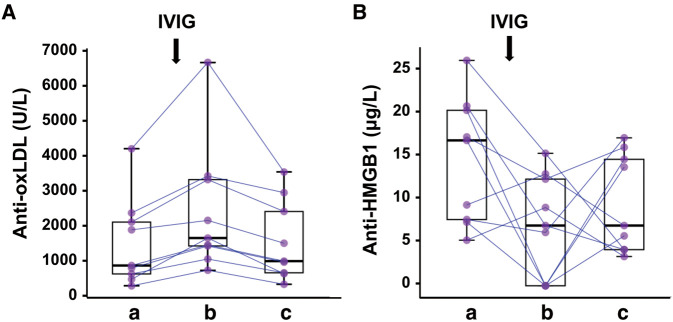
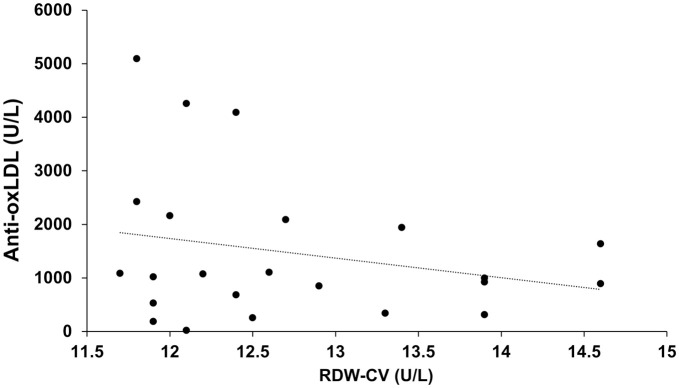
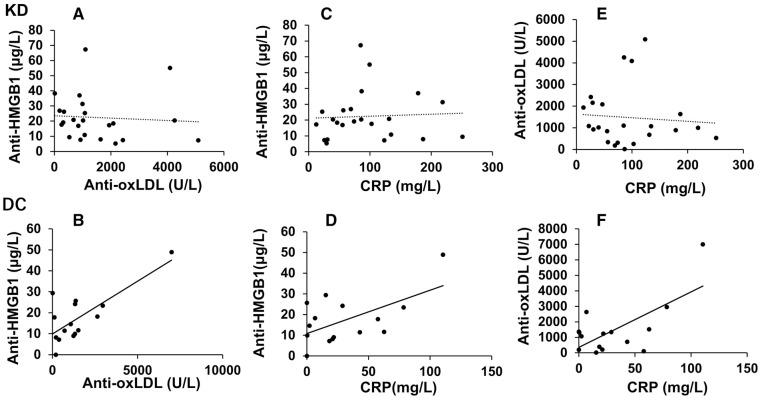
Serum levels of anti-oxidized LDL and anti-HMGB1 antibodies were measured by enzyme-linked immunosorbent assay in patients with KD and in febrile disease controls (DC). Correlations with inflammatory (C-reactive protein [CRP]) and oxidative stress (red blood cell distribution width [RDW]) markers were evaluated. Serum anti-oxidized LDL antibody levels increased significantly after intravenous immunoglobulin (IVIG) therapy in KD patients, suggesting a protective role of anti-oxidized LDL antibodies against vascular inflammation. Conversely, anti-HMGB1 antibody levels showed a decreasing trend post-IVIG. A significant correlation between antibody levels and CRP was observed in DC but not in KD patients. Furthermore, a weak inverse trend between anti-oxidized LDL antibodies and RDW-coefficient of variation was noted in KD patients.
This study highlighted the distinct roles of anti-oxidized LDL and anti-HMGB1 antibodies during the acute phase of KD. The increase in anti-oxidized LDL antibodies following IVIG treatment suggests a protective effect, while the transient nature of anti-HMGB1 antibodies warrants further exploration.
川崎病(KD)的确切发病机制尚不清楚,但涉及损伤相关分子模式(DAMPs)的免疫失调,如氧化型低密度脂蛋白(LDL)和高迁移率族蛋白B1(HMGB1),已被牵连其中。我们研究了两种抗DAMPs抗体在KD中的作用及其与炎症和氧化应激标志物的关联。
通过酶联免疫吸附测定法测量KD患者和发热性疾病对照组(DC)血清中抗氧化型LDL和抗HMGB1抗体的水平。评估其与炎症标志物(C反应蛋白[CRP])和氧化应激标志物(红细胞分布宽度[RDW])的相关性。KD患者静脉注射免疫球蛋白(IVIG)治疗后,血清抗氧化型LDL抗体水平显著升高,提示抗氧化型LDL抗体对血管炎症具有保护作用。相反,抗HMGB1抗体水平在IVIG治疗后呈下降趋势。在DC中观察到抗体水平与CRP之间存在显著相关性,而在KD患者中未观察到。此外,在KD患者中,抗氧化型LDL抗体与RDW变异系数之间存在微弱的负相关趋势。
本研究强调了抗氧化型LDL和抗HMGB1抗体在KD急性期的不同作用。IVIG治疗后抗氧化型LDL抗体的增加提示其具有保护作用,而抗HMGB1抗体的短暂性值得进一步探索。