Srinivasan Siddharth, Hegde Ajay, Nair Rajesh, Jampani Ravi Teja, Ashraf Mohammad, Chigurupati Dhanwanth, Raju Bharat Kumar, Subramanian Susanth, Baxi Udgam, Kanneganti Yasaswi, Johnson Sarah, Nayal Bhavna, Vasudevan Geeta, Nayak Deepak, Menon Girish
Department of Neurosurgery, Institute of Neurosciences, Glasgow, United Kingdom.
Department of Neurosurgery, Manipal Hospital, Bengaluru, Karnataka, India.
Surg Neurol Int. 2025 Apr 18;16:138. doi: 10.25259/SNI_1068_2024. eCollection 2025.
Pineal parenchymal tumor of intermediate differentiation (PPTID) is a rare tumor. This study aims to evaluate patient outcomes and propose a treatment algorithm based on existing literature and our case series.
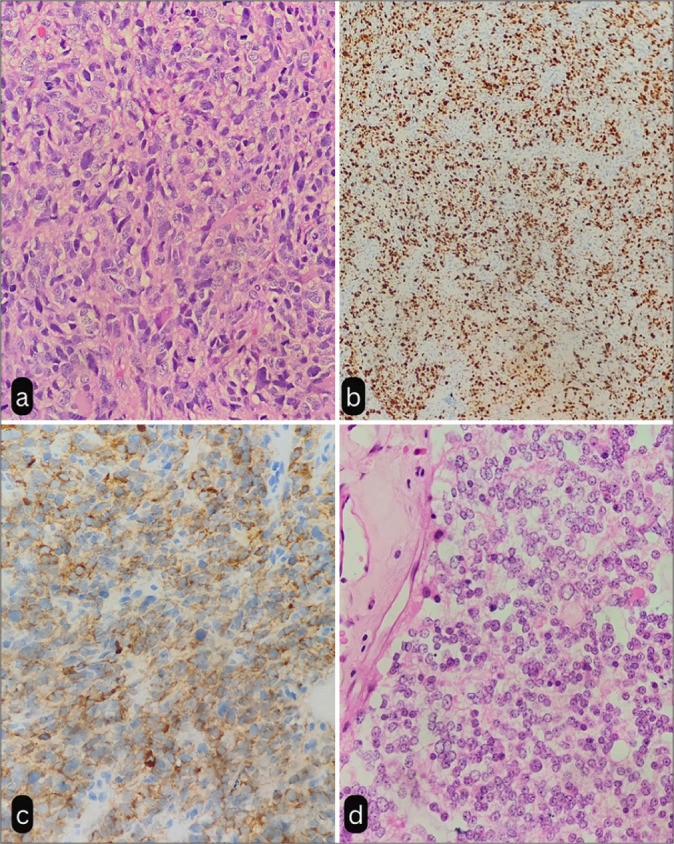
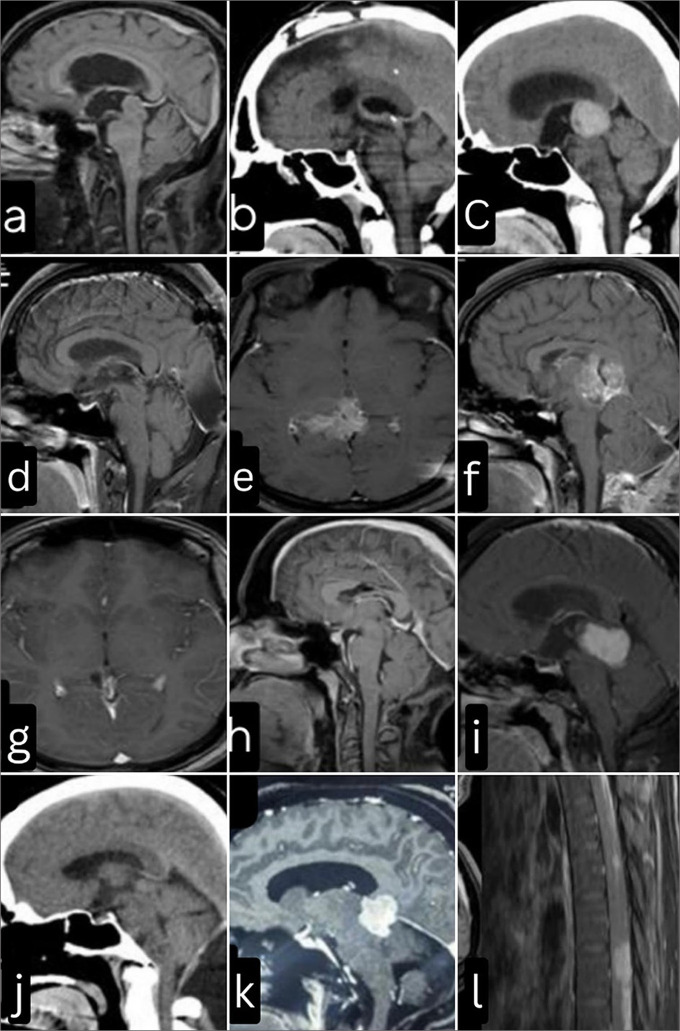
This prospective observational study includes seven patients diagnosed with PPTID through histopathology. We analyzed their clinical presentation, magnetic resonance imaging findings, surgical approaches, histopathological and immunohistochemical analysis, adjuvant treatments, and outcomes. We conducted univariate and multivariate statistical analyses.
The mean patient age was 40 years, with a male predominance. All patients presented with hydrocephalus, four of which required cerebrospinal fluid diversion procedures. The average tumor size was 3.13cm, with 85.7% showing brain invasion. Surgical outcomes included one gross total resection, two near total resections, and four subtotal resections. The supracerebellar infratentorial (Krause) approach was used in 71.4% of cases. About 85.7% were diagnosed with grade 3 PPTID. Five patients received adjuvant radiotherapy. The analysis showed each additional mitosis unit decreased survival by 0.17 units, equating to roughly 2 months ( < 0.016). Follow-up ranged from 6 to 120 months, with a 5-year survival rate of 57.1%. Factors influencing survival included the extent of tumor resection, brain invasion, tumor grade, and adjuvant treatment, although it was not statistically significant due to the small sample size.
We propose a treatment algorithm for PPTID and highlight the importance of further research to understand its biological characteristics. Safe maximal resection appears beneficial for higher-grade PPTID, but the role of adjuvant treatment after complete resection of lower-grade tumors remains uncertain.
松果体中间分化型实质瘤(PPTID)是一种罕见肿瘤。本研究旨在评估患者预后,并基于现有文献及我们的病例系列提出一种治疗方案。
这项前瞻性观察性研究纳入了7例经组织病理学确诊为PPTID的患者。我们分析了他们的临床表现、磁共振成像结果、手术入路、组织病理学和免疫组化分析、辅助治疗及预后。我们进行了单因素和多因素统计分析。
患者平均年龄为40岁,男性居多。所有患者均出现脑积水,其中4例需要脑脊液分流手术。肿瘤平均大小为3.13cm,85.7%的患者出现脑侵犯。手术结果包括1例全切除、2例近全切除和4例次全切除。71.4%的病例采用了小脑上幕下(克劳斯)入路。约85.7%的患者被诊断为3级PPTID。5例患者接受了辅助放疗。分析显示,每增加一个有丝分裂单位,生存率降低0.17个单位,约相当于2个月(<0.016)。随访时间为6至120个月,5年生存率为57.1%。影响生存的因素包括肿瘤切除范围、脑侵犯、肿瘤分级和辅助治疗,不过由于样本量小,差异无统计学意义。
我们提出了一种PPTID的治疗方案,并强调进一步研究以了解其生物学特性的重要性。安全的最大程度切除似乎对高级别PPTID有益,但低级别肿瘤完全切除后辅助治疗的作用仍不确定。