Jeyarajan Saeash, K Thejasvin, Pimpalnerkar Sneha, Deng Emily Zichu, Ahmad Zain, Banerjee Diya, de Preux Laure
Business School, Imperial College London, London, UK.
Whittington Hospital, London, UK.
BMJ Open Gastroenterol. 2025 May 12;12(1):e001709. doi: 10.1136/bmjgast-2024-001709.
This cost-effectiveness analysis compares vonoprazan against lansoprazole, a gold-standard proton pump inhibitor, in managing erosive oesophagitis.
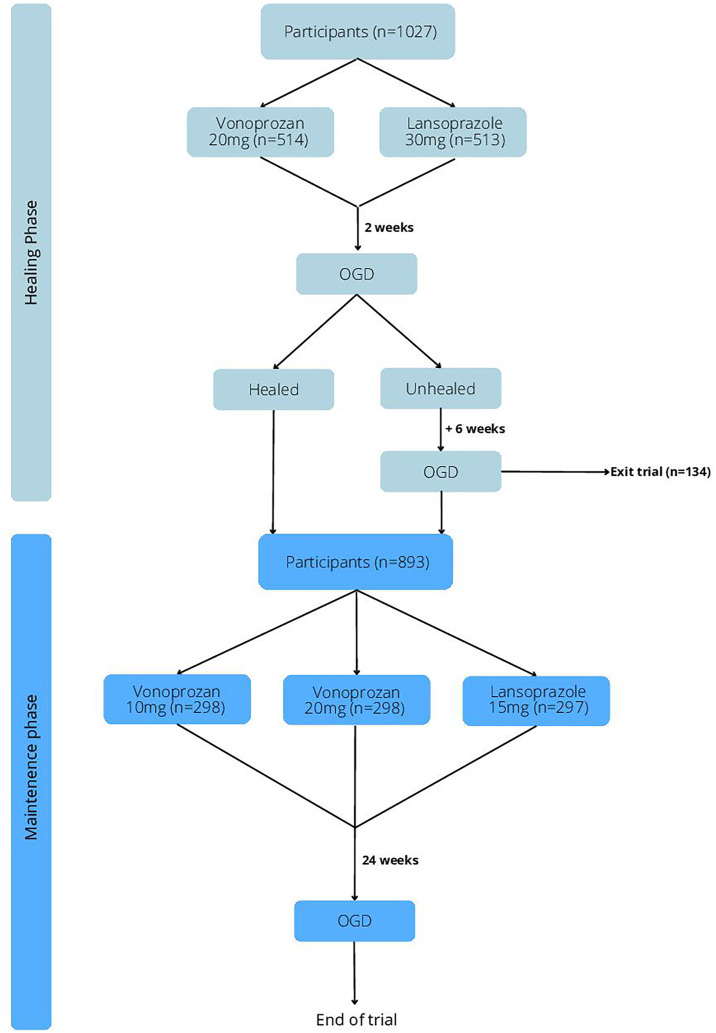
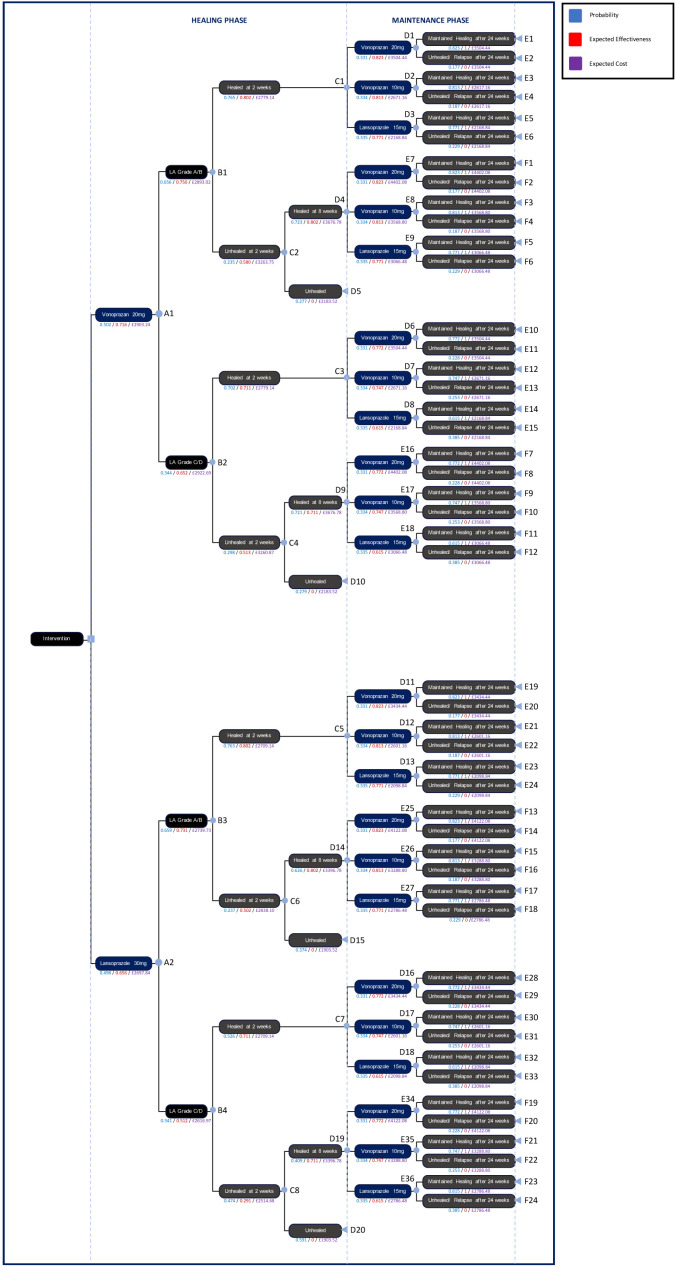
The economic evaluation was carried out using data from a double-blind, randomised control trial. Costs were measured in pounds sterling. Effectiveness was assessed on a binary scale, resolution versus non-resolution of disease, after 32 weeks.
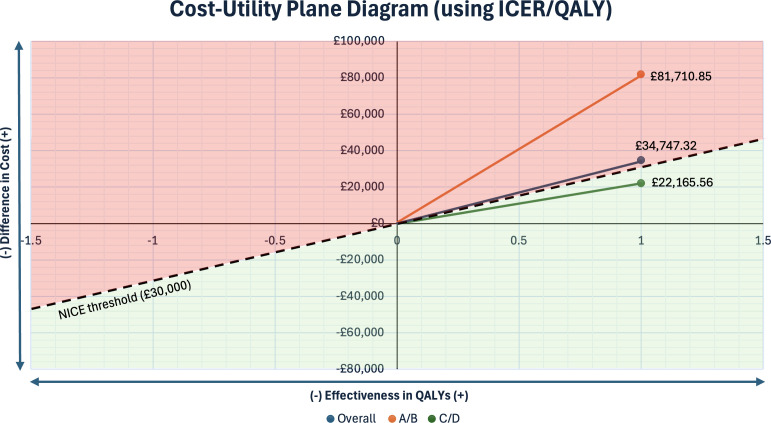
The primary analysis produced an incremental cost-effectiveness ratio (ICER) of £3421.27 per resolution. After applying quality-adjusted life year (QALY) data from the REFLUX trial (2008), we derived an ICER/QALY of £34 747.32, marginally exceeding the £30 000 threshold set by the National Institute for Health and Care Excellence. However, further subgroup analysis showed cost-effectiveness when healing severe grades of oesophagitis (ICER/QALY of £22 165.56). The first sensitivity analysis considers the typically non-invasive determination of disease resolution; the ICER/QALY of £15 826.98 supports vonoprazan's use in treating severe oesophagitis. The second considers a longer healing phase alongside a stronger 30 mg maintenance dose of lansoprazole, concordant with current guidelines; the ICER/QALY of £43 998.39 suggests the guidelines (regarding dosage, frequency and duration) must be optimised for vonoprazan. The final sensitivity analysis accounts for variations in quality-of-life measures, which grossly inflate the ICER/QALY (£118 216.32); this emphasises that vonoprazan should mainly be considered for patients with persistent symptoms and high severity.
Vonoprazan is potentially cost-effective for the initial healing of severe oesophagitis, after endoscopic diagnosis. Further trials and economic evaluations are necessary for the symptom-based prescription of vonoprazan and to determine the optimal dosage, frequency and duration.
本成本效益分析比较了沃克索拉唑与质子泵抑制剂的金标准——兰索拉唑在治疗糜烂性食管炎方面的效果。
经济评估采用双盲随机对照试验的数据。成本以英镑计量。在32周后,以疾病是否缓解的二元尺度评估疗效。
初步分析得出每例缓解的增量成本效益比(ICER)为3421.27英镑。应用反流试验(2008年)的质量调整生命年(QALY)数据后,得出的ICER/QALY为34747.32英镑,略高于英国国家卫生与临床优化研究所设定的30000英镑阈值。然而,进一步的亚组分析显示,在治愈重度食管炎时具有成本效益(ICER/QALY为22165.56英镑)。第一次敏感性分析考虑了疾病缓解的典型非侵入性判定;15826.98英镑的ICER/QALY支持沃克索拉唑用于治疗重度食管炎。第二次分析考虑了更长的愈合期以及与当前指南一致的更强的30毫克兰索拉唑维持剂量;43998.39英镑的ICER/QALY表明,必须针对沃克索拉唑优化指南(关于剂量、频率和疗程)。最后的敏感性分析考虑了生活质量测量的变化,这使ICER/QALY大幅增加(118216.32英镑);这强调沃克索拉唑主要应考虑用于有持续症状和高严重程度的患者。
内镜诊断后,沃克索拉唑在重度食管炎的初始愈合方面可能具有成本效益。对于基于症状的沃克索拉唑处方以及确定最佳剂量、频率和疗程,还需要进一步的试验和经济评估。