Foye Una, Lyons Natasha, Shah Prisha, Mitchell Lizzie, Machin Karen, Chipp Beverley, Jeffreys Stephen, Jeynes Tamar, Persaud Karen, Nicholls Vicky, Cooper Ruth E, Grundy Andrew, Pemovska Tamara, Ahmed Nafiso, Appleton Rebecca, Repper Julie, Johnson Sonia, Lloyd-Evans Brynmor, Simpson Alan
NIHR Mental Health Policy Research Unit, Department of Mental Health Nursing Research Institute of Psychiatry, Psychology & Neuroscience, Kings College London, London (KCL), SE5 8AF, UK.
NIHR Policy Research Unit in Mental Health, Division of Psychiatry, University College London (UCL), London, UK.
BMC Psychiatry. 2025 May 12;25(1):480. doi: 10.1186/s12888-025-06850-z.
Peer support roles within mental health services are rapidly increasing in number and scope in the UK and internationally. This paper explores the facilitators and barriers to delivering peer support effectively, as experienced by Peer Support Workers (PSWs) in a range of services and settings.
We conducted semi-structured qualitative interviews with paid mental health PSWs working across a range of settings in England. We took a collaborative, participatory approach. Interviews were carried out by researchers with experience of living with and/or supporting others with mental health conditions, and for some having experience delivering peer support themselves, and data were analysed using methods guided by general principles of thematic analysis.
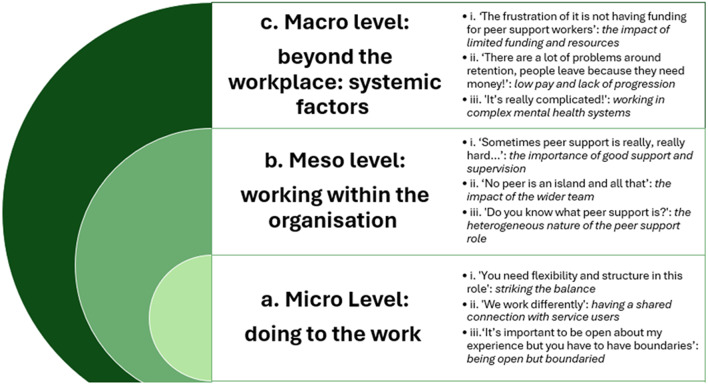
We interviewed 35 PSWs with a range of roles that spanned a range of mental health areas, and regions. Overarching facilitators and barriers were identified including the need for roles to have flexibility with some structure and boundaries; the need for support, supervision and training to ensure PSWs are skilled in delivering the unique elements of their job; the importance of working with a strong team and leaders who support and value PSW; the complexity of working where there are tensions between the flexibility of PSW and the structures of existing healthcare systems, as well as the systemic factors such as funding, pay and progression can have an effect both on the personal experience of PSWs and on the value placed on PSWs in the wider organisation.
Our findings highlight the complexity of peer support work and PSW roles, with a variety both of facilitators allowing them to carry out roles effectively and the barriers to doing so. As PSWs numbers and the scope of their roles increase, awareness of barriers and facilitators needs to inform PSW job roles, support systems and integration into teams and systems.
在英国及国际上,心理健康服务中的同伴支持角色在数量和范围上都在迅速增加。本文探讨了同伴支持工作者(PSWs)在一系列服务和环境中有效提供同伴支持的促进因素和障碍。
我们对在英格兰一系列环境中工作的有薪心理健康同伴支持工作者进行了半结构化定性访谈。我们采用了合作、参与式的方法。访谈由有心理健康状况生活经历和/或支持他人经历的研究人员进行,其中一些人自己也有提供同伴支持的经验,数据使用主题分析的一般原则指导的方法进行分析。
我们采访了35名担任一系列角色的同伴支持工作者,这些角色涵盖了一系列心理健康领域和地区。确定了总体促进因素和障碍,包括角色需要在一定结构和边界内具有灵活性;需要支持、监督和培训,以确保同伴支持工作者具备开展其工作独特要素的技能;与强大的团队和支持并重视同伴支持工作者的领导者合作的重要性;在同伴支持工作者的灵活性与现有医疗系统结构之间存在紧张关系的情况下工作的复杂性,以及资金、薪酬和职业发展等系统因素既会影响同伴支持工作者的个人体验,也会影响更广泛组织中对同伴支持工作者的重视程度。
我们的研究结果凸显了同伴支持工作和同伴支持工作者角色的复杂性,既有使他们能够有效履行职责的各种促进因素,也有这样做的障碍。随着同伴支持工作者数量及其角色范围的增加,对障碍和促进因素的认识需要为同伴支持工作者的工作职责、支持系统以及融入团队和系统提供参考。