Department of Psychiatry and Psychotherapy II, Ulm University, DE.
ImROC (Implementing Recovery through Organisational Change), Department of Learning and Organisational Development, Nottinghamshire Healthcare Foundation NHS Trust, Nottingham, UK.
Ann Glob Health. 2019 Apr 5;85(1):53. doi: 10.5334/aogh.2435.
Peers are people with lived experience of mental illness. Peer support is an established intervention in which peers offer support to others with mental illness. A large proportion of people living with severe mental illness receive no care. The care gap is largest in low- and middle-income countries, with detrimental effects on individuals and societies. The global shortage of human resources for mental health is an important driver of the care gap. Peers are an under-used resource in global mental health.
To describe rationale and methodology of an international multicentre study which will scale-up peer support for people with severe mental illness in high-, middle-, and low-income countries through mixed-methods implementation research.
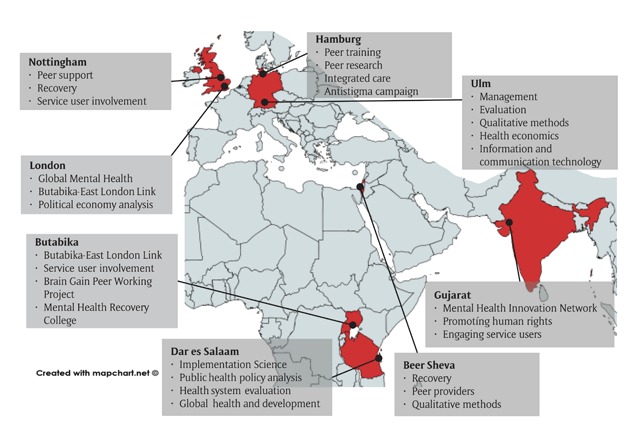
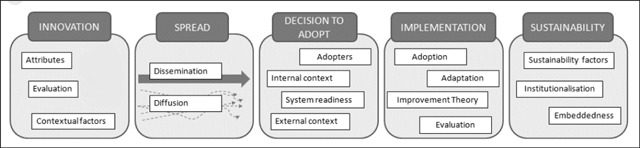
UPSIDES is an international community of research and practice for peer support, including peer support workers, mental health researchers, and other relevant stakeholders in eight study sites across six countries in Europe, Africa, and Asia. During the first two years of UPSIDES, a series of qualitative studies and systematic reviews will explore stakeholders' perceptions and the current state of peer support at each site. Findings will be incorporated into a conceptual framework to guide the development of a culturally appropriate peer support intervention to be piloted across all study sites. All intervention and study materials will be translated according to internationally recognised guidelines.Expected Impact: UPSIDES: will leverage the unique expertise of people with lived experience of mental illness to strengthen mental health systems in high-, middle- and low-income countries. UPSIDES will actively involve and empower service users and embed patient-centeredness, recovery orientation, human rights approaches, and community participation into services. The focus on capacity-building of peers may prove particularly valuable in low-resource settings in which shortages of human capital are most severe.
同伴是有精神疾病患病经历的人。同伴支持是一种已确立的干预措施,其中同伴为精神疾病患者提供支持。很大一部分患有严重精神疾病的人得不到任何照顾。在中低收入国家,这种照护差距最大,对个人和社会都有不利影响。全球精神卫生人力资源短缺是造成这种照护差距的一个重要原因。同伴是全球精神卫生领域未被充分利用的资源。
描述一项国际多中心研究的基本原理和方法,该研究将通过混合方法实施研究,在高、中、低收入国家扩大同伴支持,为严重精神疾病患者提供支持。
UPSIDES 是一个由研究和实践人员组成的国际同伴支持社区,包括同伴支持工作者、精神卫生研究人员以及来自六个国家(欧洲、非洲和亚洲)八个研究地点的其他相关利益攸关方。在 UPSIDES 的头两年,一系列定性研究和系统评价将探索各研究地点利益攸关方的看法和当前同伴支持的状况。研究结果将纳入一个概念框架,为在所有研究地点试点开展具有文化适应性的同伴支持干预措施提供指导。所有干预和研究材料都将根据国际公认的准则进行翻译。
UPSIDES 将利用精神疾病患者的独特专业知识,加强高、中、低收入国家的精神卫生系统。UPSIDES 将积极参与并赋予服务使用者权力,并将以患者为中心、康复导向、人权方法和社区参与融入服务。注重同伴能力建设可能在人力资源最短缺的资源匮乏环境中特别有价值。