Deng Jie, Oosterhof Jelle J, Eygendaal Denise, Breda Stephan J, Oei Edwin H G, de Vos Robert-Jan
Department of Orthopedics and Sports Medicine, Erasmus MC University Medical Center, Rotterdam, South Holland, Netherlands.
Department of Radiology and Nuclear Medicine, Erasmus MC University Medical Center, Rotterdam, South Holland, Netherlands.
Am J Sports Med. 2025 Jun;53(7):1568-1576. doi: 10.1177/03635465251336466. Epub 2025 May 12.
Patellar tendinopathy (PT) is a highly prevalent injury among jumping athletes. The long-term prognosis of athletes with PT following physical therapy is unknown.
To assess self-perceived recovery rate and the 5-year change in pain levels, disability, and sports participation, and to explore the prognostic factors associated with self-perceived recovery.
Cohort study; Level of evidence, 3.
Athletes with PT who were previously enrolled in a randomized trial and received education, load management advice, and exercise therapy instructions at baseline were eligible. An online questionnaire was sent 5 years after inclusion. Self-perceived recovery was assessed by a dichotomized 7-point global rating of change (recovery was defined as "significantly improved" to "completely recovered"). Pain levels during sports (0-10 points) and disability assessed by the Victorian Institute of Sport Assessment-Patellar (VISA-P) score were recorded at baseline and 5 years. Sports participation was categorized into return to performance, return to sport, return to participation, and quitting sports. Nonparametric tests were performed to compare scores at baseline and 5 years. Logistic regression models were used to identify prognostic factors.
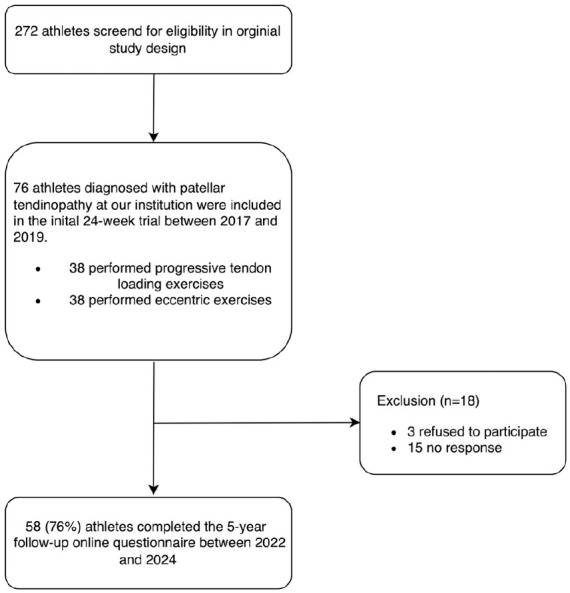
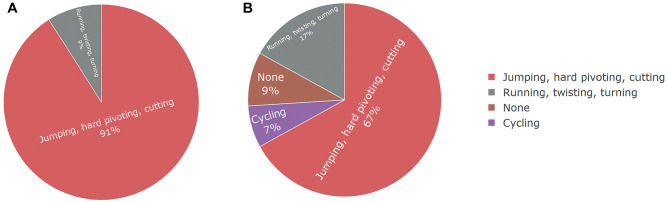
Of 76 eligible participants, 58 (76%) responded (mean age, 30 years [SD, 4 years]; 28% female). At a mean follow-up of 5 years, 76% of participants felt recovered. Pain levels during sports (median, 7 points [IQR, 7-8 points] to 2 points [IQR, 1-4 points]) and VISA-P score (median, 57 [IQR, 45-66] to 82 [IQR, 74-97] points) significantly improved from baseline to 5 years (all < .001). In total, 41 participants (71%) returned to their desired sports (68% to performance and 32% below preinjury level), 12 participants (21%) returned to participation in other sports, and 5 (9%) completely ceased sports participation. Participants who felt unrecovered had higher levels of pain and disability and lower return to performance (all < .05). No prognostic factors were identified that were associated with self-perceived recovery.
Athletes with PT after physical therapy can expect a generally acceptable long-term prognosis. However, almost one-quarter did not feel recovered and perceived worse patient-reported outcomes. Clinicians treating athletes with PT may use these findings to estimate the average prognosis.
髌腱病(PT)在跳跃项目运动员中是一种非常常见的损伤。接受物理治疗的PT运动员的长期预后尚不清楚。
评估自我感觉的恢复率以及疼痛水平、功能障碍和运动参与度在5年中的变化,并探索与自我感觉恢复相关的预后因素。
队列研究;证据等级,3级。
符合条件的为曾参加一项随机试验并在基线时接受教育、负荷管理建议和运动治疗指导的PT运动员。纳入后5年发送一份在线问卷。自我感觉的恢复通过一个二分的7分整体变化评分来评估(恢复定义为“显著改善”至“完全恢复”)。记录基线时和5年时运动期间的疼痛水平(0 - 10分)以及通过维多利亚运动评估髌腱量表(VISA - P)评分评估的功能障碍情况。运动参与情况分为恢复至比赛水平、恢复运动、恢复参与和停止运动。采用非参数检验比较基线时和5年时的评分。使用逻辑回归模型确定预后因素。
76名符合条件的参与者中,58名(76%)做出回应(平均年龄30岁[标准差4岁];28%为女性)。平均随访5年时,76%的参与者感觉已恢复。运动期间的疼痛水平(中位数,从7分[四分位间距,7 - 8分]降至2分[四分位间距,1 - 4分])和VISA - P评分(中位数,从57分[四分位间距,45 - 66分]升至82分[四分位间距,74 - 97分])从基线到5年有显著改善(均P <.001)。总共41名参与者(71%)恢复到他们期望的运动水平(68%恢复至比赛水平,32%低于伤前水平),12名参与者(21%)恢复参与其他运动,5名(9%)完全停止运动参与。感觉未恢复的参与者疼痛和功能障碍水平更高,恢复至比赛水平的比例更低(均P <.05)。未发现与自我感觉恢复相关的预后因素。
接受物理治疗后的PT运动员总体上可预期一个可接受的长期预后。然而,近四分之一的人感觉未恢复,且患者报告的结果更差。治疗PT运动员的临床医生可利用这些发现来估计平均预后。