
气管切开术期间对患有拉森综合征患者正常纵隔胸腺上疝进行部分胸腺切除术:一例报告
Partial Thymectomy during Tracheostomy for Superior Herniation of Normal Mediastinal Thymus in a Patient with Larsen Syndrome: A Case Report.
作者信息
Yoshiyama Atsushi, Morita Kaori, Takazawa Shinya, Ebihara Motoki, Yahiro Mitsuharu, Kakihara Tomo, Yoshida Mariko, Fujishiro Jun
机构信息
Department of Pediatric Surgery, The University of Tokyo Hospital, Tokyo, Japan.
出版信息
Surg Case Rep. 2025;11(1). doi: 10.70352/scrj.cr.24-0158. Epub 2025 May 9.
INTRODUCTION
Superior herniation of the mediastinal thymus is a rare cause of neck mass, characterized by intermittent migration of normal thymic tissue into the suprasternal region due to increased intrathoracic pressure. Generally, thymus resection is discouraged to avoid inducing athymia and subsequent immunodeficiency in the child. To date, no prior cases of tracheostomy combined with partial thymectomy have been reported. We present a case in which partial resection of the thymus was necessary to facilitate a tracheostomy.
CASE PRESENTATION
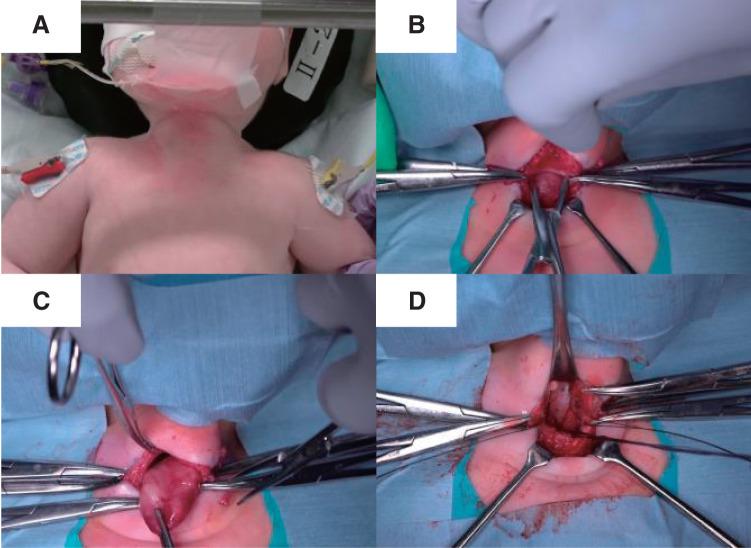
A 3-month-old female infant diagnosed with Larsen syndrome, a rare congenital connective tissue disorder, presented with respiratory failure necessitating mechanical ventilation at birth. Despite successful extubation and subsequent management with noninvasive positive pressure ventilation, she experienced recurrent episodes of apnea and oxygen desaturation. Examination revealed an anterior midline neck swelling, synchronized with respiratory movements, originating from the suprasternal notch. Ultrasound, computed tomography, and magnetic resonance imaging of the neck confirmed the presence of a normal mediastinal thymus extending into the suprasternal region. Given the risk of upper airway stenosis after the otolaryngological evaluation, an early tracheostomy under general anesthesia was planned. Upon incising the thickened cervical fascia, the thymus was visualized on the anterior surface of the trachea. The thymus and its surrounding adhesions were separated, with resection of the upper pole, followed by closure of the hernia orifice. The tracheostomy was then performed as planned. The postoperative course was uneventful, marked by gradual respiratory improvement and resolution of the intermittently visible swelling during inspiration. Cannula exchanges were completed without complications, and the patient was discharged home with a heat moisture exchanger 3 months after surgery.
CONCLUSIONS
We encountered a case of superior herniation of the normal mediastinal thymus in a patient with Larsen syndrome. While speculative, connective tissue abnormalities may contribute to this condition. In cases requiring tracheostomy, partial thymectomy and closure of the hernia orifice may be necessary to maintain fistula patency postoperatively.
引言
纵隔胸腺向上疝出是颈部肿块的罕见原因,其特征是由于胸腔内压力增加,正常胸腺组织间歇性迁移至胸骨上区域。一般而言,不主张进行胸腺切除术,以免导致儿童无胸腺及随后的免疫缺陷。迄今为止,尚无气管切开术联合部分胸腺切除术的既往病例报道。我们报告一例为便于气管切开术而需行部分胸腺切除术的病例。
病例介绍
一名3个月大的女婴被诊断为拉森综合征,这是一种罕见的先天性结缔组织疾病,出生时即出现呼吸衰竭,需要机械通气。尽管成功拔管并随后采用无创正压通气进行管理,但她仍反复出现呼吸暂停和氧饱和度下降。检查发现颈部前正中线肿胀,与呼吸运动同步,起源于胸骨上切迹。颈部超声、计算机断层扫描和磁共振成像证实存在延伸至胸骨上区域的正常纵隔胸腺。鉴于耳鼻喉科评估后存在上气道狭窄的风险,计划在全身麻醉下早期行气管切开术。切开增厚的颈筋膜后,在气管前表面可见胸腺。分离胸腺及其周围粘连,切除上极,然后闭合疝孔。随后按计划进行气管切开术。术后过程顺利,表现为呼吸逐渐改善,吸气时间歇性可见的肿胀消退。套管更换顺利完成,无并发症,患者术后3个月带着热湿交换器出院回家。
结论
我们遇到一例拉森综合征患者出现正常纵隔胸腺向上疝出的病例。虽然只是推测,但结缔组织异常可能导致这种情况。在需要气管切开术的病例中,可能需要行部分胸腺切除术并闭合疝孔,以维持术后瘘管通畅。


 Zotero 插件