Töteberg-Harms Marc, Rhee Douglas J
Massachusetts Eye & Ear Infirmary, Harvard Medical School, Boston, MA, USA.
Department of Ophthalmology & Visual Sciences, University of Iowa, Iowa City, IA, USA.
Ther Adv Ophthalmol. 2025 May 11;17:25158414251338602. doi: 10.1177/25158414251338602. eCollection 2025 Jan-Dec.
The success of trabeculectomy is highly dependent on postoperative control of inflammation and fibrosis. Prednisolone acetate is the most commonly used topical steroid after ophthalmic surgery. However, non-compliance and adherence problems are constantly thwarting this goal. A topical eye drop regimen that requires fewer drops per day and still achieves the same success rates regarding controlling fibrosis and inflammation is desirable.
This study aimed to evaluate whether similar success rates can be achieved with topical difluprednate, comparable to prednisolone acetate, following trabeculectomy.
A single-center, single-surgeon retrospective chart review.
Retrospectively, medical records were evaluated. Inclusion criteria were age ⩾18 years with no upper limit and a diagnosis of open-angle glaucoma. Exclusion criteria were follow-up of <3 months and a history of a concurrent surgery that lowers IOP other than laser trabeculoplasty, cataract surgery, or trabecular meshwork bypass procedures. Success was defined as IOP ⩽ 21 mmHg and ⩾20% reduction below baseline after 1 month, no hypotony (IOP > 5 mmHg), no subsequent glaucoma surgery, and no loss of light perception vision. Primary outcome measures were time to failure and Kaplan-Meier survival, and secondary outcome measures were change in IOP, number of anti-glaucoma medications (AGM), and postoperative interventions and complications.
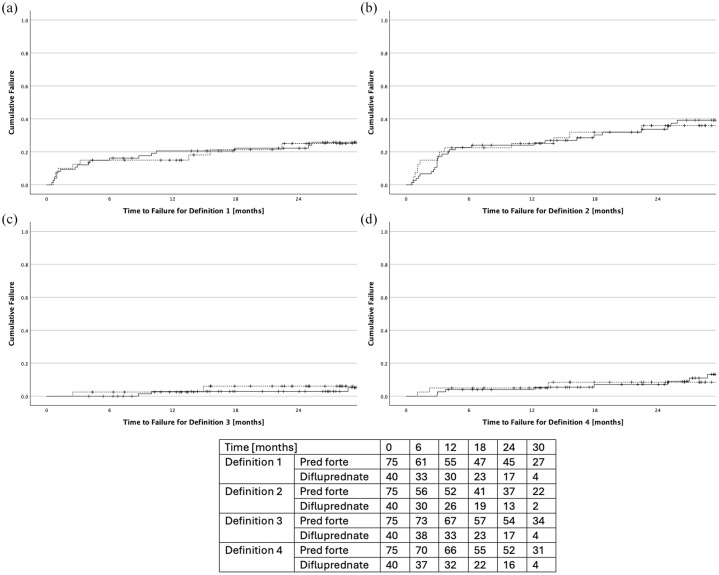
In all, 115 eyes were analyzed: 75 eyes in the prednisolone acetate group, and 40 eyes in the difluprednate group. Baseline characteristics and demographics were similar between the groups. IOP and AGM were significantly lowered, with no difference between the two groups. Failure rates varied between 12% and 31% at 1 year in the prednisolone arm, and between 12% and 35% in the difluprednate arm. No differences between the two treatment arms were found regarding survival statistics.
There was no difference in the success rate between the drug used to treat postoperative inflammation and prevent scarring after trabeculectomy. However, fewer drops per day were necessary in the difluprednate group. Both groups showed no difference in the amount by which IOP and AGM were reduced.
小梁切除术的成功高度依赖于术后炎症和纤维化的控制。醋酸泼尼松龙是眼科手术后最常用的局部类固醇药物。然而,不依从和用药依从性问题一直阻碍着这一目标的实现。因此,需要一种每天滴眼次数更少但在控制纤维化和炎症方面仍能达到相同成功率的局部滴眼液方案。
本研究旨在评估小梁切除术后局部使用地氟泼尼龙是否能取得与醋酸泼尼松龙相当的成功率。
一项单中心、单术者的回顾性病历审查。
对病历进行回顾性评估。纳入标准为年龄≥18岁(无年龄上限)且诊断为开角型青光眼。排除标准为随访时间<3个月以及除激光小梁成形术、白内障手术或小梁网旁路手术外有其他降低眼压的同期手术史。成功定义为术后1个月眼压≤21 mmHg且较基线降低≥20%,无低眼压(眼压>5 mmHg),无后续青光眼手术,且无光感丧失。主要观察指标为失败时间和Kaplan-Meier生存曲线,次要观察指标为眼压变化、抗青光眼药物(AGM)数量、术后干预措施及并发症。
共分析了115只眼:醋酸泼尼松龙组75只眼,地氟泼尼龙组40只眼。两组的基线特征和人口统计学数据相似。眼压和AGM均显著降低,两组之间无差异。醋酸泼尼松龙组1年时的失败率在12%至31%之间,地氟泼尼龙组在12%至35%之间。在生存统计方面,两组之间未发现差异。
小梁切除术后用于治疗术后炎症和预防瘢痕形成的药物在成功率上没有差异。然而,地氟泼尼龙组每天所需的滴眼次数更少。两组在眼压和AGM降低的幅度上没有差异。