Di Lorenzo Rosa, Marzetti Emanuele, Coelho-Junior Helio José, Calvani Riccardo, Pesce Vito, Landi Francesco, Leeuwenburgh Christiaan, Picca Anna
Department of Biosciences, Biotechnologies, and Environment, Università degli Studi di Bari Aldo Moro, Via Edoardo Orabona 4, 70125 Bari, Italy.
Department of Geriatrics, Orthopedics and Rheumatology, Università Cattolica del Sacro Cuore, L.go F. Vito 1, 00168 Rome, Italy.
Cells. 2025 May 3;14(9):672. doi: 10.3390/cells14090672.
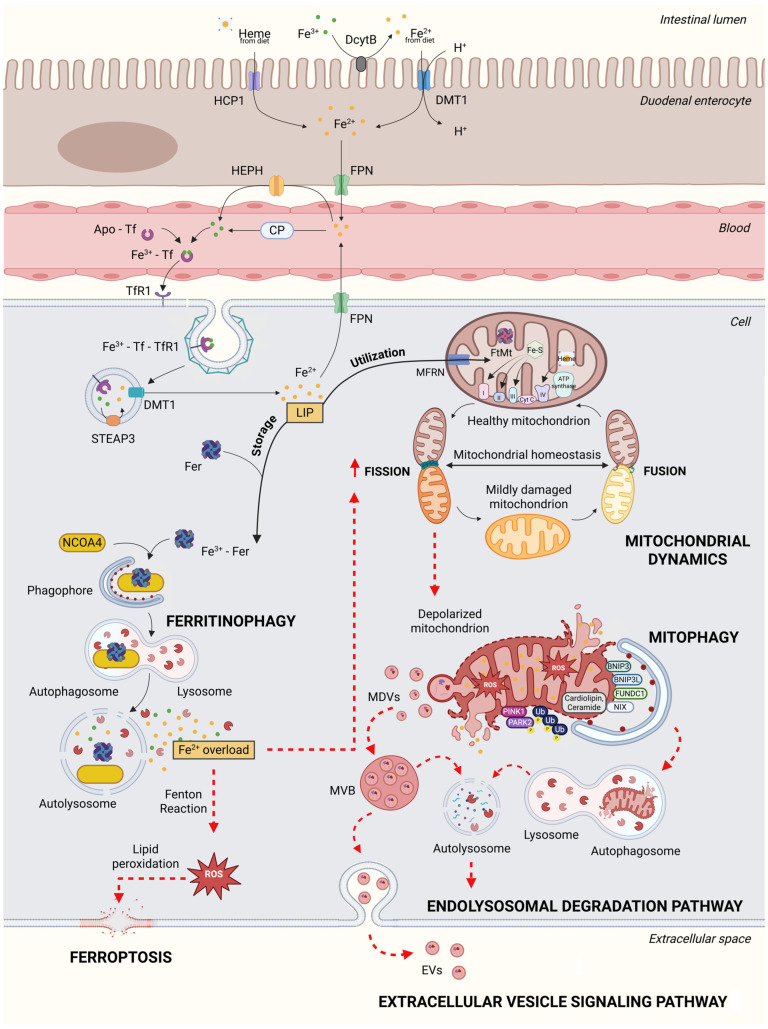
In older adults with reduced physical performance, an increase in the labile iron pool within skeletal muscle is observed. This accumulation is associated with an altered expression of mitochondrial quality control (MQC) markers and increased mitochondrial DNA damage, supporting the hypothesis that impaired MQC contributes to muscle dysfunction during aging. The autophagy-lysosome system plays a critical role in MQC by tagging and engulfing proteins and organelles for degradation in lysosomes. The endolysosomal system is also instrumental in transferrin recycling, which, in turn, regulates cellular iron uptake. In the neuromuscular system, the autophagy-lysosome system supports the structural integrity of neuromuscular junctions, and its dysfunction contributes to muscle atrophy. While MQC was thought to protect against iron-induced cell death, the discovery of ferroptosis, a form of iron-dependent cell death, has highlighted a complex interplay between MQC and iron-inflicted damage. Ferritinophagy, the autophagic degradation of ferritin, if overactivated, can induce ferroptosis. Alternatively, aging may impair ferritinophagy, leading to ferritin accumulation and the release of toxic labile iron under stress, exacerbating oxidative damage and cellular senescence. Physical activity supports muscle health also by preserving mitochondrial quantity and quality and enhancing bioenergetics. However, therapeutic strategies for preventing or reversing physical function decline in aging are still lacking due to the insufficient understanding of the underlying mechanisms. Unveiling how disruptions in iron homeostasis impact muscle quality in older adults may allow for the development of therapeutic strategies targeting iron handling to alleviate age-associated muscle decline.
在身体机能下降的老年人中,观察到骨骼肌内不稳定铁池增加。这种积累与线粒体质量控制(MQC)标志物的表达改变以及线粒体DNA损伤增加有关,支持了MQC受损导致衰老过程中肌肉功能障碍的假说。自噬 - 溶酶体系统通过标记和吞噬蛋白质及细胞器以便在溶酶体中降解,在MQC中起关键作用。内溶酶体系统在转铁蛋白循环中也起作用,而转铁蛋白循环又调节细胞对铁的摄取。在神经肌肉系统中,自噬 - 溶酶体系统支持神经肌肉接头的结构完整性,其功能障碍会导致肌肉萎缩。虽然人们曾认为MQC可防止铁诱导的细胞死亡,但铁死亡(一种铁依赖性细胞死亡形式)的发现凸显了MQC与铁造成的损伤之间复杂的相互作用。铁蛋白自噬(铁蛋白的自噬降解)如果过度激活,可诱导铁死亡。或者,衰老可能会损害铁蛋白自噬,导致铁蛋白积累以及在应激状态下释放有毒的不稳定铁,加剧氧化损伤和细胞衰老。体育活动还通过维持线粒体的数量和质量以及增强生物能量学来支持肌肉健康。然而,由于对潜在机制了解不足,仍缺乏预防或逆转老年人身体功能衰退的治疗策略。揭示铁稳态破坏如何影响老年人的肌肉质量,可能有助于开发针对铁处理的治疗策略,以减轻与年龄相关的肌肉衰退。