
解析胶原蛋白的热诱导解折叠和重折叠途径。
Decoding collagen's thermally induced unfolding and refolding pathways.
作者信息
Al-Shaer Alaa, Forde Nancy R
机构信息
Department of Molecular Biology and Biochemistry, Simon Fraser University, Burnaby, BC V5A 1S6, Canada.
Department of Physics, Simon Fraser University, Burnaby, BC V5A 1S6, Canada.
出版信息
Proc Natl Acad Sci U S A. 2025 May 20;122(20):e2420308122. doi: 10.1073/pnas.2420308122. Epub 2025 May 13.
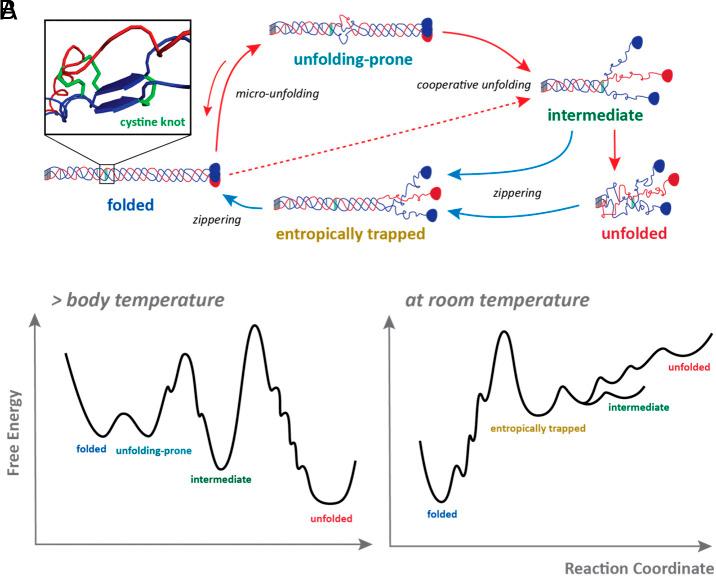
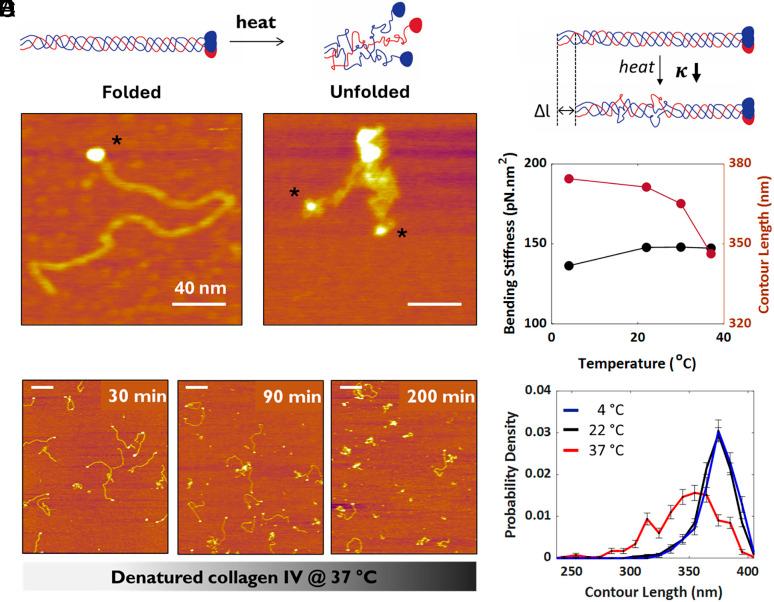
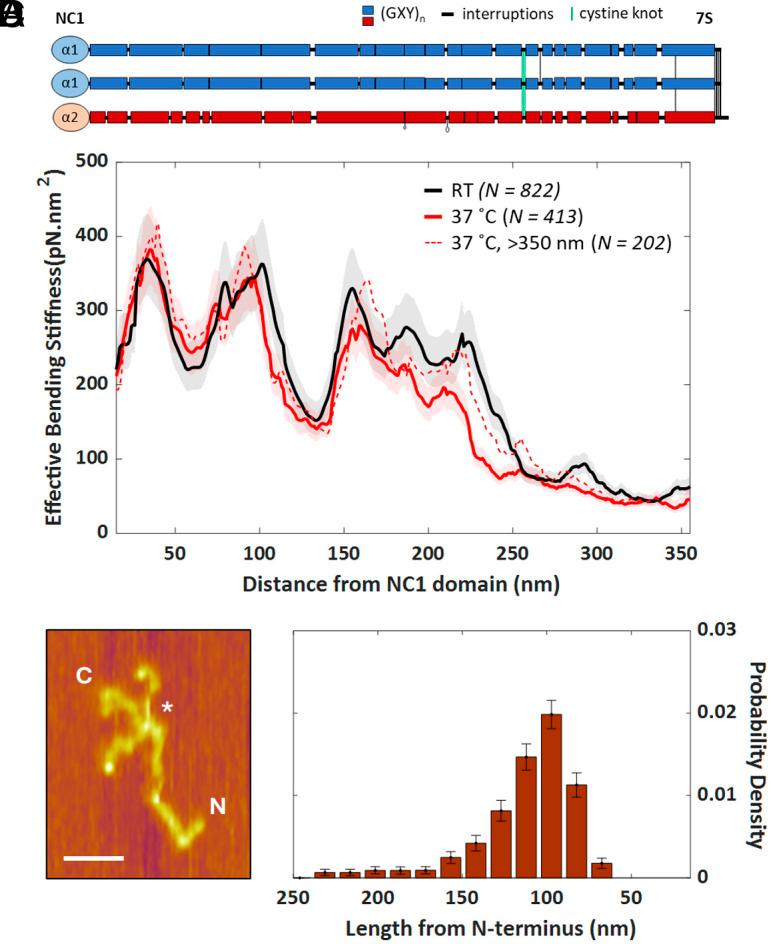
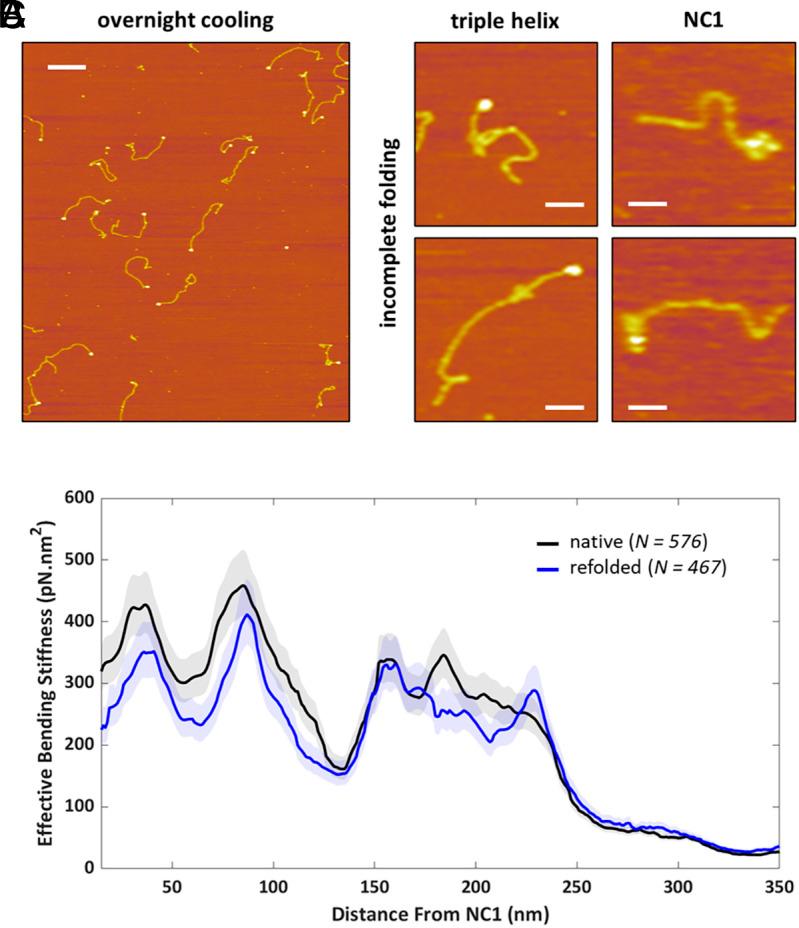
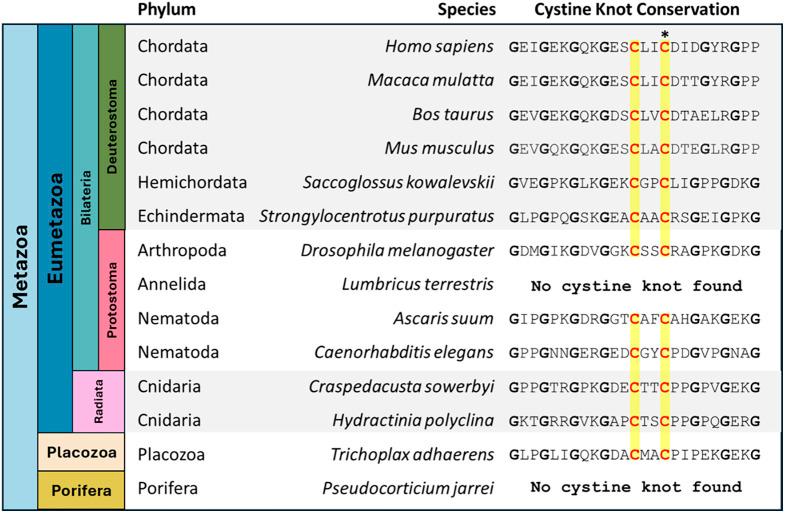
Collagen has been evolutionarily selected as the preferred building block of extracellular structures. Despite inherent thermodynamic instability of individual proteins at body temperature, collagen manages to assemble into higher-order structures that provide mechanical support to tissues. Sequence features that enhance collagen stability have been deduced primarily from studies of collagen-mimetic peptides, as collagen's large size has precluded high-resolution studies of its structure. Thus, methods are needed to analyze the structure and mechanics of full-length collagen proteins. In this study, we used AFM imaging to investigate the thermal response of collagen type IV, a key component of basement membranes. We observed a time-dependent loss of folded structures upon exposure to body temperature, with structural destabilization along the collagenous domain reflected by shorter contour lengths (seen also for collagens type I and III). We characterized the sequence-dependent bending stiffness profile of collagen IV as a function of temperature and identified a putative initiation site for thermally induced unfolding. Interchain disulfide bonds in collagen IV were shown to enhance thermal stability and serve as primary nucleation sites for in vitro refolding. In contrast to the canonical C-to-N-terminal folding direction, we found an interchain cystine knot to enable folding in the opposite direction. A multiple sequence alignment revealed that this cystine knot is evolutionarily conserved across metazoan phyla, highlighting its significance in the stabilization of early collagen IV structures. Our findings provide mechanistic insight into the unfolding and refolding pathways of collagen IV, and how its heterogeneous sequence influences stability and mechanics.
胶原蛋白在进化过程中被选为细胞外结构的首选构建模块。尽管单个蛋白质在体温下具有内在的热力学不稳定性,但胶原蛋白仍能组装成更高阶的结构,为组织提供机械支持。增强胶原蛋白稳定性的序列特征主要是从对胶原蛋白模拟肽的研究中推导出来的,因为胶原蛋白的大尺寸妨碍了对其结构进行高分辨率研究。因此,需要一些方法来分析全长胶原蛋白的结构和力学性能。在本研究中,我们使用原子力显微镜成像来研究IV型胶原蛋白(基底膜的关键成分)的热响应。我们观察到在暴露于体温时折叠结构随时间丧失,沿着胶原结构域的结构不稳定表现为轮廓长度缩短(I型和III型胶原蛋白也有此现象)。我们将IV型胶原蛋白的序列依赖性弯曲刚度概况表征为温度的函数,并确定了热诱导解折叠的推定起始位点。IV型胶原蛋白中的链间二硫键被证明可增强热稳定性,并作为体外重折叠的主要成核位点。与典型的从C端到N端的折叠方向相反,我们发现链间胱氨酸结能够使折叠朝相反方向进行。多序列比对显示,这种胱氨酸结在后生动物门中是进化保守的,突出了其在稳定早期IV型胶原蛋白结构中的重要性。我们的研究结果为IV型胶原蛋白的解折叠和重折叠途径,以及其异质序列如何影响稳定性和力学性能提供了机制上的见解。


 Zotero 插件