
评估数字病理学中基于人工智能的乳腺癌有丝分裂检测:一项关于常规实践整合的临床研究
Evaluating AI-Based Mitosis Detection for Breast Carcinoma in Digital Pathology: A Clinical Study on Routine Practice Integration.
作者信息
Simmat Clara, Guichard Loris, Sockeel Stéphane, Pozin Nicolas, Peyret Rémy, Lacroix-Triki Magali, Miquel Catherine, Gauthier Arnaud, Sockeel Marie, Prévot Sophie
机构信息
Primaa, 75002 Paris, France.
Hôpital Bicêtre (AP-HP), Paris-Saclay University, 94270 Kremin-Bicêtre, France.
出版信息
Diagnostics (Basel). 2025 Apr 28;15(9):1127. doi: 10.3390/diagnostics15091127.
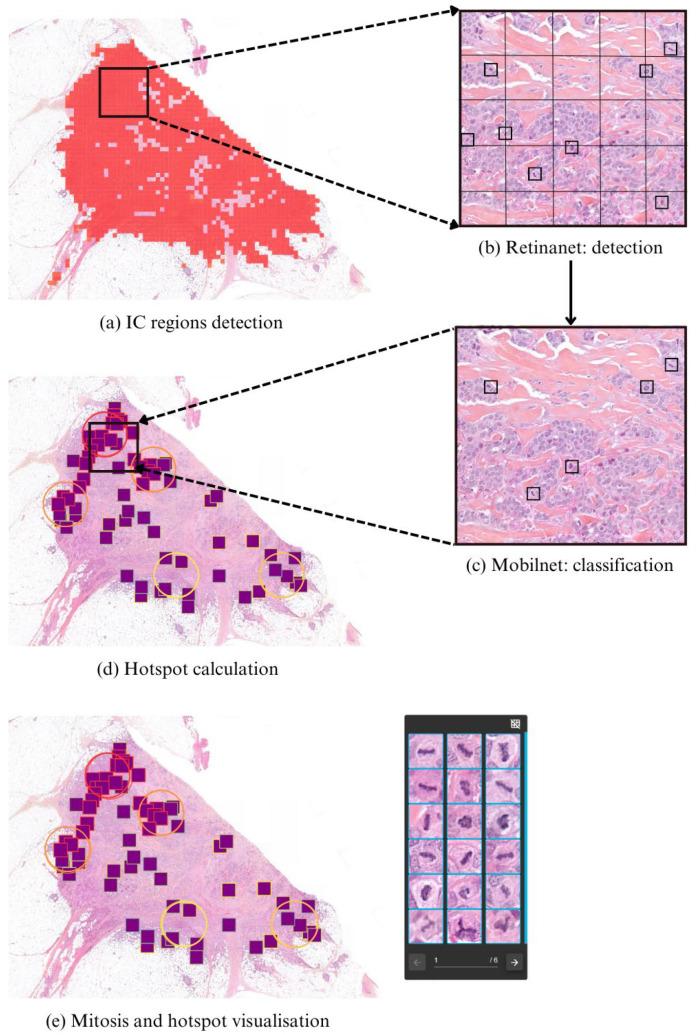
An accurate assessment of mitotic activity is crucial in the histopathological diagnosis of invasive breast carcinoma. However, this task is time-consuming and labor-intensive, and suffers from high variability between pathologists. : To assist pathologists in routine diagnostics, we developed an artificial intelligence (AI)-based tool that uses whole slide images (WSIs) to detect mitoses, identify mitotic hotspots, and assign mitotic scores according to the Elston and Ellis grading system. To our knowledge, this study is the first to evaluate such a tool fully integrated into the pathologist's routine workflow. A clinical study evaluating the tool's performance on routine data clearly demonstrated the value of this approach. With AI assistance, pathologists achieved a greater accuracy and reproducibility in mitotic scoring, mainly because the tool automatically and consistently identified hotspots. Inter-observer reproducibility improved significantly: Cohen's kappa coefficients increased from 0.378 and 0.457 (low agreement) without AI to 0.629 and 0.726 (moderate agreement) with AI. This preliminary clinical study demonstrates, for the first time in a routine diagnostic setting, that AI can reliably identify mitotic hotspots and enhance pathologists' performance in scoring mitotic activity on breast cancer WSIs.
准确评估有丝分裂活性在浸润性乳腺癌的组织病理学诊断中至关重要。然而,这项任务既耗时又费力,而且病理学家之间的差异很大。为了协助病理学家进行常规诊断,我们开发了一种基于人工智能(AI)的工具,该工具使用全切片图像(WSIs)来检测有丝分裂、识别有丝分裂热点,并根据埃尔斯特和埃利斯分级系统给出有丝分裂评分。据我们所知,本研究是首次评估这种完全融入病理学家常规工作流程的工具。一项评估该工具在常规数据上性能的临床研究清楚地证明了这种方法的价值。在人工智能的协助下,病理学家在有丝分裂评分方面实现了更高的准确性和可重复性,主要是因为该工具能自动且一致地识别热点。观察者间的可重复性显著提高:科恩kappa系数从无人工智能时的0.378和0.457(一致性低)提高到有人工智能时的0.629和0.726(一致性中等)。这项初步临床研究首次在常规诊断环境中表明,人工智能能够可靠地识别有丝分裂热点,并提高病理学家对乳腺癌全切片图像有丝分裂活性评分的表现。




 Zotero 插件