Ang Xun, Chen Hong, Xiang Jiqian, Wei Fang, Quek Siew Young
Food Science Programme, School of Chemical Sciences, The University of Auckland, Auckland 1142, New Zealand.
Riddet Institute, Centre for Research Excellence, Palmerston North 4474, New Zealand.
Molecules. 2025 Apr 30;30(9):2007. doi: 10.3390/molecules30092007.
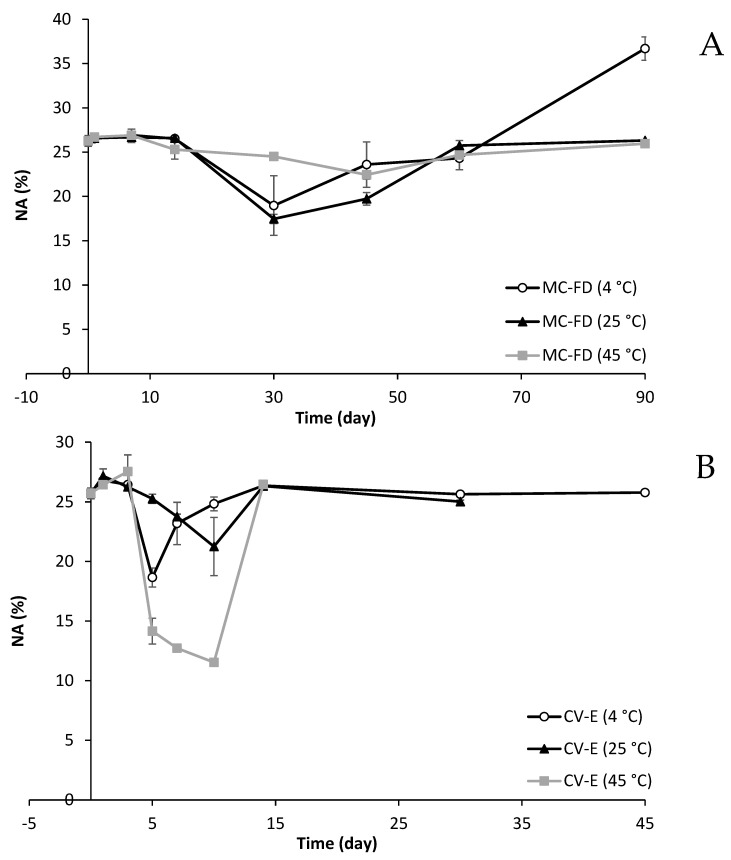
This study focuses on the encapsulation of nervonic acid-enriched structured phospholipid (NA-enriched SPL) by analysing its physical and chemical properties. Wall materials for encapsulation were initially screened, with whey protein isolate and maltodextrin exhibiting the most favourable characteristics. Optimisation of encapsulation parameters determined that a core-to-wall ratio of 1:3 provided the highest physical stability. Encapsulated samples underwent in vitro digestion, where MC-FD exhibited the highest digestibility (79.54%), followed by CV-E (72.1%) and NA-enriched SPL (29.82%). Storage stability was assessed over 90 days at 4 °C, 25 °C, and 45 °C by monitoring particle size, zeta potential, polydispersity index, microscopy, fatty acid composition, and primary and secondary lipid oxidation. MC-FD demonstrated superior stability, maintaining its physical and chemical properties, particularly at 4 °C. In contrast, CV-E showed the lowest physical stability, with significant changes in appearance and increased particle size at elevated temperatures (25 °C and 45 °C).
本研究通过分析富含神经酸的结构化磷脂(NA-富集SPL)的物理和化学性质,聚焦于其包封过程。首先对包封用壁材进行了筛选,其中乳清蛋白分离物和麦芽糊精表现出最有利的特性。包封参数的优化确定,1:3的芯壁比提供了最高的物理稳定性。对包封后的样品进行体外消化实验,结果显示MC-FD的消化率最高(79.54%),其次是CV-E(72.1%)和NA-富集SPL(29.82%)。通过监测粒径、zeta电位、多分散指数、显微镜观察、脂肪酸组成以及一级和二级脂质氧化,评估了在4°C、25°C和45°C下90天的储存稳定性。MC-FD表现出卓越的稳定性,能保持其物理和化学性质,尤其是在4°C时。相比之下,CV-E的物理稳定性最低,在较高温度(25°C和45°C)下外观有显著变化且粒径增大。