
比较裸金属支架联合秋水仙碱与药物洗脱支架预防不良心脏结局的随机临床试验:阿根廷口服秋水仙碱(ORCA)试验的三年随访结果
Randomized Clinical Trial Comparing Bare-Metal Stents Plus Colchicine Versus Drug-Eluting Stents for Preventing Adverse Cardiac Outcomes: Three-Year Follow-Up Results of the ORal Colchicine in Argentina (ORCA) Trial.
作者信息
Rodriguez-Granillo Alfredo Matias, Mieres Juan, Fernandez-Pereira Carlos, Sadouet Camila Correa, Milei Jose, Swieszkowski Sandra Patricia, Stutzbach Pablo, Santaera Omar, Wainer Pedro, Rokos Juan, Gallardo Camila, Cristodulo-Cortez Roberto, Perez de la Hoz Ricardo, Kastrati Adnan, Rodriguez Alfredo E
机构信息
Otamendi Hospital, Buenos Aires 1001, Argentina.
Centro de Estudios en Cardiología Intervencionista (CECI), Buenos Aires 1024, Argentina.
出版信息
J Clin Med. 2025 Apr 22;14(9):2871. doi: 10.3390/jcm14092871.
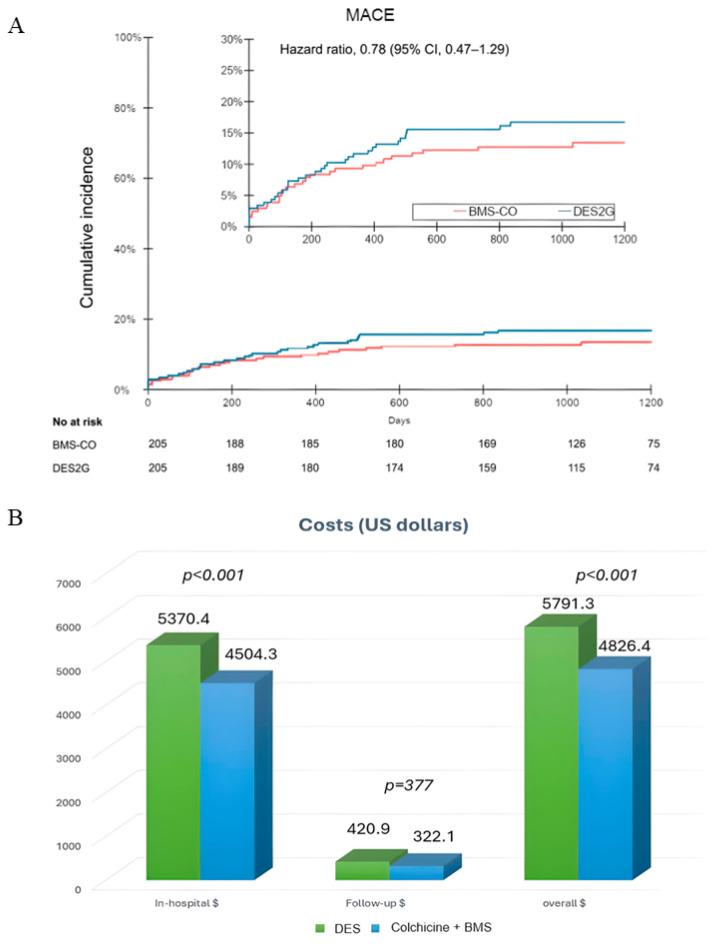
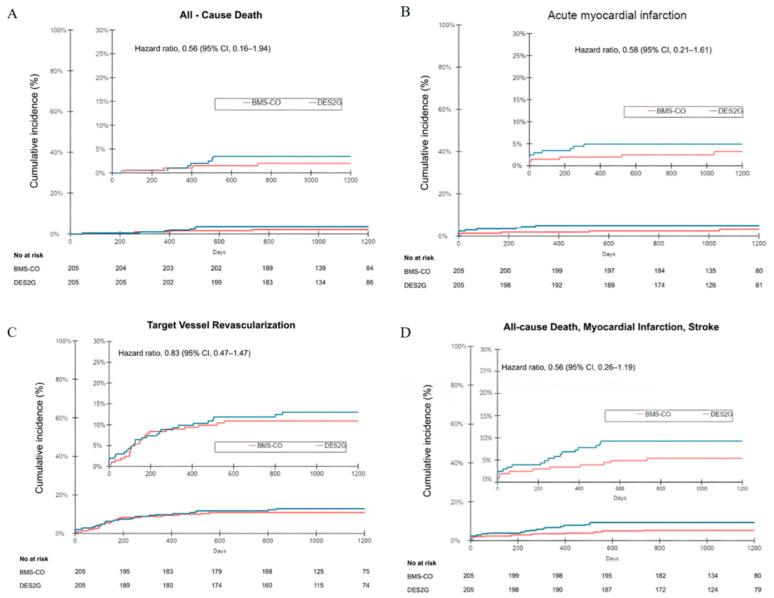
: In patients with coronary artery disease, bare-metal stents (BMS) are considered a safer but less effective treatment than drug-eluting stents (DES). Oral colchicine therapy may compensate for this limitation of BMS. This randomized trial compared the cost-effectiveness of two different revascularization strategies during percutaneous coronary intervention (PCI). : Between March 2020 and April 2022, 410 patients were randomly treated with PCI with BMS plus colchicine (BMS-CO: 205 patients) or DES (205 patients) The patients in the BMS-CO group received 0.5 mg oral doses of colchicine for 3 months. The primary endpoint was major adverse cardiac and cerebrovascular events (MACEs), defined as the composite of death, myocardial infarction, stroke, or target vessel revascularization (TVR), and the costs of each treatment strategy. The secondary endpoints included the individual components of MACEs. : No significant differences were observed in baseline characteristics, and 76% of the patients presented with acute coronary syndromes. The median follow-up period was 36.8 months. Five percent of the patients in the BMS-CO group discontinued study medication. The cumulative incidence of MACEs was not significantly different, with 12.7% in the BMS-CO group and 15.6% in the DES2G group ( = 0.39) as well individual components of the clinical endpoint. The cumulative costs were lower in the BMS-CO group than in the DES2G group (USD 4826.4 ± 2512 vs. USD 5708 ± 3637, < 0.001). : In the 3 years, the DES strategy failed to be cost-saving compared to BMS-CO. However, due to the small sample size, the equivalence in clinical outcomes with both strategies can occur by chance (NCT04382443).
在冠心病患者中,裸金属支架(BMS)被认为是一种比药物洗脱支架(DES)更安全但效果较差的治疗方法。口服秋水仙碱治疗可能弥补BMS的这一局限性。这项随机试验比较了经皮冠状动脉介入治疗(PCI)期间两种不同血运重建策略的成本效益。2020年3月至2022年4月期间,410例患者被随机接受BMS联合秋水仙碱的PCI治疗(BMS-CO组:205例患者)或DES治疗(205例患者)。BMS-CO组患者接受0.5mg口服秋水仙碱,持续3个月。主要终点是主要不良心脑血管事件(MACE),定义为死亡、心肌梗死、中风或靶血管血运重建(TVR)的综合结果,以及每种治疗策略的成本。次要终点包括MACE的各个组成部分。在基线特征方面未观察到显著差异,76%的患者表现为急性冠状动脉综合征。中位随访期为36.8个月。BMS-CO组5%的患者停止研究用药。MACE的累积发生率无显著差异,BMS-CO组为12.7%,DES2G组为15.6%(P=0.39),临床终点的各个组成部分也是如此。BMS-CO组的累积成本低于DES2G组(4826.4±2512美元对5708±3637美元,P<0.001)。在3年中,与BMS-CO相比,DES策略未能节省成本。然而,由于样本量小,两种策略在临床结果上的等效性可能是偶然发生的(NCT04382443)。
 Zotero 插件