
骨骼肌密度作为原发性不明癌症患者预后和体能储备的预测指标
Skeletal Muscle Density as a Predictor of Prognosis and Physical Reserve in Patients with Cancer of Unknown Primary.
作者信息
Lee Kwonjae, Park Se Jun, Kim Joori, Hong Sook Hee, Kim In-Ho, Lee Jieun, Lee Myung Ah, Shin Kabsoo, Mun Han Song
机构信息
Division of Medical Oncology, Department of Internal Medicine, Seoul St. Mary's Hospital, College of Medicine, The Catholic University of Korea, Seoul 06591, Republic of Korea.
Cancer Research Institute, College of Medicine, The Catholic University of Korea, Seoul 06591, Republic of Korea.
出版信息
J Clin Med. 2025 Apr 24;14(9):2947. doi: 10.3390/jcm14092947.
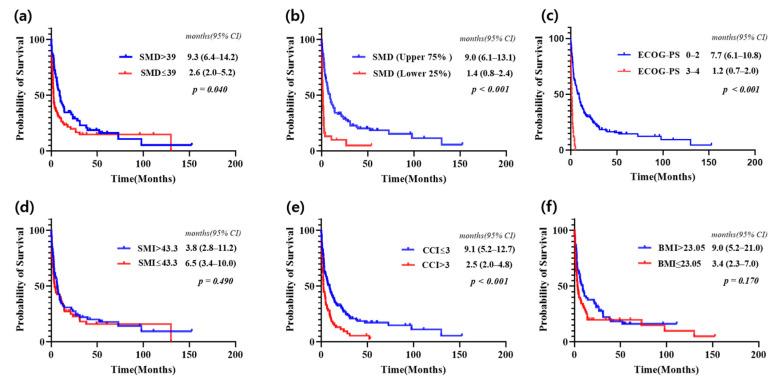
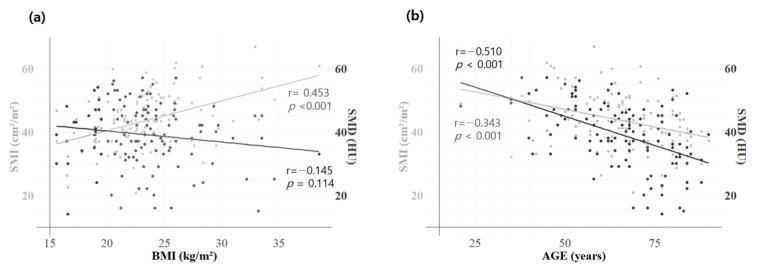
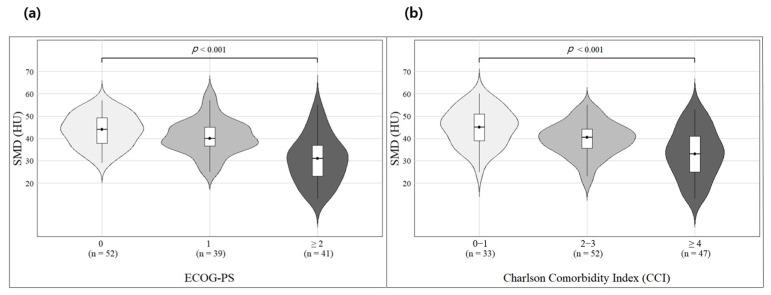
The Eastern Cooperative Oncology Group (ECOG) Performance Status (PS) is widely used to assess patient status but relies on subjective judgment and may not fully reflect their physical reserve. While studies have shown that skeletal muscle quality and quantity are associated with patient prognosis, their role in cancers of unknown primary (CUP) remains unclear. Therefore, this study aimed to investigate whether computed tomography (CT)-based skeletal muscle indicators reflect physical reserve and their prognostic value in patients with CUP. This study enrolled 184 patients with CUP, comprising both inpatients and outpatients, who were diagnosed at Seoul St. Mary's Hospital between 1 January 2008, and 30 June 2024. Overall survival (OS) was evaluated using the Kaplan-Meier method and analyzed using the log-rank test. Univariate and multivariate analyses were performed using Cox proportional hazard models. Statistical significance was defined as < 0.05. Correlation analyses were conducted to evaluate the relationships between skeletal muscle density (SMD), skeletal muscle index (SMI), and other prognostic factors. SMD was positively correlated with SMI and negatively correlated with age, neutrophil-to-lymphocyte ratio, Charlson Comorbidity Index (CCI), and ECOG-PS. Jonckheere's trend test revealed that SMD decreased significantly as CCI and ECOG-PS increased ( < 0.001), indicating that a higher comorbidity burden and poorer performance status were associated with lower SMD. Both ECOG-PS and SMD were identified as prognostic factors in the univariate analysis of survival; however, only SMD demonstrated statistical significance regarding prognostic value in the multivariate analysis ( = 0.004) SMD, as a measure of muscle quality, demonstrates superior prognostic value compared to the subjective ECOG-PS and may serve as a reliable objective tool for assessing physical reserve in patients with CUP.
东部肿瘤协作组(ECOG)体能状态(PS)被广泛用于评估患者状态,但它依赖主观判断,可能无法充分反映患者的身体储备。虽然研究表明骨骼肌质量和数量与患者预后相关,但其在原发灶不明癌症(CUP)中的作用仍不清楚。因此,本研究旨在探讨基于计算机断层扫描(CT)的骨骼肌指标是否能反映身体储备及其在CUP患者中的预后价值。本研究纳入了184例CUP患者,包括住院患者和门诊患者,这些患者于2008年1月1日至2024年6月30日在首尔圣玛丽医院被确诊。采用Kaplan-Meier法评估总生存期(OS),并使用对数秩检验进行分析。使用Cox比例风险模型进行单因素和多因素分析。统计学显著性定义为P<0.05。进行相关性分析以评估骨骼肌密度(SMD)、骨骼肌指数(SMI)与其他预后因素之间的关系。SMD与SMI呈正相关,与年龄、中性粒细胞与淋巴细胞比值、Charlson合并症指数(CCI)和ECOG-PS呈负相关。Jonckheere趋势检验显示,随着CCI和ECOG-PS升高,SMD显著降低(P<0.001),表明更高的合并症负担和更差的体能状态与更低的SMD相关。在生存的单因素分析中,ECOG-PS和SMD均被确定为预后因素;然而,在多因素分析中,只有SMD在预后价值方面具有统计学显著性(P=0.004)。SMD作为肌肉质量的指标,与主观的ECOG-PS相比,具有更好的预后价值,可作为评估CUP患者身体储备的可靠客观工具。
 Zotero 插件