Zhang Lei, Xu Yanhui, Lou Qinqin, Chen Fangfang, Li Fang, Chai Kun, Gao Junshun, Tong Mingjie, Ma Yan, Xia Lilong, Zhao Kaixiang, Gao Junli, Zhu Xinhai
Department of Thoracic Surgery, Zhejiang Hospital, Hangzhou, 310013, China.
Hangzhou Cosmos Wisdom Mass Spectrometry Center of Zhejiang University Medical School, Hangzhou, 311200, China.
Clin Exp Med. 2025 May 14;25(1):159. doi: 10.1007/s10238-025-01672-5.
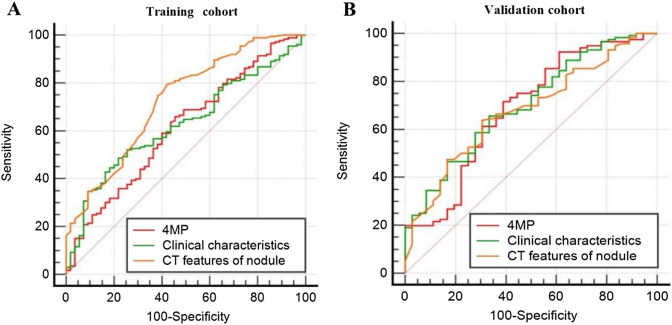
Previous studies have demonstrated that a four-protein marker panel (4MP), consisting of Pro-SFTPB, CA125, Cyfra21-1, and CEA could be used to identify benign and malignant lung nodules. This study aims to improve the 4MP's performance by combining clinical characteristics and low-dose chest computed tomography (LDCT) screening features. This study involved 380 patients with pulmonary nodules, diagnosing 91 benign and 289 early-stage lung cancer via postoperative histopathology. Serum levels of Pro-SFTPB, CA125, Cyfra21-1, and CEA were assessed using an immunofluorescence assay. Clinical features were selected using the LassoCV method. A new diagnostic model was developed using logistic regression, incorporating 4MP, clinical characteristics, and LDCT features. The model's diagnostic performance was compared to the lung cancer biomarker panel (LCBP) nodule risk model, and evaluated through sensitivity, specificity, and the AUC value. The AUC values for distinguishing between benign and malignant pulmonary nodules were 0.612 for the 4MP model. We screened out 7 factors of patient clinical information and CT features of nodules. The composite model (4MP + age + gender + BMI + family history of cancer + nodule size + nodule margin + nodule density) achieved an AUC of 0.808, especially for small nodules (AUC = 0.835 for nodules ≤ 6 mm). Furthermore, within the same validation cohort, the performance of the composite model (AUC = 0.680) surpassed that of the LCBP nodule risk model (AUC = 0.599). The novel composite model accurately diagnoses malignant pulmonary nodules, especially small ones, helping to stratify patients by lung cancer risk.
先前的研究表明,由表面活性蛋白B前体(Pro-SFTPB)、癌抗原125(CA125)、细胞角蛋白19片段(Cyfra21-1)和癌胚抗原(CEA)组成的四蛋白标志物组合(4MP)可用于鉴别肺结节的良恶性。本研究旨在通过结合临床特征和低剂量胸部计算机断层扫描(LDCT)筛查特征来提高4MP的性能。本研究纳入了380例肺结节患者,通过术后组织病理学诊断出91例良性结节和289例早期肺癌。采用免疫荧光法检测血清中Pro-SFTPB、CA125、Cyfra21-1和CEA的水平。使用套索交叉验证(LassoCV)方法选择临床特征。采用逻辑回归建立了一个新的诊断模型,纳入了4MP、临床特征和LDCT特征。将该模型的诊断性能与肺癌生物标志物组合(LCBP)结节风险模型进行比较,并通过敏感性、特异性和曲线下面积(AUC)值进行评估。4MP模型区分良性和恶性肺结节的AUC值为0.612。我们筛选出了7个患者临床信息和结节CT特征的因素。复合模型(4MP + 年龄 + 性别 + 体重指数 + 癌症家族史 + 结节大小 + 结节边缘 + 结节密度)的AUC为0.808,尤其是对于小结节(直径≤6 mm的结节AUC = 0.835)。此外,在同一验证队列中,复合模型(AUC = 0.680)的性能超过了LCBP结节风险模型(AUC = 0.599)。这种新型复合模型能够准确诊断恶性肺结节,尤其是小结节,有助于根据肺癌风险对患者进行分层。