Syeda Samar M, Dunmore Christopher J, Skinner Matthew M, Berger Lee R, Churchill Steven E, Zipfel Bernhard, Kivell Tracy L
Richard Gilder Graduate School, American Museum of Natural History, New York, NY 10024, USA.
Division of Anthropology, American Museum of Natural History, New York, NY 10024, USA.
Sci Adv. 2025 May 16;11(20):eadt1201. doi: 10.1126/sciadv.adt1201. Epub 2025 May 14.
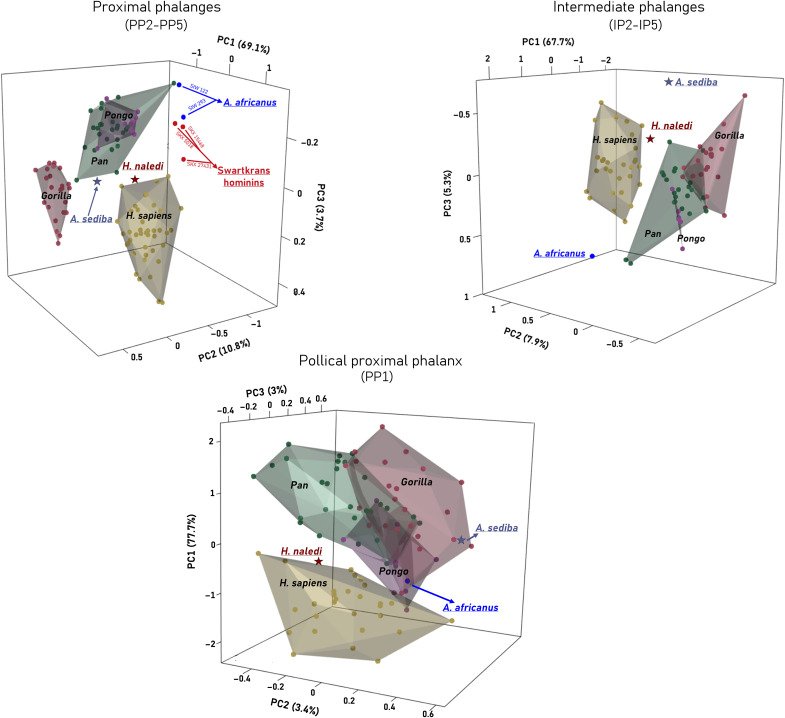
The evolution of the human hand is marked by a transition from a hand primarily used for locomotion to one primarily used for dexterous manipulation. The hand skeletons of Plio-Pleistocene hominins have different mosaics of human-like features associated with enhanced dexterity and ape-like features associated with locomotor hand use. However, the functional relevance of the ape-like features is debated, particularly due to a lack of complete and associated hand remains. Here, we investigate the internal phalangeal cortical structure of the nearly complete MH2 hand and hand 1 to provide both insight into the manual behaviors of these fossil hominins and functional clarity regarding the mosaic features found within their hands. The phalangeal cortical structure demonstrates diversity in Plio-Pleistocene hand use, with and each indicating different dexterous abilities and different climbing strategies, supporting the functional importance of the ape-like features.
人类手部的进化以从主要用于移动的手向主要用于灵巧操作的手的转变为标志。上新世 - 更新世古人类的手部骨骼具有不同的组合,既有与增强灵巧性相关的类人特征,也有与用于移动的手部使用相关的类猿特征。然而,类猿特征的功能相关性存在争议,特别是由于缺乏完整且相关联的手部遗骸。在这里,我们研究了近乎完整的MH2手和手部1的内部指骨皮质结构,以深入了解这些化石古人类的手部行为,并明确其手部发现的镶嵌特征的功能。指骨皮质结构表明上新世 - 更新世手部使用存在多样性,其中[具体内容缺失]和[具体内容缺失]分别表明不同的灵巧能力和不同的攀爬策略,支持了类猿特征的功能重要性。