Xu Guige, Zhou Jiangrong, Liu Kuan, Wang Yining, Tsikari Theano, Qin Fang, van den Hil Francijna, Boor Patrick P C, Ayada Ibrahim, de Vries Annemarie C, Li Jiajing, Jiang Shijin, Offermans Dewy M, Kainov Denis E, Janssen Harry L A, Peppelenbosch Maikel P, Bijvelds Marcel J C, Wang Wenshi, Orlova Valeria V, Pan Qiuwei, Li Pengfei
Department of Preventive Veterinary Medicine, College of Veterinary Medicine, Shandong Agricultural University, Taian, Shandong, 271018, China.
Department of Gastroenterology and Hepatology, Erasmus MC-University Medical Center, Rotterdam, the Netherlands.
Nat Commun. 2025 May 14;16(1):4475. doi: 10.1038/s41467-025-59639-9.
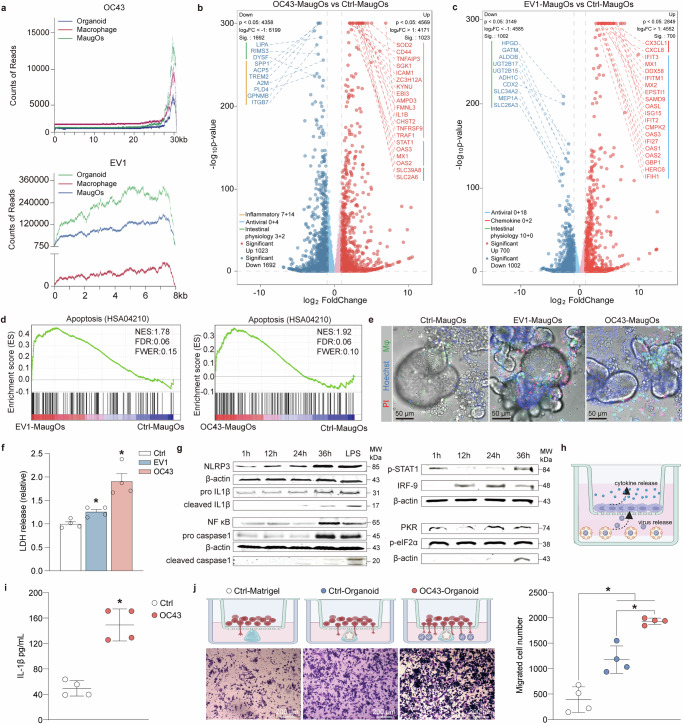
The pathogenesis of enteric viral infections is attributed to both viral replication and the resultant immune-inflammatory response. To recapitulate this complex pathophysiology, we engineer macrophage-augmented organoids (MaugOs) by integrating human macrophages into primary intestinal organoids. Echovirus 1, echovirus 6, rotavirus, seasonal coronavirus OC43 and SARS-CoV-2- known to directly invade the intestine- are used as disease modalities. We demonstrate that these viruses efficiently propagate in MaugOs and stimulate the host antiviral response. However, rotavirus, coronavirus OC43 and SARS-CoV-2, but not the two echoviruses, trigger inflammatory responses. Acetate, a microbial metabolite abundantly present in the intestine, potently inhibits virus-induced inflammatory responses in MaugOs, while differentially affecting viral replication in macrophages and organoids. Furthermore, we provide a proof-of-concept of combining antiviral agent with either anti-inflammatory regimen or acetate to simultaneously inhibit viral infection and inflammatory response in MaugOs. Collectively, these findings demonstrate that MaugOs are innovative tools for studying the complex virus-host interactions and advancing therapeutic development.
肠道病毒感染的发病机制归因于病毒复制以及由此产生的免疫炎症反应。为了重现这种复杂的病理生理学过程,我们通过将人类巨噬细胞整合到原代肠道类器官中来构建巨噬细胞增强类器官(MaugOs)。已知能直接侵袭肠道的埃可病毒1型、埃可病毒6型、轮状病毒、季节性冠状病毒OC43和严重急性呼吸综合征冠状病毒2(SARS-CoV-2)被用作致病模型。我们证明这些病毒能在MaugOs中有效繁殖并刺激宿主抗病毒反应。然而,轮状病毒、冠状病毒OC43和SARS-CoV-2,而非这两种埃可病毒,会引发炎症反应。乙酸盐是肠道中大量存在的一种微生物代谢产物,能有效抑制MaugOs中病毒诱导的炎症反应,同时对巨噬细胞和类器官中的病毒复制有不同影响。此外,我们提供了一个概念验证,即将抗病毒药物与抗炎方案或乙酸盐联合使用,以同时抑制MaugOs中的病毒感染和炎症反应。总的来说,这些发现表明MaugOs是研究复杂的病毒-宿主相互作用以及推进治疗方法开发的创新工具。