Panico Antonio, Corvi Alberto, Collini Luca, Sciancalepore Corrado
Department of Engineering for Industrial Systems and Technologies, University of Parma, Parma, 43124, Italy.
Sci Rep. 2025 May 14;15(1):16753. doi: 10.1038/s41598-025-01016-z.
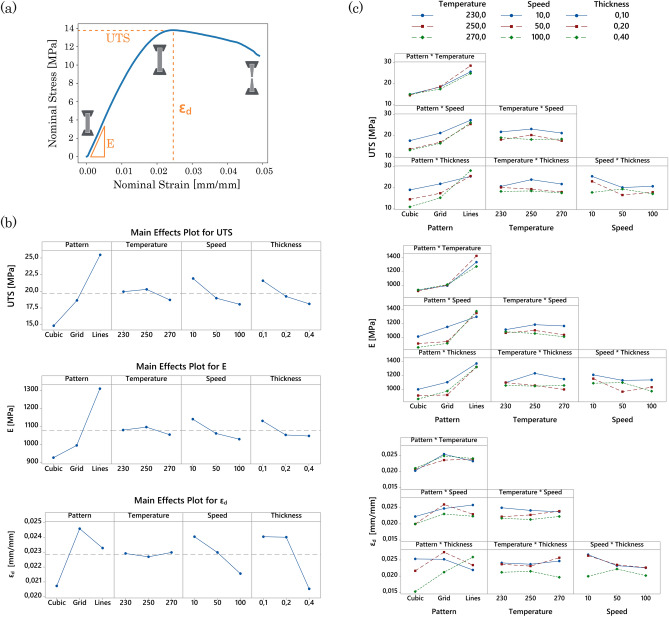
The choice of the optimal printing setup for Fused Deposition Modeling (FDM) 3D-printing technology is challenging due to complex interactions between process parameters and mechanical properties. This especially affects engineering applications where the maximum performance is required. To address this challenge, this study explores the influence of main controllable printing parameters including layer thickness, extrusion temperature, printing speed and deposition patterns, on the mechanical properties of FDM-printed ABS specimens using the Design-of-Experiments (DoE) approach by a full factorial design. Main-effects and Interaction-effects on tensile strength, elastic modulus, and strain at maximum stress are investigated via ANOVA analysis, providing interesting hints to evaluate at the design stage. Given the complexity of these effects, a deeper investigation is conducted with a quadratic regression model of the Response Surface Method and the Random Forest regressor, with the latter enhancing the predictive capability ( ) on test data by more than 40% for all the mechanical properties. Eventually, a Genetic Algorithm (NSGA-II) is integrated to estimate the optimal parameter set for multiple responses. Overall results indicate that the deposition strategy is the parameter affecting the most the overall mechanical response, with "Lines" pattern providing the best balanced results in maximizing the elastic modulus and the tensile strength, respectively 1381 MPa and 33.3 MPa. Testing of a set of specimens printed with the found optimal parameters confirm the model's prediction.
由于工艺参数与机械性能之间存在复杂的相互作用,为熔融沉积建模(FDM)3D打印技术选择最佳打印设置具有挑战性。这尤其影响到需要最高性能的工程应用。为应对这一挑战,本研究采用全因子设计的实验设计(DoE)方法,探索包括层厚、挤出温度、打印速度和沉积模式在内的主要可控打印参数对FDM打印ABS试样机械性能的影响。通过方差分析(ANOVA)研究了对拉伸强度、弹性模量和最大应力下应变的主效应和交互效应,为在设计阶段进行评估提供了有趣的线索。鉴于这些效应的复杂性,使用响应面法的二次回归模型和随机森林回归器进行了更深入的研究,后者将所有机械性能的测试数据预测能力提高了40%以上。最终,集成了遗传算法(NSGA-II)来估计多个响应的最佳参数集。总体结果表明,沉积策略是对整体机械响应影响最大的参数,“线条”模式在分别最大化弹性模量(1381MPa)和拉伸强度(33.3MPa)方面提供了最佳平衡结果。对一组使用找到的最佳参数打印的试样进行测试,证实了模型的预测。