Tang Wei-Zhen, Cai Qin-Yu, Huang Kang-Jin, Xu Wei-Ze, Li Jia-Zheng, Pan Yun-Ren, Xu Hong-Yu, Zhao Yi-Fan, Sheng Ting-He, Li Zhi-Mou, Liu Tai-Hang, Li Ying-Bo
Department of Bioinformatics, School of Basic Medical Sciences, Chongqing Medical University, Chongqing, 400016, China.
The Joint International Research Laboratory of Reproduction and Development, Chongqing Medical University, Chongqing, 400016, China.
BMC Public Health. 2025 May 14;25(1):1774. doi: 10.1186/s12889-025-22881-3.
Globally, common gynecological disorders such as Polycystic Ovary Syndrome (PCOS), endometriosis, uterine fibroids (non-malignant gynecological diseases), as well as cervical cancer, uterine cancer, and ovarian cancer (gynecological cancers), profoundly impact women's physical and mental health. The burden of these diseases exhibits significant geographical disparities across different countries and regions, making a comprehensive and precise assessment of the global burden of gynecological diseases particularly crucial. Such an assessment will facilitate the development of region-specific prevention and treatment strategies, contributing to a more effective response to these health challenges.
Incidence, prevalence, mortality rates, and Disability-Adjusted Life Years (DALYs) data for the aforementioned gynecological conditions were obtained from the 2021 Global Burden of Disease (GBD) study and analyzed by age, location, and year. The burden associated with gynecological diseases was analyzed based on the Socio-demographic Index (SDI) and attributable risk factors. The Estimated Annual Percentage Change (EAPC) and its 95% Confidence Interval (CI) were used to assess temporal trends in burden.
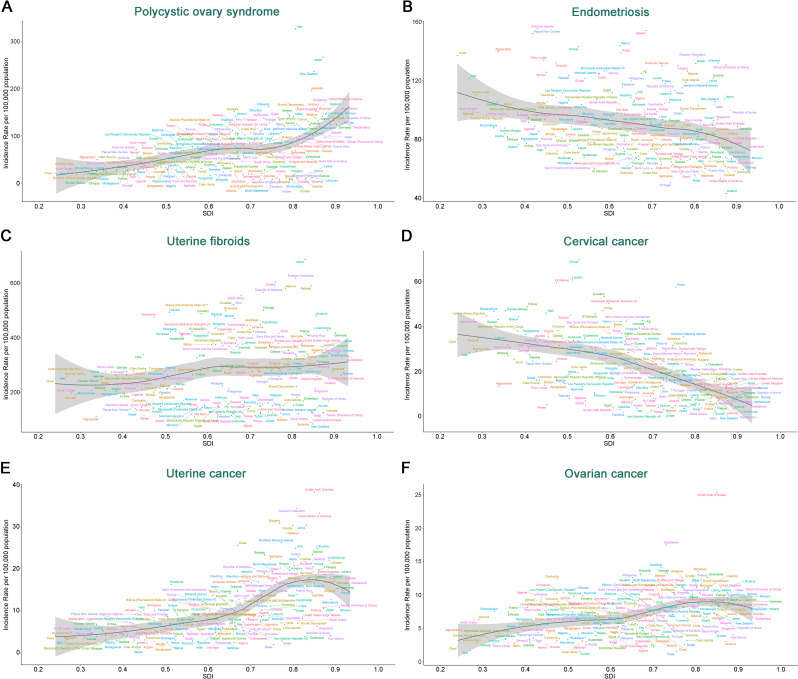
In 2021, uterine fibroids were the leading non-malignant gynecological condition contributing to the highest Age-Standardized Incidence Rate (ASIR) and Age-Standardized Prevalence Rate (ASPR), with rates of 250.93 and 2841.07 per 100,000, respectively. Cervical cancer was the main contributor to the Age-Standardized Mortality Rate (ASMR) and Age-Standardized Disability Rate (ASDR) among the eight selected gynecological diseases, with rates of 6.62 and 226.28 per 100,000, respectively. From 1990 to 2021, the ASIR and ASPR for non-malignant gynecological conditions, such as PCOS and uterine fibroids, increased, while the ASDR for PCOS also rose. Among gynecological cancers, the ASIR for uterine cancer increased, while the ASPR for cervical cancer rose. However, the ASIR for cervical and ovarian cancers decreased, along with reductions in the ASMR and ASDR for these cancers and uterine cancer. There were notable regional disparities based on the SDI. In 2021, lower SDI regions had higher incidence, prevalence, mortality rates, and DALYs for endometriosis and cervical cancer, whereas higher SDI regions saw higher rates for PCOS, uterine fibroids, ovarian cancer, and uterine cancer, with more significant mortality and DALYs for ovarian and uterine cancers. The age distribution of these conditions varied. Non-malignant gynecological conditions, such as PCOS and uterine fibroids, primarily affect women aged 30-34 and 40-69. Endometriosis is most common in women aged 20-34, particularly between 25 and 29. Gynecological cancers, including cervical, uterine, and ovarian cancers, predominantly affect women over 35, especially between 40 and 69, with cervical cancer peaking at ages 50-54. Regarding attributable risk factors globally, 1% of cervical cancer deaths were linked to unsafe sexual behaviors, while a high Body Mass Index(BMI) contributed to 0.09% of ovarian cancer deaths and 0.34% of uterine cancer deaths.
The global burden of these six gynecological conditions poses a significant public health challenge. There is an urgent need for international collaboration to advance the development of age and regionally differentiated management strategies for gynecological diseases, including the development of effective diagnostic screening tools and the implementation of high-quality, targeted prevention and treatment strategies.
在全球范围内,多囊卵巢综合征(PCOS)、子宫内膜异位症、子宫肌瘤(非恶性妇科疾病)以及宫颈癌、子宫癌和卵巢癌(妇科癌症)等常见妇科疾病对女性的身心健康产生了深远影响。这些疾病的负担在不同国家和地区呈现出显著的地理差异,因此全面、准确地评估全球妇科疾病负担尤为关键。这样的评估将有助于制定针对特定区域的预防和治疗策略,从而更有效地应对这些健康挑战。
从2021年全球疾病负担(GBD)研究中获取上述妇科疾病的发病率、患病率、死亡率和伤残调整生命年(DALYs)数据,并按年龄、地点和年份进行分析。基于社会人口指数(SDI)和可归因风险因素分析了与妇科疾病相关的负担。使用估计年度百分比变化(EAPC)及其95%置信区间(CI)来评估负担的时间趋势。
2021年,子宫肌瘤是导致最高年龄标准化发病率(ASIR)和年龄标准化患病率(ASPR)的主要非恶性妇科疾病,发病率和患病率分别为每10万人250.93例和2841.07例。在所选的八种妇科疾病中,宫颈癌是导致年龄标准化死亡率(ASMR)和年龄标准化伤残率(ASDR)的主要原因,死亡率和伤残率分别为每10万人6.62例和226.28例。从1990年到2021年,PCOS和子宫肌瘤等非恶性妇科疾病的ASIR和ASPR有所上升,PCOS的ASDR也有所上升。在妇科癌症中,子宫癌的ASIR上升,宫颈癌的ASPR上升。然而,宫颈癌和卵巢癌的ASIR下降,这些癌症以及子宫癌的ASMR和ASDR也有所下降。基于SDI存在显著的区域差异。2021年,SDI较低的地区子宫内膜异位症和宫颈癌的发病率、患病率、死亡率和DALYs较高,而SDI较高的地区PCOS、子宫肌瘤、卵巢癌和子宫癌的发病率较高,卵巢癌和子宫癌的死亡率和DALYs更高。这些疾病的年龄分布各不相同。PCOS和子宫肌瘤等非恶性妇科疾病主要影响30 - 34岁和40 - 69岁的女性。子宫内膜异位症在20 - 34岁的女性中最为常见,尤其是在25 - 29岁之间。包括宫颈癌、子宫癌和卵巢癌在内的妇科癌症主要影响35岁以上的女性,尤其是在40 - 69岁之间,宫颈癌在50 - 54岁时达到峰值。就全球可归因风险因素而言,1%的宫颈癌死亡与不安全的性行为有关,而高体重指数(BMI)导致0.09%的卵巢癌死亡和0.34%的子宫癌死亡。
这六种妇科疾病的全球负担构成了重大的公共卫生挑战。迫切需要开展国际合作,以推动制定针对妇科疾病的年龄和区域差异化管理策略,包括开发有效的诊断筛查工具以及实施高质量、有针对性的预防和治疗策略。