Sun Ping, Yu Chang, Yin Limei, Chen Yan, Sun Zhaochen, Zhang TingTing, Shuai Ping, Zeng Kaihong, Yao Xiaoqin, Chen Jianyu, Liu Yuping, Wan Zhengwei
Department of Health Management Center & Institute of Health Management, Sichuan Provincial People's Hospital, University of Electronic Science and Technology of China, Chengdu, China.
Preventive Medicine Clinic, Sichuan Provincial Center for Disease Control and Prevention, Chengdu, China.
EClinicalMedicine. 2024 Jul 2;74:102713. doi: 10.1016/j.eclinm.2024.102713. eCollection 2024 Aug.
The global status of women's health is underestimated, particularly the burden on women of child-bearing age (WCBA). We aim to investigate the pattern and trend of female cancers among WCBA from 1990 to 2021.
We retrieved data from the Global Burden of Disease Study (GBD) 2021 on the incidence and disability-adjusted life-years (DALYs) of four major female cancers (breast, cervical, uterine, and ovarian cancer) among WCBA (15-49 years) in 204 countries and territories from 1990 to 2021. Estimated annual percentage changes (EAPC) in the age-standardised incidence and DALY rates of female cancers, by age and socio-demographic index (SDI), were calculated to quantify the temporal trends. Spearman correlation analysis was used to examine the correlation between age-standardised rates and SDI.
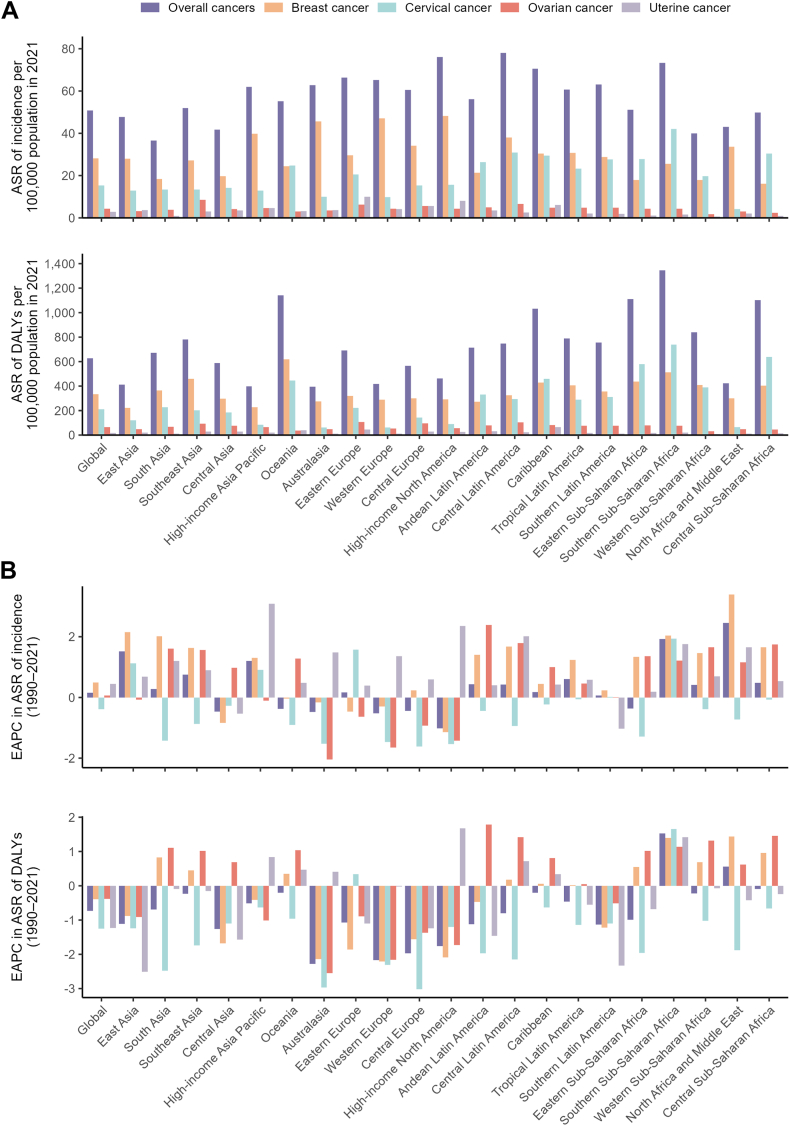
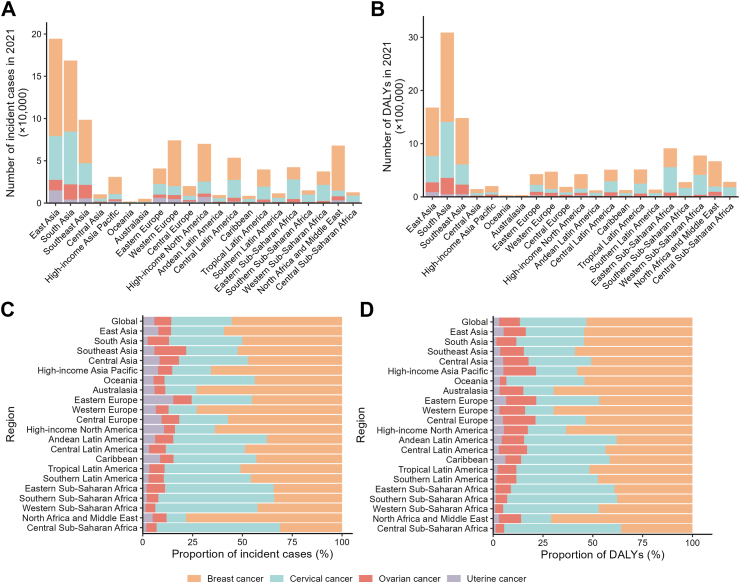
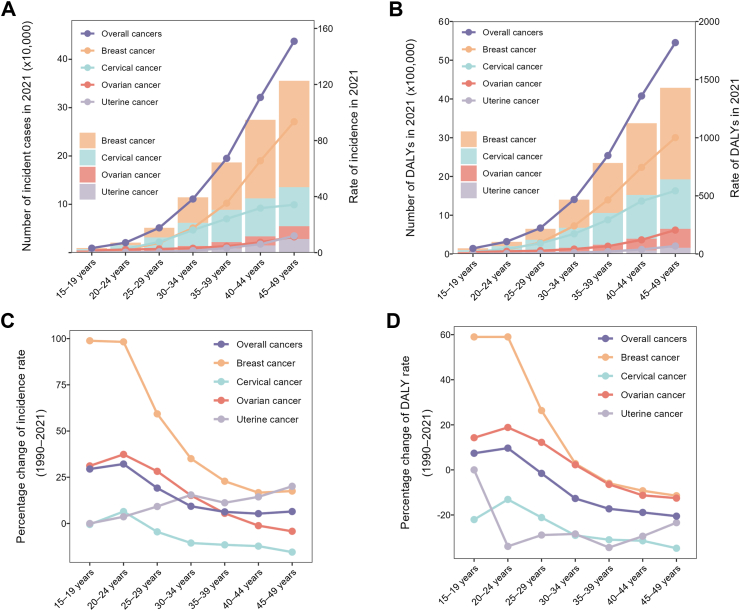
In 2021, an estimated 1,013,475 new cases of overall female cancers were reported globally, with a significant increase in age-standardised incidence rate (EAPC 0.16%), and a decrease in age-standardised DALY rate (-0.73%) from 1990 to 2021. Annual increase trends of age-standardised incidence rate were observed in all cancers, except for that in cervical cancer. Contrary, the age-standardised DALY rate decreased in all cancers. Breast and cervical cancers were prevalent among WCBA worldwide, followed by ovarian and uterine cancers, with regional disparities in the burden of four female cancers. In addition, the age-standardised incidence rates of breast, ovarian, and uterine cancers basically showed a consistent upward trend with increasing SDI, while both the age-standardised incidence and DALY rates in cervical cancer exhibited downward trends with SDI. Age-specific rates of female cancers increased with age in 2021, with the most significant changes observed in younger age groups, except for uterine cancer.
The rising global incidence of female cancers, coupled with regional variations in DALYs, underscores the urgent need for innovative prevention and healthcare strategies to mitigate the burden among WCBA worldwide.
This study was supported by the Science Foundation for Young Scholars of Sichuan Provincial People's Hospital (NO. 2022QN44 and NO. 2022QN18); the Key R&D Projects of Sichuan Provincial Department of Science and Technology (NO. 2023YFS0196); the National Natural Science Foundation of China (No. 82303701).
全球女性健康状况被低估,尤其是育龄期女性(WCBA)所承受的负担。我们旨在调查1990年至2021年WCBA中女性癌症的发病模式和趋势。
我们从《2021年全球疾病负担研究》(GBD 2021)中检索了1990年至2021年204个国家和地区WCBA(15 - 49岁)中四种主要女性癌症(乳腺癌、宫颈癌、子宫癌和卵巢癌)的发病率和伤残调整生命年(DALYs)数据。计算按年龄和社会人口指数(SDI)划分的女性癌症年龄标准化发病率和DALY率的估计年百分比变化(EAPC),以量化时间趋势。采用Spearman相关性分析来检验年龄标准化率与SDI之间的相关性。
2021年,全球估计报告了1,013,475例女性癌症新发病例,1990年至2021年年龄标准化发病率显著上升(EAPC 0.16%),年龄标准化DALY率下降(-0.73%)。除宫颈癌外,所有癌症的年龄标准化发病率均呈年度上升趋势。相反,所有癌症的年龄标准化DALY率均下降。乳腺癌和宫颈癌在全球WCBA中最为常见,其次是卵巢癌和子宫癌,四种女性癌症的负担存在地区差异。此外,乳腺癌、卵巢癌和子宫癌的年龄标准化发病率基本随SDI的增加呈一致上升趋势,而宫颈癌的年龄标准化发病率和DALY率均随SDI呈下降趋势。2021年女性癌症的年龄别发病率随年龄增加,除子宫癌外,在较年轻年龄组中变化最为显著。
全球女性癌症发病率上升,加上DALYs的地区差异,凸显了迫切需要创新的预防和医疗保健策略来减轻全球WCBA的负担。
本研究得到四川省人民医院青年学者科学基金(编号2022QN44和2022QN18);四川省科学技术厅重点研发项目(编号2023YFS0196);中国国家自然科学基金(编号82303701)的支持。