Wu Dan, An Jiye, Nan Shan, She Yutong, Duan Huilong, Deng Ning
College of Biomedical Engineering and Instrument Science, Ministry of Education Key Laboratory of Biomedical Engineering, Zhejiang University, Hangzhou, China.
Sir Run Run Shaw Hospital, School of Medicine, Zhejiang University, Hangzhou, China.
BMC Med Inform Decis Mak. 2025 May 14;25(1):183. doi: 10.1186/s12911-025-03019-2.
Health examination identifies risk factors and diseases at an early stage through a series of health examination items. In China, however, the incidence of consulting services for health examination items is low and the current health examination item package is insufficiently personalized. Therefore, we created and evaluated a clinical decision support system (CDSS) for personalized health examination items.
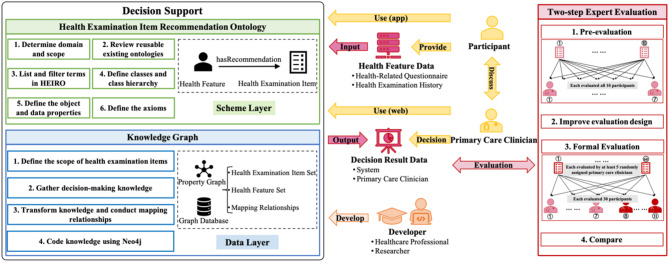
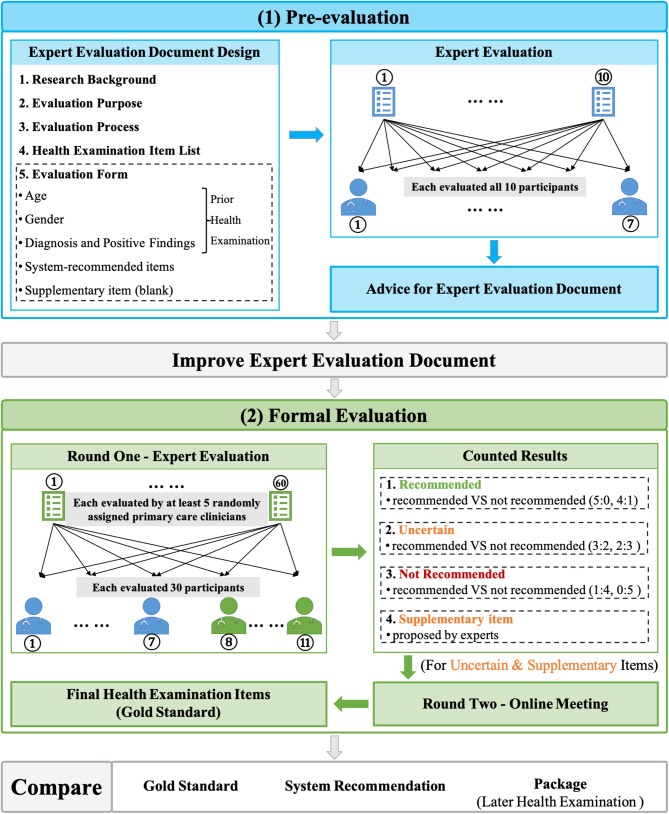
An ontology with the data properties as the core design was created to guide the knowledge expression. A knowledge graph composed of ontology-guided property graphs was developed to provide rich and clear decision-making knowledge. The system, including the web for primary care clinicians and the app for participants, was constructed to directly assist primary care clinicians through personalized and interpretable health examination item recommendations. The enter rate and mapping rate were created to evaluate the system's capability to process input health feature data. The two-step expert evaluation was designed to assess whether recommendations with several health examination items were appropriate for participants. The system recommendations and existing packages were compared to the expert's gold standard.
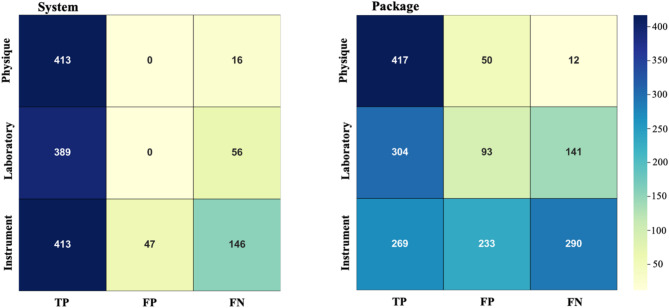
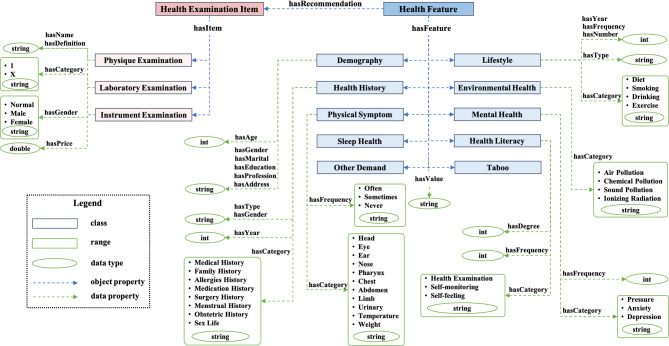
There were 15 classes, 2-level class hierarchies, 3 types of object properties, and 16 types of data properties in the health examination item recommendation ontology. Several different data properties could express a piece of complex decision-making knowledge and reduce the number of classes. There were 584 classes, 781 object properties, and 1094 data properties in the knowledge graph. Retrospective data from 70 participants, with a total of 472 health features, were selected for system evaluation. The ontology can cover 96.2% of the health features. 56.4% health features entered into the system had corresponding health examination items. The precision and recall of the system were 96.3% and 84.8%, and the packages were 72.5% and 69.1%.
The performance of this system was close to experts and outperformed the current impersonalized health examination item packages. This system could improve the personalization of health examination items and the health examination consultation services, and promote participants' engagement in the health examination.
健康检查通过一系列健康检查项目在早期识别风险因素和疾病。然而,在中国,健康检查项目咨询服务的发生率较低,且当前的健康检查项目套餐个性化不足。因此,我们创建并评估了一个用于个性化健康检查项目的临床决策支持系统(CDSS)。
创建了一个以数据属性为核心设计的本体来指导知识表达。开发了一个由本体引导的属性图组成的知识图谱,以提供丰富且清晰的决策知识。构建了该系统,包括面向基层医疗临床医生的网络端和面向参与者的应用程序,通过个性化且可解释的健康检查项目推荐直接协助基层医疗临床医生。创建了录入率和映射率来评估系统处理输入健康特征数据的能力。设计了两步专家评估来评估包含多个健康检查项目的推荐对参与者是否合适。将系统推荐和现有套餐与专家的金标准进行比较。
健康检查项目推荐本体中有15个类、2级类层次结构、3种对象属性和16种数据属性。几种不同的数据属性可以表达一条复杂的决策知识并减少类的数量。知识图谱中有584个类、781个对象属性和1094个数据属性。选择了70名参与者的回顾性数据,共472个健康特征,用于系统评估。本体可以覆盖96.2%的健康特征。录入系统的健康特征中有56.4%有相应的健康检查项目。系统的精确率和召回率分别为96.3%和84.8%,套餐的精确率和召回率分别为72.5%和69.1%。
该系统的性能接近专家水平,且优于当前非个性化的健康检查项目套餐。该系统可以提高健康检查项目的个性化程度和健康检查咨询服务水平,并促进参与者参与健康检查。