Keshavarz Maryam, Ghorbani Afsaneh, Allahqoli Leila, Sarvi Fatemeh, Salehiniya Hamid, Alkatout Ibrahim
Reproductive Sciences and Technology Research Center; Department of Midwifery and Reproductive Health, School of Nursing and Midwifery, Iran University of Medical Sciences, Tehran, Iran.
Ministry of Health and Medical Education, Tehran, Iran.
BMC Womens Health. 2025 May 15;25(1):226. doi: 10.1186/s12905-025-03735-x.
Sexual function is a particularly important aspect of pregnant women's lives that can affect mental health and family cohesion.
This study aimed to determine the effect of sexual health education on sexual function in primigravida women.
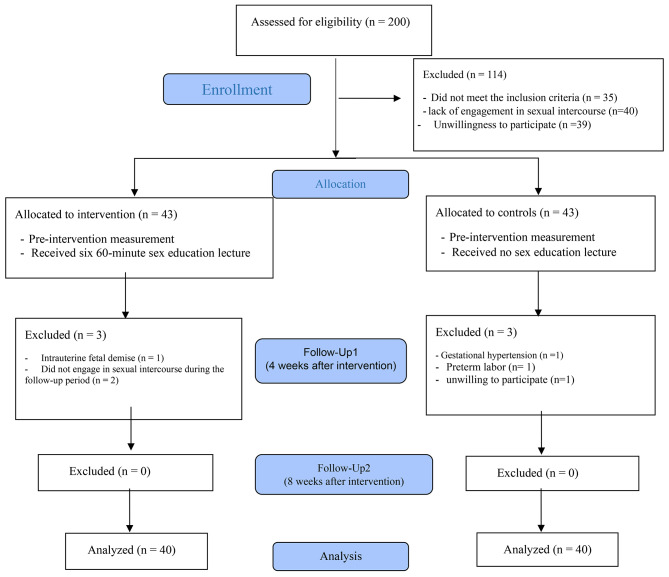
In a non-randomized study, primigravida women were divided into an intervention group (n = 43) and a control group (n = 43). The intervention group participated in six 60-minute sex education sessions, while the control group received no intervention. Both groups were monitored for 8 weeks. Sexual function was evaluated using the Female Sexual Function Index (FSFI) questionnaire before the intervention, at 4 weeks, and at 8 weeks post-intervention.
Ultimately, data from 80 patients were analyzed. The two groups did not differ significantly in terms of demographic and pre-intervention clinical characteristics. At the 4-week mark post-intervention, there was no statistically significant difference observed in the average score of the overall index of sexual performance between the pregnant women in the two groups. However, upon comparing sexual function before intervention and at 4 and 8 weeks after intervention, significant improvements were noted in desire, arousal, lubrication, orgasm, satisfaction, and pain subscale scores within the intervention group (p < 0.001). Conversely, in the control group, desire (psychological interest or motivation), arousal (physiological and emotional readiness), lubrication, and satisfaction subscale scores decreased, while the pain subscale score slightly increased between pre-intervention and the 8-week follow-up. The mean difference in the overall FSFI score before and 8 weeks after the intervention was notably higher in the intervention group (7.37 points) compared to the control group (-0.87 points (p < 0.001).
The findings of this study highlight the transformative impact of sexual health education during pregnancy. By dispelling misconceptions and enriching knowledge, such interventions have the potential to enhance the sexual function of pregnant women significantly. These results underscore the effectiveness of integrating sexual health education into routine prenatal care, emphasizing its pivotal role in promoting the overall well-being of primiparous pregnant women.
This study retrospectively registered with the Iranian Clinical of Trials Registry with IRCT registration number IRCT20090810002324N20 (08-04-2025) ( https://irct.behdasht.gov.ir/trial/82382 ).
性功能是孕妇生活中一个特别重要的方面,会影响心理健康和家庭凝聚力。
本研究旨在确定性健康教育对初产妇性功能的影响。
在一项非随机研究中,初产妇被分为干预组(n = 43)和对照组(n = 43)。干预组参加了6次每次60分钟的性教育课程,而对照组未接受干预。两组均被监测8周。在干预前、干预后4周和8周,使用女性性功能指数(FSFI)问卷对性功能进行评估。
最终,对80名患者的数据进行了分析。两组在人口统计学和干预前临床特征方面无显著差异。在干预后4周时,两组孕妇的性功能总体指数平均得分无统计学显著差异。然而,在比较干预前和干预后4周及8周的性功能时,干预组的性欲、性唤起、润滑、性高潮、满意度和疼痛子量表得分有显著改善(p < 0.001)。相反,在对照组中,干预前到8周随访期间,性欲(心理兴趣或动机)、性唤起(生理和情感准备)、润滑和满意度子量表得分下降,而疼痛子量表得分略有上升。干预组干预前和干预后8周的FSFI总分平均差异(7.37分)明显高于对照组(-0.87分,p < 0.001)。
本研究结果凸显了孕期性健康教育的变革性影响。通过消除误解和丰富知识,此类干预措施有可能显著增强孕妇的性功能。这些结果强调了将性健康教育纳入常规产前护理的有效性,强调了其在促进初产孕妇整体健康方面的关键作用。
本研究在伊朗临床试验注册中心进行了回顾性注册,注册号为IRCT20090810002324N20(2025年4月8日)(https://irct.behdasht.gov.ir/trial/82382 )