
经口内镜下胃肌切开术可改善难治性胃轻瘫患者的慢性腹泻。
Gastric peroral endoscopic myotomy improves chronic diarrhea in patients with refractory gastroparesis.
作者信息
Jaccard Maxime, Marx Mariola, Romailler Elodie, Dalex Meddy, Phillipart Marie, Caillol Fabrice, Mantziari Styliani, Godat Sébastien
机构信息
Department of Gastroenterology and Hepatology, CHUV, Lausanne, Switzerland (Maxime Jaccard, Mariola Marx, Elodie Romailler, Meddy Dalex, Marie Phillipart, Sébastien Godat).
Department of Gastroenterology, Paoli-Calmettes Institute, Marseille, France (Fabrice Caillol).
出版信息
Ann Gastroenterol. 2025 May-Jun;38(3):255-261. doi: 10.20524/aog.2025.0956. Epub 2025 Apr 28.
BACKGROUND
The main symptoms of gastroparesis are early satiety, nausea, vomiting and bloating. In our daily practice, we observed some patients presenting with concomitant chronic alteration of stool frequency. The present study describes retrospectively the impact of gastric peroral endoscopic myotomy (G-POEM) on patients presenting refractory gastroparesis and concomitant chronic diarrhea or constipation.
METHODS
This retrospective study analyzed the clinical course of patients with refractory gastroparesis and concomitant chronic alteration of stool frequency who were consecutively treated with G-POEM between January 2019 and October 2023 in a tertiary referral center.
RESULTS
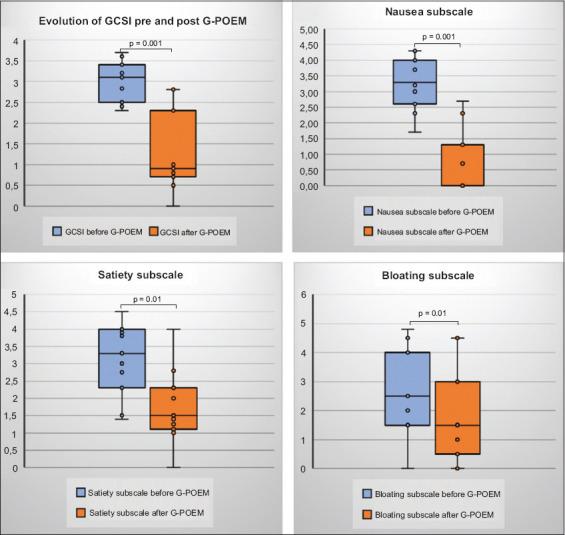
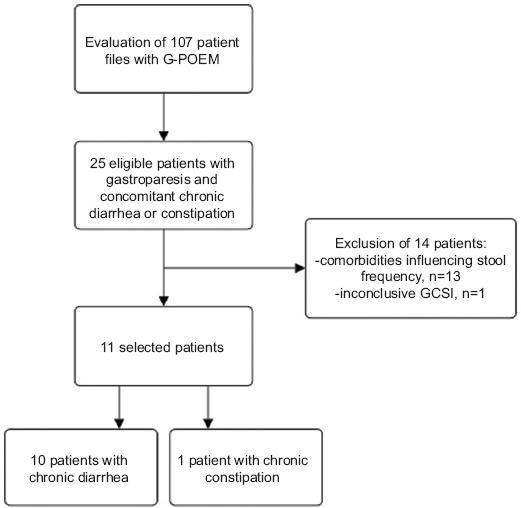
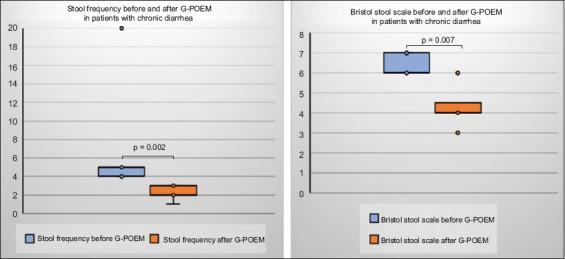
Of 107 patients with refractory gastroparesis treated by G-POEM, 11 (10.3%) patients (mean age 60.4±16.2 years, 64% female) had altered bowel frequency for >6 months without any other underlying disease (diarrhea n=10; constipation n=1). Scintigraphy confirmed delayed gastric emptying in 10/11 (91%) of cases. G-POEM was technically feasible in all patients without adverse events during or after endoscopic treatment. The median follow-up period was 170 days (interquartile range [IQR] 33-1002). In 9/11 (81%) patients, G-POEM achieved clinical success with a mean gastroparesis cardinal symptom index (GCSI) of 3.1 (interquartile range [IQR] 2.7-3.4) before, and 0.9 (IQR 0.7-1.7) after the endoscopic treatment. Normalization of bowel movements after G-POEM was observed in 9/11 (81%) of patients. Two patients had partial symptom improvement (loose bowels, but normal frequency), 1 of them without improvement of GCSI and persistent delayed emptying on scintigraphy.
CONCLUSION
Gastroparesis may present with concomitant chronic diarrhea that improves after endoscopic treatment by G-POEM.
背景
胃轻瘫的主要症状为早饱、恶心、呕吐和腹胀。在我们的日常临床工作中,我们观察到一些患者同时存在大便频率的慢性改变。本研究回顾性描述了经口内镜下胃肌切开术(G-POEM)对难治性胃轻瘫合并慢性腹泻或便秘患者的影响。
方法
这项回顾性研究分析了2019年1月至2023年10月在一家三级转诊中心连续接受G-POEM治疗的难治性胃轻瘫合并大便频率慢性改变患者的临床病程。
结果
在107例接受G-POEM治疗的难治性胃轻瘫患者中,11例(10.3%)患者(平均年龄60.4±16.2岁,64%为女性)大便频率改变超过6个月,且无任何其他基础疾病(腹泻10例;便秘1例)。闪烁扫描证实11例中的10例(91%)存在胃排空延迟。G-POEM在所有患者中技术上可行,内镜治疗期间及之后均无不良事件发生。中位随访期为170天(四分位间距[IQR]33 - 1002)。11例中的9例(81%)患者G-POEM取得临床成功,内镜治疗前胃轻瘫主要症状指数(GCSI)平均为3.1(四分位间距[IQR]2.7 - 3.4),治疗后为0.9(IQR 0.7 - 1.7)。G-POEM后11例中的9例(81%)患者排便恢复正常。2例患者症状部分改善(大便变稀,但频率正常),其中1例GCSI无改善,闪烁扫描显示胃排空持续延迟。
结论
胃轻瘫可能伴有慢性腹泻,经G-POEM内镜治疗后腹泻症状改善。
 Zotero 插件