
一项关于在心脏手术中使用经病原体灭活的血小板与未经病原体灭活的血小板校正粘弹性血小板功能检测的前瞻性非劣效性试验。
A prospective non-inferiority trial of pathogen reduced platelets compared to non-pathogen reduced platelets for correction of viscoelastic platelet function testing in cardiac surgery.
作者信息
Fontaine Magali J, Lasola Jackline J M, Martinez-Hernandez Aidaelis, Marshall Juliana N, Bentzen Soren, Zhan Min, Lokhandwala Parvez M, Tanaka Kenichi, Villa Carlos H, Jones Alexis, Atreya Chintamani D, Henderson Reney A
机构信息
Department of Pathology, University of Maryland School of Medicine, Baltimore, Maryland, USA.
Department of Epidemiology and Public Health, University of Maryland School of Medicine, Baltimore, Maryland, USA.
出版信息
Transfusion. 2025 Jul;65(7):1293-1306. doi: 10.1111/trf.18281. Epub 2025 May 15.
BACKGROUND
Cardiac surgery on cardiopulmonary bypass (CPB) may alter platelet (PLT) function causing bleeding. The goal of this study is to evaluate the hemostatic effect of PRT-PLTs compared to untreated PLTs stored in platelet additive solution (PAS) following transfusion in bleeding patients undergoing cardiac surgery on CPB.
METHODS
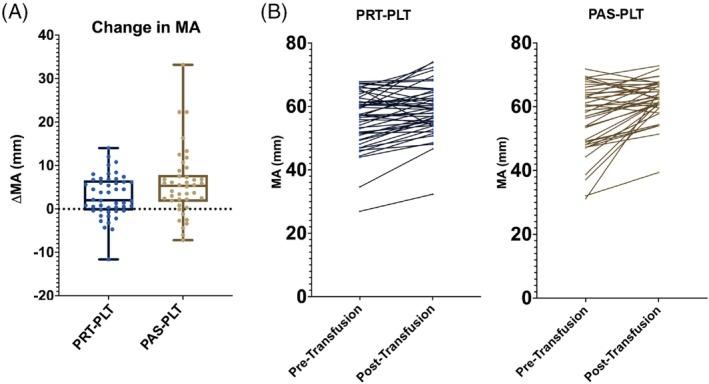
In this single-center, prospective single-blinded two-arm noninferiority trial, patients being weaned off CPB were allocated to either a PRT-PLT or a standard PAS-PLT. The primary outcome was the change in maximum amplitude (ΔMA) on thromboelastographic testing (TEG) from pre- to post-transfusion. The non-inferiority margin was chosen as 50% of the ΔMA observed with PAS-PLT using a 1-sided 95% confidence interval. The secondary outcomes included the volume of chest tube drainage (CTD) and the number of blood products transfused during the first 24 h post-surgery.
RESULTS
A modified intention-to-treat analysis included 90 patients (48 PRT-PLTs; 42 PAS-PLTs). The ΔMA for PRT-PLT was 2.93 mm (95% CI 1.52-4.34) and was lower than that achieved with PAS-PLT at 5.68 mm (95% CI 3.26-8.09) (2-tailed p = .052). The ratio of ΔMA for PRT-PLT relative to PAS-PLT was estimated at .52 with a 90% confidence interval (.29, .89) and did not meet the non-inferiority criterion (>.5). The CTD and the number of blood products transfused during the first 24 h post-surgery were similar in both arms.
CONCLUSION
PRT-PLT transfusion results in lower responses in viscoelastic testing compared to PAS-PLT, although clinical outcomes with respect to blood component utilization and chest tube drainage were similar.
背景
体外循环(CPB)下的心脏手术可能会改变血小板(PLT)功能,导致出血。本研究的目的是评估在接受CPB心脏手术的出血患者输血后,与储存在血小板添加剂溶液(PAS)中的未处理血小板相比,PRT-PLT的止血效果。
方法
在这项单中心、前瞻性单盲双臂非劣效性试验中,脱离CPB的患者被分配到PRT-PLT组或标准PAS-PLT组。主要结局是输血前后血栓弹力图检测(TEG)上最大振幅的变化(ΔMA)。使用单侧95%置信区间,将非劣效性界值设定为PAS-PLT观察到的ΔMA的50%。次要结局包括术后24小时内胸腔引流管引流量(CTD)和输注的血液制品数量。
结果
改良意向性分析纳入了90例患者(48例PRT-PLT;42例PAS-PLT)。PRT-PLT的ΔMA为2.93mm(95%CI 1.52-4.34),低于PAS-PLT的5.68mm(95%CI 3.26-8.09)(双侧p = 0.052)。PRT-PLT相对于PAS-PLT的ΔMA比值估计为0.52,90%置信区间为(0.29,0.89),未达到非劣效性标准(>0.5)。两组术后24小时内的CTD和输注的血液制品数量相似。
结论
与PAS-PLT相比,PRT-PLT输血导致粘弹性检测中的反应较低,尽管在血液成分利用和胸腔引流方面的临床结局相似。

 Zotero 插件