Chisanga Musonda, M'kandawire Ethel, Choongo Kennedy, Kalunga Gerald, Yabe John
Department of Para-Clinical Studies, School of Veterinary Medicine, The University of Zambia, P.O Box 32379, Lusaka, Zambia.
Department of Disease Control, School of Veterinary Medicine, The University of Zambia, P.O 32379, Lusaka, Zambia.
Environ Sci Pollut Res Int. 2025 May;32(23):13904-13917. doi: 10.1007/s11356-025-36506-0. Epub 2025 May 15.
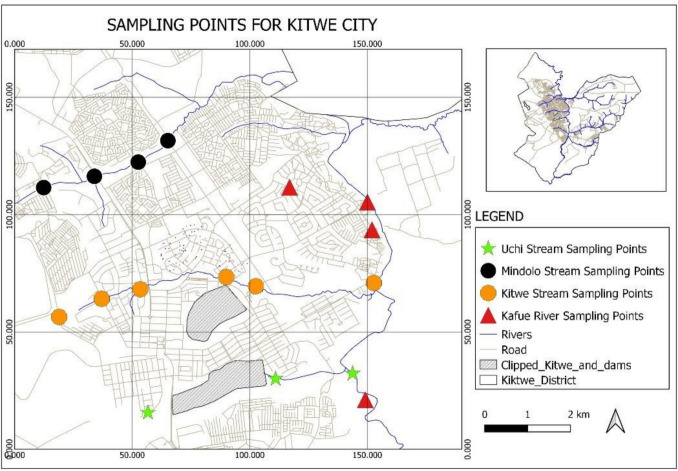
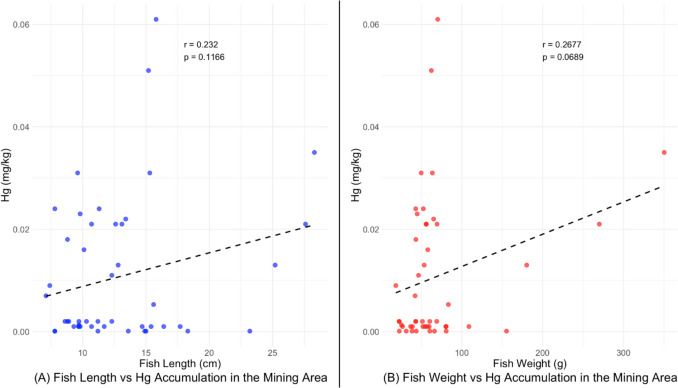
Mercury (Hg) is a heavy metal of global concern because of its persistence in the environment and its ability to bioaccumulate and biomagnify in ecosystems. Despite evidence of extensive environmental pollution in the Copperbelt Province, few studies have investigated Hg contamination in the Kafue River and its tributaries in Kitwe District, Zambia. Total Hg concentrations were determined in soil, sediments, and tilapia by inductively coupled plasma mass spectrometer (ICP-MS) from the mining areas and non-mining areas. There were significant differences in the population means for soil samples (Mean = 1.066, Mean ) = 0.041, p ) and sediment samples (Mean = 1.304, Mean = 0.034), p ) between mining and non-mining areas. There were also statistically significant differences in the population means for fish samples (Mean = 0.015, Mean = 0.007, p ) between mining and non-mining areas. The levels of Hg in the soil and sediments from the mining area were higher than the United States Environmental Protection Agency (USEPA) reference values of 0.3 mg/kg and 0.2 mg/kg, respectively. There was a weak positive correlation between the size of the fish (length) and Hg accumulation in the Kitwe mining area (r = 0.232, P = 0.1166). The observed correlation between Hg accumulation and length of fish was not statistically significant (P > 0.05). The EDI from the consumption of fish from the mining area was below the USEPA and WHO/FAO maximum tolerable daily intake of 0.1 µg/kg/day and 0.23 µg/kg, respectively. The THQ < 1 was also reported in the current study, suggesting that the exposure level may not cause adverse health effects during a lifetime in the human population. Although the EDI and THQ < 1 in the current study were below the USEPA and WHO/FAO maximum tolerable limit, the presence of Hg in fish in this area must be monitored due to its ability to bioaccumulate in large and predatory fish. The lower EDI value reported in the current study might be attributed to the smaller size of the tilapia fish specimens, resulting in low bioaccumulation of Hg. Since the Hg levels in sediments were above the USEPA limit, we recommend further studies on the bioavailability of Hg in humans and other fish species in the region, particularly carnivorous fish, due to Hg biomagnification to offer a clearer perspective on the environmental and health impacts.
汞(Hg)是一种备受全球关注的重金属,因为它在环境中具有持久性,并且能够在生态系统中生物累积和生物放大。尽管有证据表明铜带省存在广泛的环境污染,但很少有研究调查赞比亚基特韦区卡富埃河及其支流中的汞污染情况。通过电感耦合等离子体质谱仪(ICP-MS)测定了矿区和非矿区土壤、沉积物及罗非鱼中的总汞浓度。矿区和非矿区土壤样本(均值 = 1.066,均值 = 0.041,p )以及沉积物样本(均值 = 1.304,均值 = 0.034)的总体均值存在显著差异(p )。矿区和非矿区鱼类样本的总体均值也存在统计学显著差异(均值 = 0.015,均值 = 0.007,p )。矿区土壤和沉积物中的汞含量分别高于美国环境保护局(USEPA)0.3 mg/kg和0.2 mg/kg的参考值。在基特韦矿区,鱼的大小(长度)与汞积累之间存在弱正相关(r = 0.232,P = 0.1166)。观察到的汞积累与鱼长度之间的相关性无统计学意义(P > 0.05)。矿区鱼类消费的估计每日摄入量(EDI)分别低于USEPA和世界卫生组织/联合国粮农组织(WHO/FAO)的每日最大可耐受摄入量0.1 μg/kg/天和0.23 μg/kg。本研究还报告了危害商数(THQ)< 1,这表明该暴露水平在人群一生中可能不会导致不良健康影响。尽管本研究中的EDI和THQ < 1低于USEPA和WHO/FAO的最大可耐受限值,但由于汞在大型和掠食性鱼类中具有生物累积能力,该地区鱼类中汞的存在情况仍须监测。本研究报告的较低EDI值可能归因于罗非鱼样本尺寸较小,导致汞的生物累积量较低。由于沉积物中的汞含量高于USEPA限值,鉴于汞的生物放大作用,我们建议对该地区人类和其他鱼类物种(特别是肉食性鱼类)中汞的生物有效性进行进一步研究,以便更清楚地了解其对环境和健康的影响。