Dai Zhenwei, Liu Xin, Jing Shu, Wang Hao, Huang Yiman, Fu Jiaqi, Wu Yijin, Zhang Ling, Han Bicheng, Su Xiaoyou
Peking University Sixth Hospital, Peking University Institute of Mental Health, NHC Key Laboratory of Mental Health (Peking University), National Clinical Research Center for Mental Disorders (Peking University Sixth Hospital), Beijing, China.
School of Population Medicine and Public Health, Chinese Academy of Medical Sciences & Peking Union Medical College, Beijing, China.
BMC Psychiatry. 2025 May 15;25(1):492. doi: 10.1186/s12888-025-06886-1.
Middle-aged and elderly patients with cardiovascular disease (CVD) who have recovered from SARS-CoV-2 infection may experience depressive symptoms due to the physical and psychological impact of the pandemic.
To investigate the prevalence and predictors of depressive symptoms among the middle-aged and elderly with CVD who have recovered from SARS-CoV-2 infection in Wuhan, China, and to develop a prediction model for depressive symptoms.
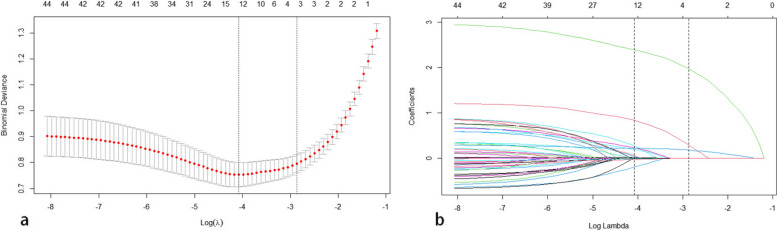
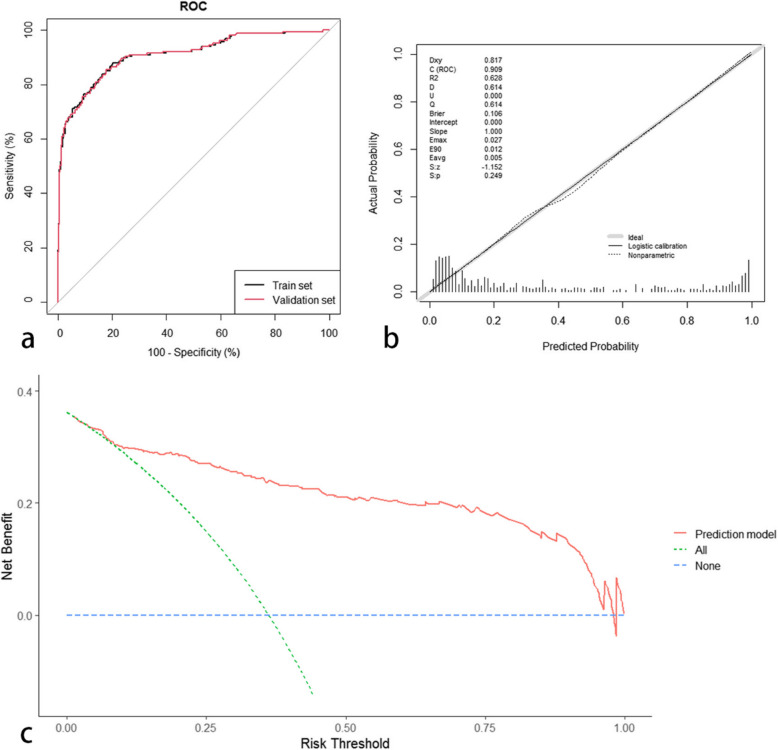
A cross-sectional study was conducted among 462 former SARS-CoV-2 middle-aged and elderly patients with CVD in Jianghan District, Wuhan, China from June 10 to July 25, 2021. Depressive symptoms were assessed by the Patient Health Questionnaire-9 (PHQ-9). Potential predictors of depressive symptoms were selected by the least absolute shrinkage and selection operator (LASSO) regression. A prediction model was developed by random forest (RF) and logistic regression models and compared by the area under the receiver operating characteristic curve (AUROC). The discrimination, calibration, and practical utility of the prediction model were evaluated by the receiver operating characteristic (ROC) curve, calibration curve, and decision curve analysis (DCA). Bootstrap sampling was used for internal validation.
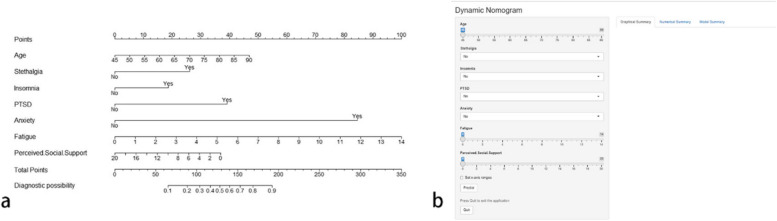
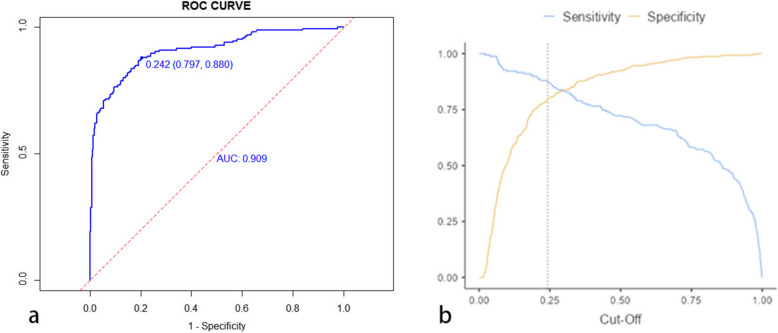
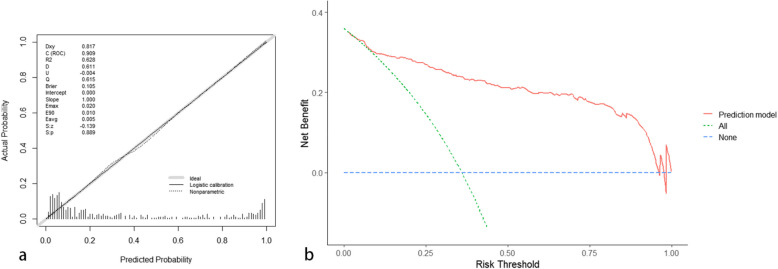
The prevalence of depressive symptoms among the participants was 35.93%. The prediction model included age, stethalgia after recovery, insomnia after recovery, post-traumatic stress disorder (PTSD), anxiety, fatigue, and perceived social support as predictors. The AUROC of the logistic regression model was 0.909 (95%CI: 0.879 ~ 0.939), indicating good discrimination. The calibration curve showed good calibration. The DCA showed that the prediction model had a net benefit for a wide range of risk thresholds. The internal validation confirmed the stability of the prediction model.
Depressive symptoms are common among middle-aged and elderly CVD patients who have recovered from SARS-CoV-2 infection in Wuhan, China. A prediction model with satisfactory performance was developed to estimate the risk of depressive symptoms among this population. Interventions targeting long COVID symptoms and social support should be considered to prevent depressive symptoms in CVD patients.
从新型冠状病毒肺炎(SARS-CoV-2)感染中康复的中老年心血管疾病(CVD)患者可能会因疫情的身心影响而出现抑郁症状。
调查中国武汉从SARS-CoV-2感染中康复的中老年CVD患者抑郁症状的患病率及预测因素,并建立抑郁症状预测模型。
2021年6月10日至7月25日,在中国武汉江汉区对462名曾感染SARS-CoV-2的中老年CVD患者进行了一项横断面研究。采用患者健康问卷9项(PHQ-9)评估抑郁症状。通过最小绝对收缩和选择算子(LASSO)回归选择抑郁症状的潜在预测因素。采用随机森林(RF)和逻辑回归模型建立预测模型,并通过受试者操作特征曲线下面积(AUROC)进行比较。通过受试者操作特征(ROC)曲线、校准曲线和决策曲线分析(DCA)评估预测模型的辨别力、校准度和实用性。采用自助抽样进行内部验证。
参与者中抑郁症状的患病率为35.93%。预测模型纳入的预测因素包括年龄、康复后胸痛、康复后失眠、创伤后应激障碍(PTSD)、焦虑、疲劳和感知到的社会支持。逻辑回归模型的AUROC为0.909(95%CI:0.879~0.939),表明辨别力良好。校准曲线显示校准良好。DCA表明,预测模型在广泛的风险阈值范围内具有净效益。内部验证证实了预测模型的稳定性。
在中国武汉,从SARS-CoV-2感染中康复的中老年CVD患者中抑郁症状很常见。开发了一个性能良好的预测模型来估计该人群中抑郁症状的风险。应考虑针对新冠后症状和社会支持的干预措施,以预防CVD患者出现抑郁症状。