López-Pineda Adriana, Martinez-Muñoz María, Nouni-García Rauf, Esquerdo-Arroyo Amanda, Carbonell-Soliva Álvaro, Ramirez-Familia Elizabeth, Tomás-Rodríguez Mª Isabel, Quesada Jose A, C Concepción Carratalá-Munuera, Gil-Guillén Vicente F
Department of Clinical Medicine, University of Miguel Hernandez Elche, Sant Joan d'Alacant, Comunidad Valenciana, Spain.
Research Network On Chronicity Primary Care and Prevention and Health Promotion, Barcelona, Spain.
Syst Rev. 2025 May 15;14(1):110. doi: 10.1186/s13643-025-02853-9.
Adherence to statin therapy is crucial for reducing the recurrence of cardiovascular events. Numerous methods exist to measure medication adherence, including those based on prescription data, patient self-report, medication counting, and direct methods. It is important to determine which of these methods are appropriate for use in clinical practice. This systematic review aimed to identify the methods used to measure adherence and persistence to statins in patients undergoing cardiovascular secondary prevention and to evaluate the validity indicators of these methods.
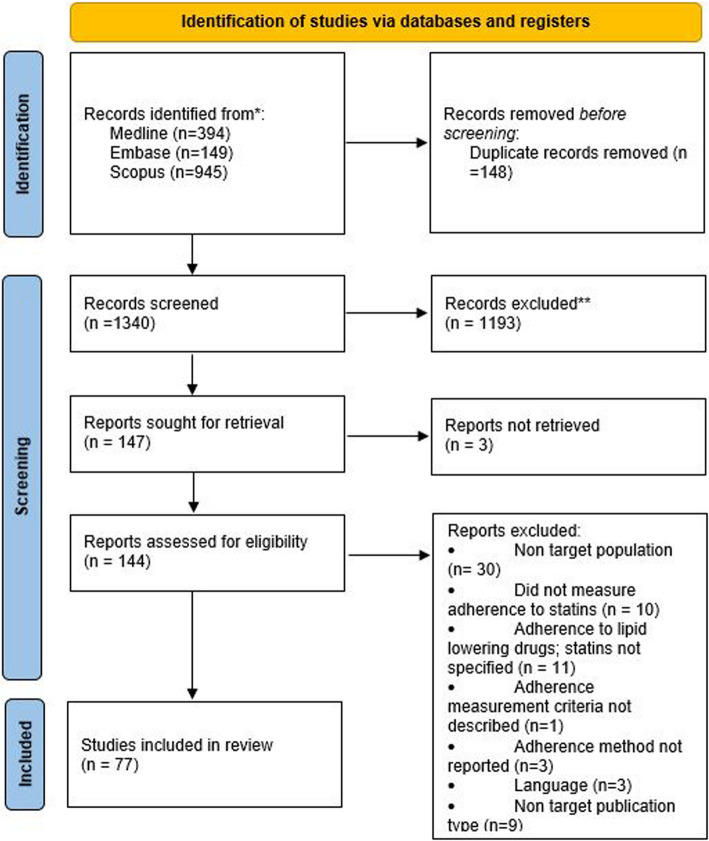
This systematic review included studies reporting methods to measure adherence and/or persistence to statins in cardiovascular secondary prevention. Medline, Embase, and Scopus databases were searched from inception to February 2025. Rayyan was used for the study selection and extraction data processes. Validity indicators of the adherence/persistence methods were collected; it was reported. Risk of bias of studies reporting the method validity was evaluated using the COSMIN (Consensus-based Standards for the Selection of Health Measurement Instruments) tool.
A total of 77 studies were included. Regarding adherence measurement, the most frequently used method was prescription refill records (n = 55) and self-report methods (n = 20). Electronic monitoring methods (n = 2), self-perceived adherence by physician (n = 1), and pill counting (n = 1) were less frequently used methods. Direct methods, using HPLC-MS/MS, were used in combination with other indirect methods (n = 5). For measuring persistence, prescription refill records were the predominant method (n = 9), while self-report methods were used in three studies, and one study used a standardized questionnaire. Several of the indirect methods have validity indicators for measuring adherence in different study populations and to different medications. Only one study provides validity indicators for the MAT questionnaire specifically adapted for statins.
The methods for measuring adherence to statins in secondary cardiovascular prevention were predominantly indirect, relying on prescription and supply records and self-report methods. Pill counting, electronic monitoring, and direct measurement via LC-MS/MS were less commonly used. Persistence was primarily measured through prescription refill records. None of the indirect methods was validated; thus, their use for measuring adherence to statins is not recommended. There is a need for new validated tools, incorporating a gender perspective, to measure adherence to statins in this population.
PROSPERO CRD42023463981.
坚持他汀类药物治疗对于降低心血管事件复发至关重要。存在多种测量药物依从性的方法,包括基于处方数据、患者自我报告、药物计数和直接测量法。确定这些方法中哪些适用于临床实践很重要。本系统评价旨在确定用于测量心血管二级预防患者他汀类药物依从性和持续性的方法,并评估这些方法的有效性指标。
本系统评价纳入了报告心血管二级预防中测量他汀类药物依从性和/或持续性方法的研究。检索了Medline、Embase和Scopus数据库,检索时间从建库至2025年2月。使用Rayyan进行研究筛选和数据提取过程。收集了依从性/持续性方法的有效性指标,并进行了报告。使用COSMIN(基于共识的健康测量工具选择标准)工具评估报告方法有效性的研究的偏倚风险。
共纳入77项研究。在依从性测量方面,最常用的方法是处方 refill 记录(n = 55)和自我报告方法(n = 20)。电子监测方法(n = 2)、医生自我感知的依从性(n = 1)和药丸计数(n = 1)是较少使用的方法。使用HPLC-MS/MS的直接测量法与其他间接方法联合使用(n = 5)。在测量持续性方面,处方 refill 记录是主要方法(n = 9),而三项研究使用了自我报告方法,一项研究使用了标准化问卷。几种间接方法在不同研究人群和不同药物中具有测量依从性的有效性指标。只有一项研究提供了专门适用于他汀类药物的MAT问卷的有效性指标。
心血管二级预防中测量他汀类药物依从性的方法主要是间接方法,依赖于处方和供应记录以及自我报告方法。药丸计数、电子监测和通过LC-MS/MS进行的直接测量较少使用。持续性主要通过处方 refill 记录来测量。没有一种间接方法得到验证;因此,不建议使用它们来测量他汀类药物的依从性。需要新的经过验证的工具,纳入性别视角,以测量该人群中他汀类药物的依从性。
PROSPERO CRD42023463981。