Chen Shu-Ting, Huang Shih-Ting, Shau Wen-Yi, Lai Chao-Lun, Li Jim Z, Fung Selwyn, Tse Vicki C, Lai Mei-Shu
Institute of Epidemiology and Preventive Medicine, College of Public Health, National Taiwan University, No. 17, Xu-Zhou Road, Zhongzheng District, Taipei, Taiwan, 10055.
Pfizer Inc, No 177, Zhongzheng East Road, Tamsui District, New Taipei City, Taiwan, 25159.
BMC Cardiovasc Disord. 2019 Mar 15;19(1):62. doi: 10.1186/s12872-019-1032-4.
Despite the recommendations of statins treatment for secondary prevention of atherosclerotic cardiovascular disease (ASCVD), treatment adherence and persistence are still a concern. This study examined the real world practice of long-term adherence and persistence to statins treatment initiated after hospital discharge for ASCVD, and their associated factors in a nationwide cohort.
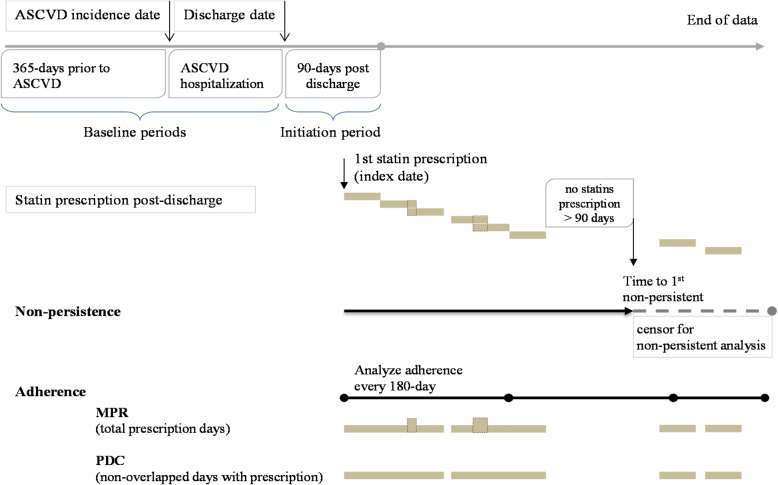
Post discharge statin prescriptions between 2006 and 2012 were extracted from the Taiwan National Health Insurance claims database. Good adherence, defined as proportion of days covered (PDC) ≥0.8 and mean medication possession ratio (MPR), was measured every 180-day period. Non-persistence was defined on the date patients failed to refill statin for 90 days after the end of the last prescription. Their associations with influential factors were analyzed using a generalized estimating equation and Cox's proportional hazard model.
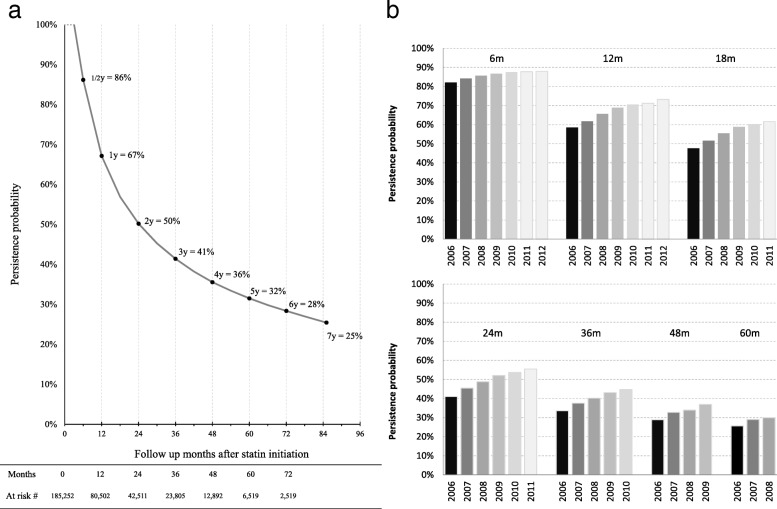
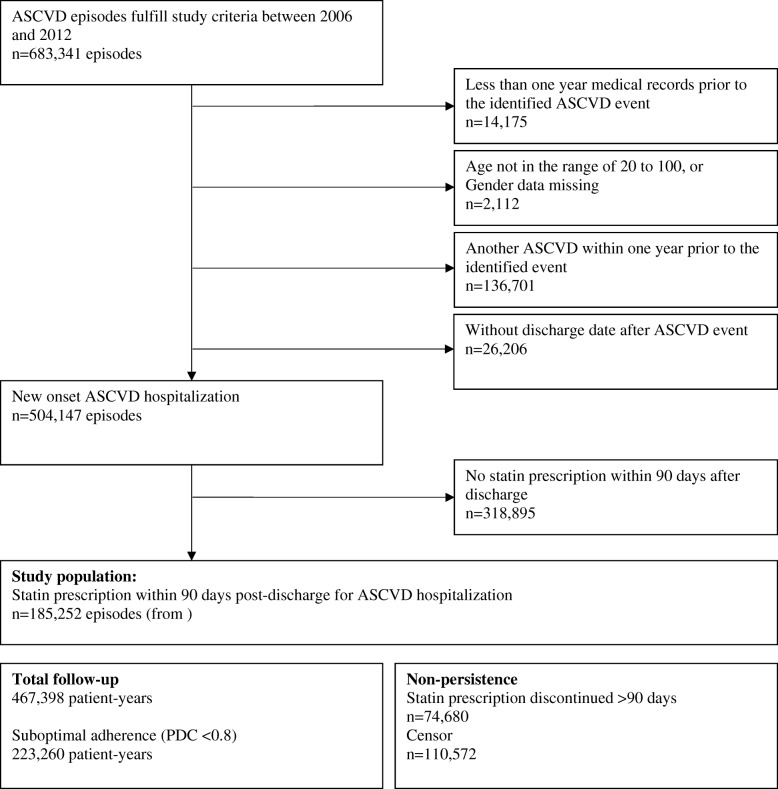
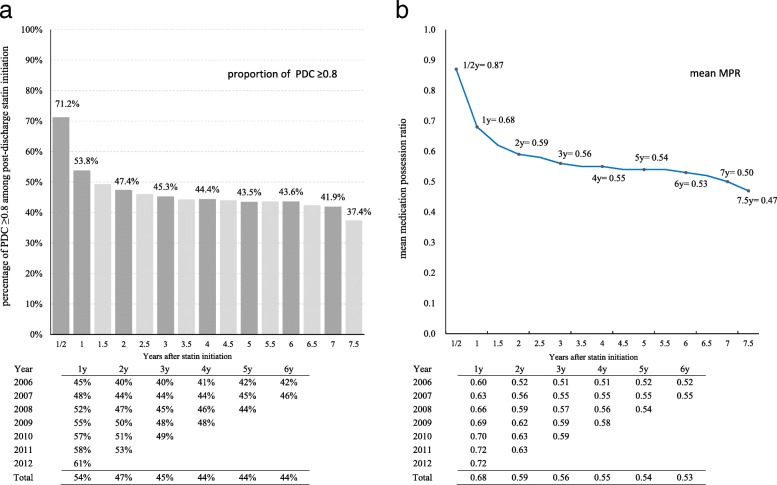
There was a total of 185,252 post-discharge statin initiations (from 169,624 patients) and followed for 467,398 patient-years in the study cohort. Percentage of good adherence (mean MPR) was 71% (0.87) at 6-months; declined to 54% (0.68), 47% (0.59), and 42% (0.50) at end of year 1, 2, and 7, respectively. Persistence in statin treatment was 86, 67, 50, and 25% at 6-month, 1-, 2-, and 7-year, respectively. Comparing the statin-cohort initiated from year 2006 to 2012, 1-year persistence increased from 58 to 73%, and 1-year good adherence improved from 45 to 61%. Factors associated with sub-optimal adherence and non-persistence included: prescription by primary care clinics or non-cardiology specialties; patients' age > 75 years; no history of previous statin use; ASCVD events with ischemic stroke diagnosis; comorbidities of renal disease, liver disease, depression, and chronic obstructive pulmonary disease.
Despite the improving trends, long-term adherence and persistence of statin treatment were suboptimal in Taiwan. Strategies to maintain statin treatment adherence and persistence need to be implemented to further enhance the positive trend.
尽管有他汀类药物用于动脉粥样硬化性心血管疾病(ASCVD)二级预防的建议,但治疗依从性和持续性仍是一个问题。本研究调查了出院后因ASCVD开始他汀类药物治疗的长期依从性和持续性的实际情况,以及在全国队列中的相关因素。
从台湾国民健康保险理赔数据库中提取2006年至2012年出院后的他汀类药物处方。每180天测量一次良好依从性,定义为覆盖天数比例(PDC)≥0.8和平均药物持有率(MPR)。非持续性定义为患者在上次处方结束后90天内未重新开具他汀类药物的日期。使用广义估计方程和Cox比例风险模型分析它们与影响因素的关联。
研究队列中共有185,252例出院后开始他汀类药物治疗(来自169,624名患者),随访467,398患者年。6个月时良好依从性(平均MPR)百分比为71%(0.87);在第1、2和7年末分别降至54%(0.68)、47%(0.59)和42%(0.50)。他汀类药物治疗的持续性在6个月、1年、2年和7年时分别为86%、67%、50%和25%。比较2006年至2012年开始的他汀类药物队列,1年持续性从58%增加到73%,1年良好依从性从45%提高到61%。与依从性欠佳和非持续性相关的因素包括:由基层医疗诊所或非心脏病专科开具处方;患者年龄>75岁;既往无他汀类药物使用史;诊断为缺血性中风的ASCVD事件;肾病、肝病、抑郁症和慢性阻塞性肺疾病的合并症。
尽管有改善趋势,但台湾他汀类药物治疗的长期依从性和持续性仍不理想。需要实施维持他汀类药物治疗依从性和持续性的策略,以进一步加强这一积极趋势。