Najafpour Zahra, Golmakani Mohammad-Taghi, Moosavi-Nasab Marzieh, Hosseini Seyed Mohammad Hashem, Niakousari Mehrdad
Department of Food Science and Technology, School of Agriculture Shiraz University Shiraz Iran.
Food Sci Nutr. 2025 May 14;13(5):e70199. doi: 10.1002/fsn3.70199. eCollection 2025 May.
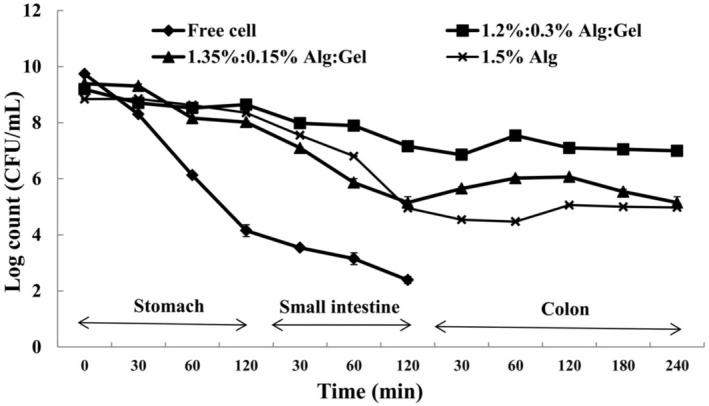
In the present research, we aimed to create a novel controlled-release device using two polymeric systems: beads of alginate hydrogel embedded with gellan fluid gel that contained cells. Three different formulations, 1.5% alginate (Alg), 1.35%:0.15% alginate:gellan (Alg:Gel), and 1.2%:0.3% (Alg:Gel), were used in this research. We investigated the effect of this system on the physical properties of beads and probiotic viability, as well as application in sour cherry juice (for 8 weeks). The results showed that the presence of gellan fluid gel in the alginate microcapsules increased the hardness and diameter of the beads from 1.15 to 3.43 N and 1.71 to1.87 mm, respectively. Also, this system improved the viability of the microencapsulated bacteria under simulated gastrointestinal and thermal conditions (final counts of 7.17 and 7.00 logs CFU/mL, respectively). Regarding the probiotic viability during 28 days of storage (-18°C, 4°C, and 25°C), the counts of all treatments decreased during the storage, but the best results were observed at the freezing temperature (7.85 log CFU/mL). Raman confocal microscopy showed that the wall thickness of beads decreased by increasing gellan fluid gel from 10.3 to 8.6 μm. In the case of sour cherry juice, the viability of cells decreased in the range of 7.4-8.7 log CFU/mL, vitamin C in the range of 0.45-1.14 mg/L, and phenolic content in the range of 0.42-0.62 mg/L at the end of the storage period. As a result, the samples containing encapsulated , especially alginate/gellan fluid gel beads, showed better results. In summary, the beads made from 1.2% alginate and 0.3% gellan fluid gel proved to be an effective delivery and release system for cells and application in sour cherry juice.
在本研究中,我们旨在使用两种聚合物体系创建一种新型控释装置:包裹含有细胞的结冷胶流体凝胶的海藻酸盐水凝胶珠。本研究使用了三种不同配方,即1.5%海藻酸盐(Alg)、1.35%:0.15%海藻酸盐:结冷胶(Alg:Gel)和1.2%:0.3%(Alg:Gel)。我们研究了该体系对珠子物理性质和益生菌活力的影响,以及在酸樱桃汁中的应用(为期8周)。结果表明,海藻酸盐微胶囊中结冷胶流体凝胶的存在分别使珠子的硬度从1.15 N增加到3.43 N,直径从1.71 mm增加到1.87 mm。此外,该体系在模拟胃肠道和热条件下提高了微囊化细菌的活力(最终计数分别为7.17和7.00 log CFU/mL)。关于在-18°C、4°C和25°C储存28天期间的益生菌活力,所有处理的计数在储存期间均下降,但在冷冻温度下观察到最佳结果(7.85 log CFU/mL)。拉曼共聚焦显微镜显示,随着结冷胶流体凝胶的增加,珠子的壁厚从10.3μm降至8.6μm。在酸樱桃汁的情况下,储存期结束时细胞活力在7.4 - 8.7 log CFU/mL范围内下降,维生素C在0.45 - 1.14 mg/L范围内下降,酚类含量在0.42 - 0.62 mg/L范围内下降。结果,含有微囊化的样品,尤其是海藻酸盐/结冷胶流体凝胶珠,显示出更好的结果。总之,由1.2%海藻酸盐和0.3%结冷胶流体凝胶制成的珠子被证明是一种有效的细胞递送和释放系统,并可应用于酸樱桃汁中。