Li Junlong, Zhao Tiancheng, Liu Zhiling, Chen Li, Wang Xiuli, Pan Jay
Sichuan Vocational College of Health and Rehabilitation, Zigong, China.
HEOA Group, West China School of Public Health and West China Fourth Hospital, Sichuan University, Chengdu, China.
Inquiry. 2025 Jan-Dec;62:469580251337232. doi: 10.1177/00469580251337232. Epub 2025 May 16.
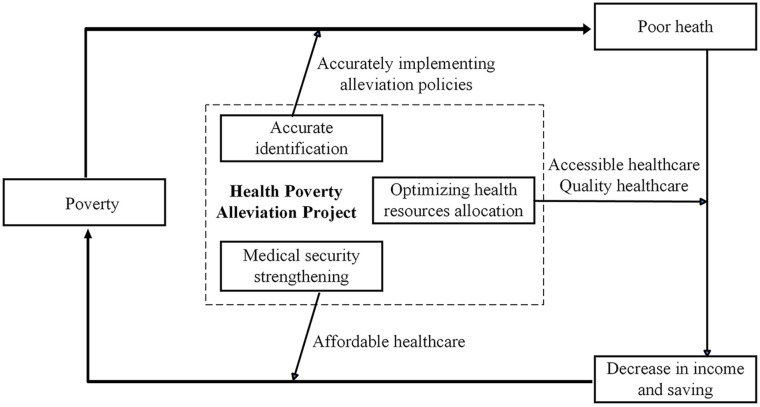
Poverty eradication and good health and well-being are at the core of Sustainable Development Goals (SDGs) concerns. As illness greatly contributes to poverty, addressing health poverty is crucial to combat the broader issue. Global poverty reduction (PR) efforts currently face significant challenges. Remarkably, China accelerated its poverty alleviation efforts in 2015 with the implementation of the Health Poverty Alleviation Project. However, existing knowledge about China's health PR policies is scattered across the literature, which impedes a comprehensive understanding among researchers and practitioners. This study seeks to bridge knowledge gap as input for further research by synthesizing relevant policies and literature. It reviews China's 12 policies on health PR since 2015, analyzes the governance logic and key governance initiatives for health PR, and assesses the effectiveness of governance in this area by reviewing 27 pieces of literature. Most studies show that China's policies to alleviate health poverty have enhanced PR. China initially established a nationwide, systematic, and coordinated health poverty governance system, which demonstrated good PR effects. These insights offer valuable lessons for the global poverty reduction agenda, such as accurate identification of the poor, systematic implementation of health PR, and sustained promotion of health PR. We hope that these efforts will help some nations or regions optimize their PR initiatives and advance the cause of eradicating poverty worldwide.
消除贫困以及促进健康和福祉是可持续发展目标(SDGs)关注的核心。由于疾病是导致贫困的重要因素,解决健康贫困问题对于应对更广泛的贫困问题至关重要。当前全球减贫努力面临重大挑战。值得注意的是,中国于2015年通过实施健康扶贫工程加速了扶贫工作。然而,关于中国健康扶贫政策的现有知识分散在各种文献中,这妨碍了研究人员和从业者的全面理解。本研究旨在通过综合相关政策和文献来弥合知识差距,为进一步研究提供参考。它回顾了中国自2015年以来的12项健康扶贫政策,分析了健康扶贫的治理逻辑和关键治理举措,并通过回顾27篇文献评估了该领域治理的有效性。大多数研究表明,中国缓解健康贫困的政策增强了减贫效果。中国初步建立了全国性、系统性和协调性的健康贫困治理体系,展现出良好的减贫成效。这些见解为全球减贫议程提供了宝贵经验,例如精准识别贫困人口、系统实施健康扶贫以及持续推进健康扶贫。我们希望这些努力将有助于一些国家或地区优化其减贫举措,并推动全球消除贫困事业的发展。