Karan Anup, Yip Winnie, Mahal Ajay
Indian Institute of Public Health Delhi (IIPHD), Public Health Foundation of India, Delhi NCR, India.
Department of Global Health and Population, Harvard T. H. Chan School of Public Health, Harvard University, Boston, USA.
Soc Sci Med. 2017 May;181:83-92. doi: 10.1016/j.socscimed.2017.03.053. Epub 2017 Mar 27.
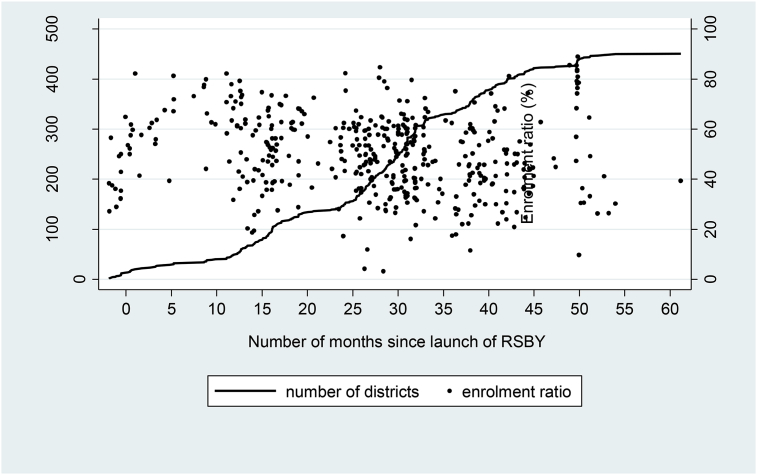
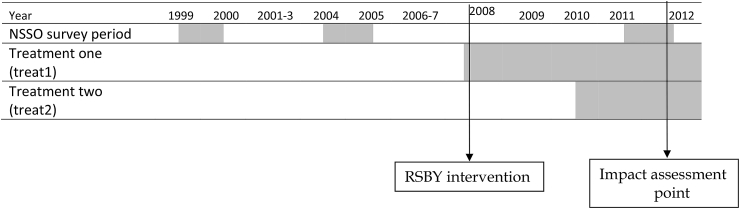
India launched the 'Rashtriya Swasthya Bima Yojana' (RSBY) health insurance scheme for the poor in 2008. Utilising 3 waves (1999-2000, 2004-05 and 2011-12) of household level data from nationally representative surveys of the National Sample Survey Organisation (NSSO) (N = 346,615) and district level RSBY administrative data on enrolment, we estimated causal effects of RSBY on out-of-pocket expenditure. Using 'difference-in-differences' methods on households in matched districts we find that RSBY did not affect the likelihood of inpatient out-of-pocket spending, the level of inpatient out of pocket spending or catastrophic inpatient spending. We also do not find any statistically significant effect of RSBY on the level of outpatient out-of-pocket expenditure and the probability of incurring outpatient expenditure. In contrast, the likelihood of incurring any out of pocket spending (inpatient and outpatient) rose by 30% due to RSBY and was statistically significant. Although out of pocket spending levels did not change, RSBY raised household non-medical spending by 5%. Overall, the results suggest that RSBY has been ineffective in reducing the burden of out-of-pocket spending on poor households.
印度于2008年为贫困人口推出了“国家健康保险计划”(RSBY)。利用国家抽样调查组织(NSSO)具有全国代表性的家庭层面调查的三轮数据(1999 - 2000年、2004 - 2005年和2011 - 2012年)(N = 346,615)以及地区层面RSBY的参保行政数据,我们估计了RSBY对自付费用的因果效应。运用“差异中的差异”方法对匹配地区的家庭进行分析,我们发现RSBY并未影响住院自付费用的可能性、住院自付费用水平或灾难性住院费用。我们也未发现RSBY对门诊自付费用水平和产生门诊费用的概率有任何统计学上的显著影响。相比之下,由于RSBY,产生任何自付费用(住院和门诊)的可能性上升了30%,且具有统计学显著性。尽管自付费用水平没有变化,但RSBY使家庭非医疗支出增加了5%。总体而言,结果表明RSBY在减轻贫困家庭自付费用负担方面效果不佳。