Chau Pui Hing, Cheung Denise Shuk Ting, Kwok Jojo Yan Yan, Chan Wai Chi, Yu Doris Sau Fung
School of Nursing, The University of Hong Kong, Hong Kong, China (Hong Kong).
Department of Psychiatry, The University of Hong Kong, Hong Kong, China (Hong Kong).
JMIR Aging. 2025 May 16;8:e67267. doi: 10.2196/67267.
Cognitive training for older adults is crucial before cognitive impairment emerges. During periods of social distancing like the COVID-19 pandemic, cognitive stimuli are lacking. Online dual-task training is proposed as a solution to address these needs.
We aimed to explore the feasibility, acceptance, and potential effects of online group-based dual-task training as an intervention for enhancing cognitive function among community-dwelling older adults.
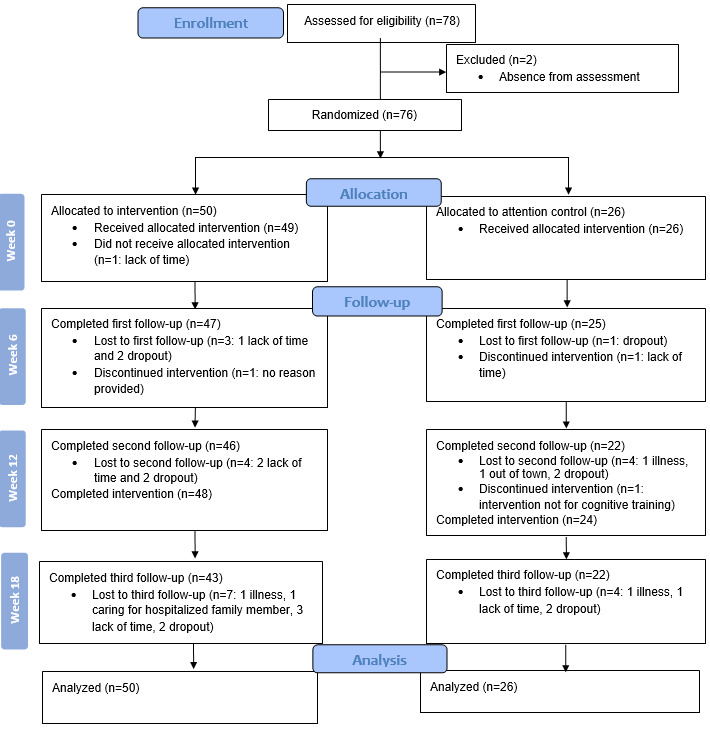
A randomized controlled feasibility study was conducted with 76 participants in Hong Kong, randomly assigned to the intervention and attention control groups in a ratio of 2:1 (n=50, 66% and n=26, 34%, respectively). The intervention group underwent 60-minute online dual-task training sessions twice a week for 12 weeks, incorporating cognitive components (upper limb and finger movement, arithmetic operation, and verbal fluency) and physical components (chair-based exercises) developed through a co-design approach. The attention control group received online health talks. Outcomes related to feasibility and acceptance included class attendance and self-reported satisfaction. Main outcomes related to potential effects included the Memory Inventory in Chinese and the Montreal Cognitive Assessment 5 Minutes (Hong Kong Version) at baseline, 6 weeks (midintervention), 12 weeks (postintervention) and 18 weeks (follow-up). Descriptive statistics and linear mixed effects models were used. Effect size was described with Cohen d. Qualitative feedback was collected from 12 informants and analyzed by thematic analysis.
About 72% (36/50) of the participants in the intervention group and 62% (16/26) in the control group attended over 75% of the classes. In total, 44 (88%) participants from the intervention group provided acceptance feedback; 82% (36/44) were satisfied and 84% (37/44) would recommend the training to others. Improvement in the Memory Inventory in Chinese score in the intervention group was observed at midintervention, postintervention, and follow-up, with a medium-to-large effect size (d=0.65, 0.43 and 0.85, respectively). Adjusting for baseline values, the between-group differences in the Montreal Cognitive Assessment 5 Minutes (Hong Kong Version) score attained a small-to-medium effect size at midintervention (d=0.34) and postintervention (d=0.23). Qualitative feedback highlighted the timesaving and convenient aspects of online dual-task training, with participants finding the sessions challenging and enjoyable, and reporting benefits across cognitive, physical, and psychosocial domains. However, a preference for traditional in-person training was noted among the older adults despite the advantages of online training.
Online dual-task training is a feasible intervention accepted by the older adults, with potential benefits in cognitive abilities. Online training may complement in-person sessions. Further investigation in a full-scale randomized controlled trial is warranted to comprehensively explore its effects and address areas for improvement.
ClinicalTrials.gov NCT05573646; https://clinicaltrials.gov/study/NCT05573646.
在认知障碍出现之前,对老年人进行认知训练至关重要。在诸如新冠疫情期间的社交距离限制时期,认知刺激较为缺乏。在线双任务训练被提议作为满足这些需求的一种解决方案。
我们旨在探讨基于在线小组的双任务训练作为一种干预措施,以增强社区居住老年人认知功能的可行性、可接受性和潜在效果。
在香港对76名参与者进行了一项随机对照可行性研究,参与者以2:1的比例随机分配到干预组和注意力控制组(分别为n = 50,66%和n = 26,34%)。干预组每周进行两次60分钟的在线双任务训练课程,为期12周,训练内容包括通过共同设计方法开发的认知成分(上肢和手指运动、算术运算和语言流畅性)和身体成分(基于椅子的锻炼)。注意力控制组接受在线健康讲座。与可行性和可接受性相关的结果包括课程出勤率和自我报告的满意度。与潜在效果相关的主要结果包括在基线、6周(干预中期)、12周(干预后)和18周(随访)时的中文版记忆量表和蒙特利尔认知评估5分钟(香港版)。使用描述性统计和线性混合效应模型。效应大小用科恩d值描述。从12名受访者收集了定性反馈,并通过主题分析进行分析。
干预组约72%(36/50)的参与者和对照组62%(16/26)的参与者参加了超过75%的课程。干预组共有44名(88%)参与者提供了可接受性反馈;82%(36/44)的人表示满意,84%(3