
虚拟现实运动认知训练对社区认知衰弱老年人的可行性及效果:前瞻性随机对照试验
Feasibility and Effects of Virtual Reality Motor-Cognitive Training in Community-Dwelling Older People With Cognitive Frailty: Pilot Randomized Controlled Trial.
作者信息
Kwan Rick Yiu Cho, Liu Justina Yat Wa, Fong Kenneth Nai Kuen, Qin Jing, Leung Philip Kwok-Yuen, Sin Olive Suk Kan, Hon Pik Yuen, Suen Lydia W, Tse Man-Kei, Lai Claudia Ky
机构信息
Centre for Gerontological Nursing, School of Nursing, The Hong Kong Polytechnic University, Hong Kong, China (Hong Kong).
Department of Rehabilitation Sciences, The Hong Kong Polytechnic University, Hong Kong, China (Hong Kong).
出版信息
JMIR Serious Games. 2021 Aug 6;9(3):e28400. doi: 10.2196/28400.
BACKGROUND
Cognitive frailty refers to the coexistence of physical frailty and cognitive impairment, and is associated with many adverse health outcomes. Although cognitive frailty is prevalent in older people, motor-cognitive training is effective at enhancing cognitive and physical function. We proposed a virtual reality (VR) simultaneous motor-cognitive training program, which allowed older people to perform daily activities in a virtual space mimicking real environments.
OBJECTIVE
We aimed to (1) explore the feasibility of offering VR simultaneous motor-cognitive training to older people with cognitive frailty and (2) compare its effects with an existing motor-cognitive training program in the community on the cognitive function and physical function of older people with cognitive frailty.
METHODS
A two-arm (1:1), assessor-blinded, parallel design, randomized controlled trial was employed. The eligibility criteria for participants were: (1) aged ≥60 years, (2) community dwelling, and (3) with cognitive frailty. Those in the intervention group received cognitive training (ie, cognitive games) and motor training (ie, cycling on an ergometer) simultaneously on a VR platform, mimicking the daily living activities of older people. Those in the control group received cognitive training (ie, cognitive games) on tablet computers and motor training (ie, cycling on the ergometer) sequentially on a non-VR platform. Both groups received a 30-minute session twice a week for 8 weeks. Feasibility was measured by adherence, adverse outcomes, and successful learning. The outcomes were cognitive function, physical frailty level, and walking speed.
RESULTS
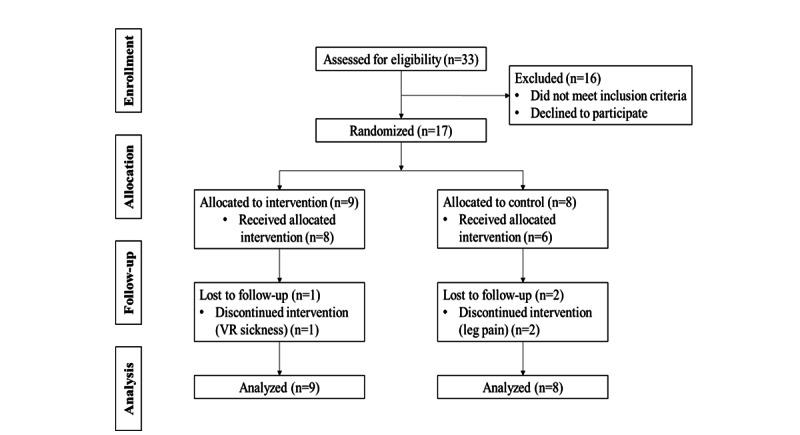
Seventeen participants were recruited and randomized to either the control group (n=8) or intervention group (n=9). At baseline, the median age was 74.0 years (IQR 9.5) and the median Montreal Cognitive Assessment score was 20.0 (IQR 4.0). No significant between-group differences were found in baseline characteristics except in the number of chronic illnesses (P=.04). At postintervention, the intervention group (Z=-2.67, P=.01) showed a significantly larger improvement in cognitive function than the control group (Z=-1.19, P=.24). The reduction in physical frailty in the intervention group (Z=-1.73, P=.08) was similar to that in the control group (Z=-1.89, P=.06). Improvement in walking speed based on the Timed Up-and-Go test was moderate in the intervention group (Z=-0.16, P=.11) and greater in the control group (Z=-2.52, P=.01). The recruitment rate was acceptable (17/33, 52%). Both groups had a 100% attendance rate. The intervention group had a higher completion rate than the control group. Training was terminated for one participant (1/9, 11%) due to minimal VR sickness (Virtual Reality Sickness Questionnaire score=18.3/100). Two participants (2/8, 25%) in the control group withdrew due to moderate leg pain. No injuries were observed in either group.
CONCLUSIONS
This study provides preliminary evidence that the VR simultaneous motor-cognitive training is effective at enhancing the cognitive function of older people with cognitive frailty. The effect size on frailty was close to reaching a level of significance and was similar to that observed in the control group. VR training is feasible and safe for older people with cognitive frailty.
TRIAL REGISTRATION
ClinicalTrials.gov NCT04467216; https://clinicaltrials.gov/ct2/show/NCT04467216.
背景
认知衰弱指身体衰弱与认知障碍并存,且与许多不良健康结局相关。尽管认知衰弱在老年人中普遍存在,但运动认知训练对增强认知和身体功能有效。我们提出了一种虚拟现实(VR)同步运动认知训练方案,该方案让老年人在模拟真实环境的虚拟空间中进行日常活动。
目的
我们旨在(1)探讨为认知衰弱的老年人提供VR同步运动认知训练的可行性,以及(2)将其效果与社区现有的运动认知训练方案对认知衰弱老年人的认知功能和身体功能的影响进行比较。
方法
采用双臂(1:1)、评估者盲法、平行设计的随机对照试验。参与者的纳入标准为:(1)年龄≥60岁,(2)居住在社区,(3)患有认知衰弱。干预组在VR平台上同时接受认知训练(即认知游戏)和运动训练(即在测力计上骑自行车),模拟老年人的日常生活活动。对照组在非VR平台上依次在平板电脑上接受认知训练(即认知游戏)和运动训练(即在测力计上骑自行车)。两组均每周进行两次30分钟的训练,共8周。通过依从性、不良结局和成功学习来衡量可行性。结局指标为认知功能、身体衰弱水平和步行速度。
结果
招募了17名参与者并随机分为对照组(n = 8)或干预组(n = 9)。基线时,年龄中位数为74.0岁(四分位间距9.5),蒙特利尔认知评估量表得分中位数为20.0(四分位间距4.0)。除慢性病数量外,两组基线特征无显著组间差异(P = 0.04)。干预后,干预组(Z = -2.67,P = 0.01)在认知功能方面的改善明显大于对照组(Z = -1.19,P = 0.24)。干预组身体衰弱的减轻程度(Z = -1.73,P = 0.08)与对照组(Z = -1.89,P = 0.06)相似。基于定时起立行走测试的步行速度改善在干预组中中等(Z = -0.16,P = 0.11),在对照组中更大(Z = -2.52,P = 0.01)。招募率可接受(17/33,52%)。两组的出勤率均为100%。干预组的完成率高于对照组。一名参与者(1/9,11%)因轻微的VR不适(虚拟现实不适问卷得分 = 18.3/100)而终止训练。对照组有两名参与者(2/8,25%)因中度腿痛退出。两组均未观察到受伤情况。
结论
本研究提供了初步证据,表明VR同步运动认知训练对增强认知衰弱老年人的认知功能有效。对衰弱的效应量接近达到显著水平,且与对照组观察到的相似。VR训练对认知衰弱的老年人是可行且安全的。
试验注册
ClinicalTrials.gov NCT04467216;https://clinicaltrials.gov/ct2/show/NCT04467216。
 Zotero 插件