Ouyang Shengrong, Cao Dingding, Yin Yan, Ma Feifei, Ren Gang
Department of Biochemistry and Immunology, Capital Institute of Pediatrics, Beijing, China.
Department of Integrated Early Childhood Development, Capital Institute of Pediatrics, Beijing, China.
Sci Rep. 2025 May 16;15(1):17003. doi: 10.1038/s41598-025-01807-4.
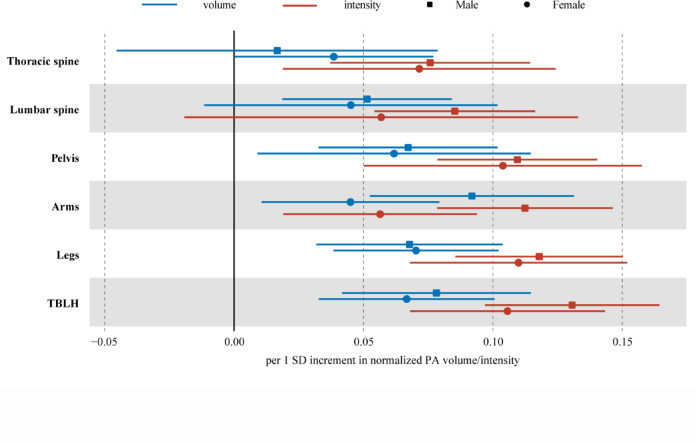
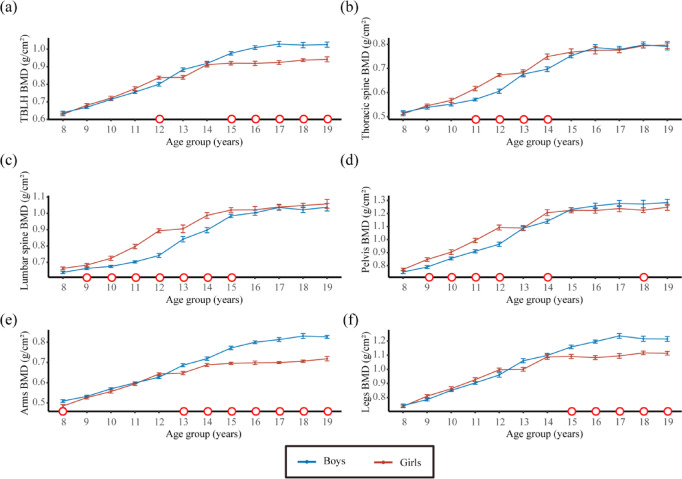
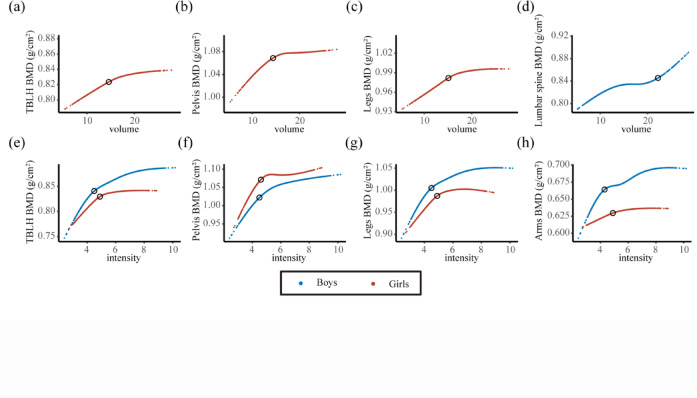
Physical activity (PA) serves as a modifiable determinant of bone mineral density (BMD). However, sex- and site-specific dose-response relationships remain poorly defined. Leveraging data from the National Health and Nutrition Examination Survey (NHANES 2011-2014), this cross-sectional study investigated sex-specific associations between accelerometer-derived PA (volume and intensity) and site-specific BMD in 2,659 children and adolescents aged 8-19 years. BMD assessment was conducted via dual-energy X-ray absorptiometry, and PA was quantified using monitor-independent movement summary units (MIMS). Linear and nonlinear analyses revealed distinct patterns: boys exhibited stronger linear associations between PA volume and BMD at weight-bearing sites (e.g., pelvis, arms, and legs; β = 0.003-0.004, P < 0.05), and girls demonstrated nonlinear thresholds (e.g., volume threshold: 15.0 × 10 MIMS/day). Both sexes had intensity-driven thresholds (~ 45-49 MIMS/min), with diminishing returns above these values (β = 0.010 in boys; stagnation in girls). Directional trends suggest the greater BMD gains per standard deviation (SD) increase in PA for boys compared with that for girls across most skeletal regions (e.g., total body less head: 0.131 SD vs. 0.106 SD for intensity). However, statistical significance (P < 0.05) was observed only for arm BMD responses. Mechanistic analyses highlighted the corresponding biomechanical principles, with weight-bearing regions showing stronger PA-BMD links than nonweight-bearing sites (e.g., spine). These findings underscore the importance of prioritizing high-intensity, weight-bearing activities, particularly for girls, to optimize skeletal health during growth. Public health strategies should focus on achieving, rather than exceeding, the identified daily 60 min intensity thresholds (~ 45-49 MIMS/min) through school- and community-based interventions.
身体活动(PA)是骨矿物质密度(BMD)的一个可改变的决定因素。然而,性别和部位特异性的剂量反应关系仍不明确。本横断面研究利用国家健康与营养检查调查(NHANES 2011 - 2014)的数据,调查了2659名8 - 19岁儿童和青少年中,加速度计测量的PA(量和强度)与部位特异性BMD之间的性别特异性关联。通过双能X线吸收法进行BMD评估,使用与监测器无关的运动汇总单位(MIMS)对PA进行量化。线性和非线性分析揭示了不同的模式:男孩在负重部位(如骨盆、手臂和腿部)的PA量与BMD之间表现出更强的线性关联(β = 0.003 - 0.004,P < 0.05),而女孩表现出非线性阈值(如量阈值:15.0×10 MIMS/天)。两性都有强度驱动的阈值(约45 - 49 MIMS/分钟),超过这些值后收益递减(男孩β = 0.010;女孩则停滞)。方向趋势表明,在大多数骨骼区域,男孩每增加一个标准差(SD)的PA所获得的BMD增加量比女孩更大(如全身除头部:强度方面,男孩为0.131 SD,女孩为0.106 SD)。然而,仅在手臂BMD反应中观察到统计学显著性(P < 0.05)。机制分析强调了相应的生物力学原理,负重区域显示出比非负重部位(如脊柱)更强的PA与BMD的联系。这些发现强调了优先进行高强度负重活动的重要性,特别是对女孩而言,以在生长过程中优化骨骼健康。公共卫生策略应通过基于学校和社区的干预措施,专注于达到而非超过确定的每日60分钟强度阈值(约45 - 49 MIMS/分钟)。