Arslan Nazli Pinar, Albayrak Seyda, Budak-Savas Aysenur, Hacimuftuoglu Ahmet, Orak Tugba, Ozdemir Aysenur, Karadagoglu Omer, Yildirim Sevval, Cinar-Yilmaz Handan, Taskin Mesut
Vocational School of Health Services Bingol University Bingol Turkey.
Department of Molecular Biology and Genetics, Faculty of Science Ataturk University Erzurum Turkey.
Food Sci Nutr. 2025 May 16;13(5):e70301. doi: 10.1002/fsn3.70301. eCollection 2025 May.
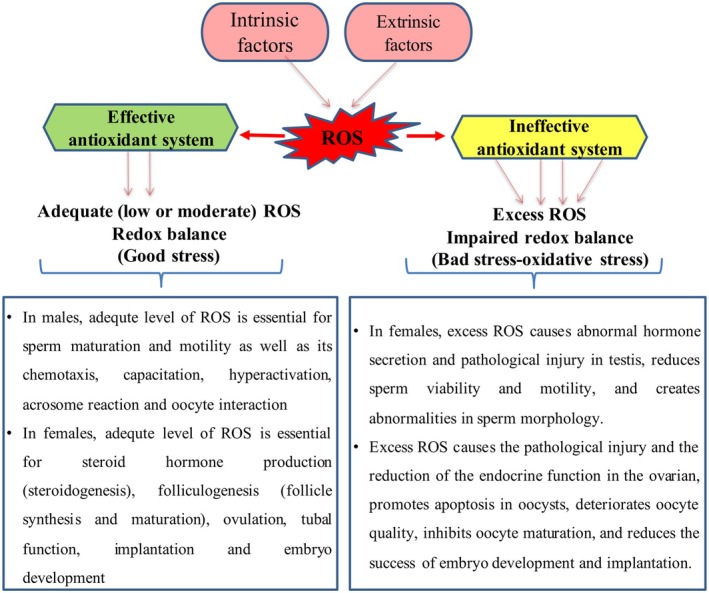
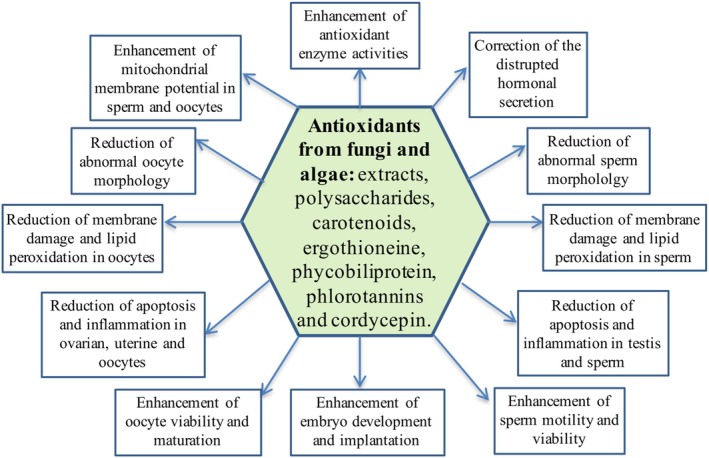
The intrinsic and extrinsic factors (natural aging, diseases, infections, chemicals, radiation, heavy metals etc.) create oxidative stress, thereby causing reproductive defects in males and females. Similarly, oxidative stress causes the abnormalities in sperm and oocytes, and thus reduces the success of in vitro fertilization. Fungi and/or algae-derived metabolites (polysaccharides, carotenoids, ergothioneine, phycobiliproteins, phlorotannins, and cordycepin) alleviate the damages in ovaries and testis and correct the impaired reproductive functions (spermatogenesis, ovulation, fertilization and implantation) in the in vivo models by increasing antioxidant enzyme activities (superoxide dismutase, catalase, glutathione peroxidase etc.), making mitochondrial parameters better (membrane potential, distribution, dynamics and activity of mitochondria), decreasing oxidative stress (the reductions in intracellular ROS and malondialdehyde levels), inflammation (the reductions in COX-2, IL-6, IL-1β, and TNF-α levels) and apoptosis (the reductions in and levels) and balancing blood hormone levels (follicle stimulating hormone, luteinizing hormone, testosterone). Similarly, in the in vitro models, they increase antioxidant enzymes activities, decrease oxidative stress and apoptosis, and make mitochondrial functions better, thereby restoring the defects in sperm and oocyte parameters and increasing blastocyst formation. Overall, this review study reveals that the antioxidants from fungi and algae contribute to the improvement of the reproductive outcome of humans and animals and assisted reproductive technology by preventing or alleviating oxidative stress. However, more in vitro, in vivo, or clinical studies are needed to prove the safety profile and efficacy of fungi- and algae-based antioxidants. This is the first review study focusing on the protective effects of fungi and algae-based antioxidants against oxidative stress-induced reproductive defects.
内在和外在因素(自然衰老、疾病、感染、化学物质、辐射、重金属等)会产生氧化应激,从而导致男性和女性的生殖缺陷。同样,氧化应激会导致精子和卵母细胞异常,进而降低体外受精的成功率。真菌和/或藻类衍生的代谢产物(多糖、类胡萝卜素、麦角硫因、藻胆蛋白、褐藻多酚和虫草素)通过提高抗氧化酶活性(超氧化物歧化酶、过氧化氢酶、谷胱甘肽过氧化物酶等),改善线粒体参数(线粒体膜电位、分布、动态和活性),降低氧化应激(细胞内活性氧和丙二醛水平的降低)、炎症(环氧合酶-2、白细胞介素-6、白细胞介素-1β和肿瘤坏死因子-α水平的降低)和细胞凋亡( 和 水平的降低)以及平衡血液激素水平(促卵泡激素、黄体生成素、睾酮),减轻卵巢和睾丸的损伤,并纠正体内模型中受损的生殖功能(精子发生、排卵、受精和着床)。同样,在体外模型中,它们可提高抗氧化酶活性,降低氧化应激和细胞凋亡,并改善线粒体功能,从而恢复精子和卵母细胞参数的缺陷并增加囊胚形成。总体而言,本综述研究表明,真菌和藻类中的抗氧化剂通过预防或减轻氧化应激,有助于改善人类和动物的生殖结局以及辅助生殖技术。然而,需要更多的体外、体内或临床研究来证明基于真菌和藻类的抗氧化剂的安全性和有效性。这是第一项聚焦于基于真菌和藻类的抗氧化剂对氧化应激诱导的生殖缺陷的保护作用的综述研究。