Neale Zoe E, Cooke Megan E, Cárcamo Jasmine, Trabilsy Maissa, Barr Peter B, Chatzinakos Chris, Chorlian David B, Kuang Weipeng, Pandey Gayathri, Goate Alison M, Porjesz Bernice, Amstadter Ananda B, Meyers Jacquelyn L
State University of New York Downstate Health Sciences University, Department of Psychiatry and Behavioral Sciences, Brooklyn, NY, USA.
VA New York Harbor Healthcare System, Brooklyn, NY, USA.
medRxiv. 2025 May 6:2025.05.02.25326879. doi: 10.1101/2025.05.02.25326879.
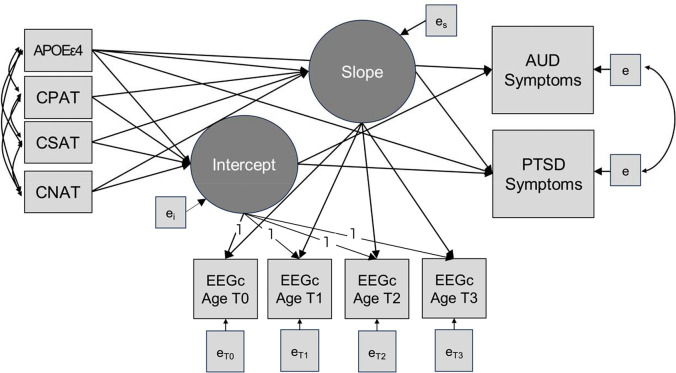
Childhood trauma affects neurodevelopment and lifelong risk for posttraumatic stress disorder (PTSD) and alcohol use disorder (AUD). Changes in brain structures and function are observed in young carriers of , the genetic factor most associated with Alzheimer's disease. Longitudinal studies of , childhood trauma, and neural connectivity in adolescence have not been explored. We studied 837 trauma-exposed participants (53% female) from the Collaborative Study on the Genetics of Alcoholism prospective sample, using latent growth curve models to assess associations of childhood trauma and on repeated measures of frontal alpha EEG coherence (EEGc) throughout adolescence and young adulthood. Young adult AUD and PTSD symptoms were also examined. Results indicate childhood trauma and are linked to neural connectivity, with effects differing by sex and trauma type. In females, sexual trauma was associated with a higher EEGc baseline but less growth, while associated with lower right frontocentral (RFC) EEGc baseline and higher slope. In males, physical assault was associated with lower left frontocentral (LFC) EEGc baseline but increased growth, and non-assaultive trauma was linked to a lower RFC baseline and no association with growth. was associated with lower LFC baseline and higher slope in males. Links between EEGc and AUD and PTSD were observed in both sexes, though effects differed in direction and strength. No significant trauma-by- interactions emerged, nor direct links between and PTSD or AUD. Findings highlight how EEGc may help explain connections between genetics, trauma, and psychopathology, guiding at-risk group identification and informing prevention strategies.
童年创伤会影响神经发育以及创伤后应激障碍(PTSD)和酒精使用障碍(AUD)的终生风险。在与阿尔茨海默病最相关的遗传因素——[此处原文缺失相关基因名称]的年轻携带者中,观察到了大脑结构和功能的变化。尚未对[此处原文缺失相关基因名称]、童年创伤和青少年神经连接性进行纵向研究。我们对来自酒精中毒遗传学合作研究前瞻性样本的837名有创伤经历的参与者(53%为女性)进行了研究,使用潜在增长曲线模型来评估童年创伤和[此处原文缺失相关基因名称]与整个青春期和青年期额叶阿尔法脑电图连贯性(EEGc)重复测量值之间的关联。还对青年期的AUD和PTSD症状进行了检查。结果表明,童年创伤和[此处原文缺失相关基因名称]与神经连接性有关,其影响因性别和创伤类型而异。在女性中,性创伤与较高的EEGc基线相关,但增长较少,而[此处原文缺失相关基因名称]与较低的右额中央(RFC)EEGc基线和较高的斜率相关。在男性中,身体攻击与较低的左额中央(LFC)EEGc基线相关,但增长增加,非攻击性创伤与较低的RFC基线相关且与增长无关联。[此处原文缺失相关基因名称]与男性较低的LFC基线和较高的斜率相关。在两性中均观察到EEGc与AUD和PTSD之间的联系,尽管其影响在方向和强度上有所不同。未出现显著的创伤与[此处原文缺失相关基因名称]的交互作用,也未发现[此处原文缺失相关基因名称]与PTSD或AUD之间的直接联系。研究结果凸显了EEGc如何有助于解释遗传学、创伤和精神病理学之间的联系,为高危人群的识别提供指导并为预防策略提供信息。