Liang Kaizhi, Su Danyan, Pang Yusheng
Department of Pediatrics, The First Affiliated Hospital of Guangxi Medical University, Nanning, China.
Transl Pediatr. 2025 Apr 30;14(4):545-558. doi: 10.21037/tp-2024-516. Epub 2025 Apr 27.
Cardiovascular and kidney diseases are interconnected through shared biological mechanisms. However, research on renal function in Kawasaki disease (KD) remains insufficient. This study focused on coronary artery aneurysm (CAA), a severe cardiac consequence of KD, aiming to examine the predictive value of cystatin C (Cys C) and other common laboratory indicators before and after intravenous immunoglobulin (IVIG) treatment on KD with CAA.
Based on patients' coronary status, 122 KD individuals were categorized in this retrospective analysis. After comparing the clinical and laboratory information of the patients with KD, multivariate logistic regression analysis was employed to identify independent risk factors for CAA development among them. Additionally, the predictive values of these parameters in CAA development of KD were assessed by receiver operating characteristic (ROC) curves.
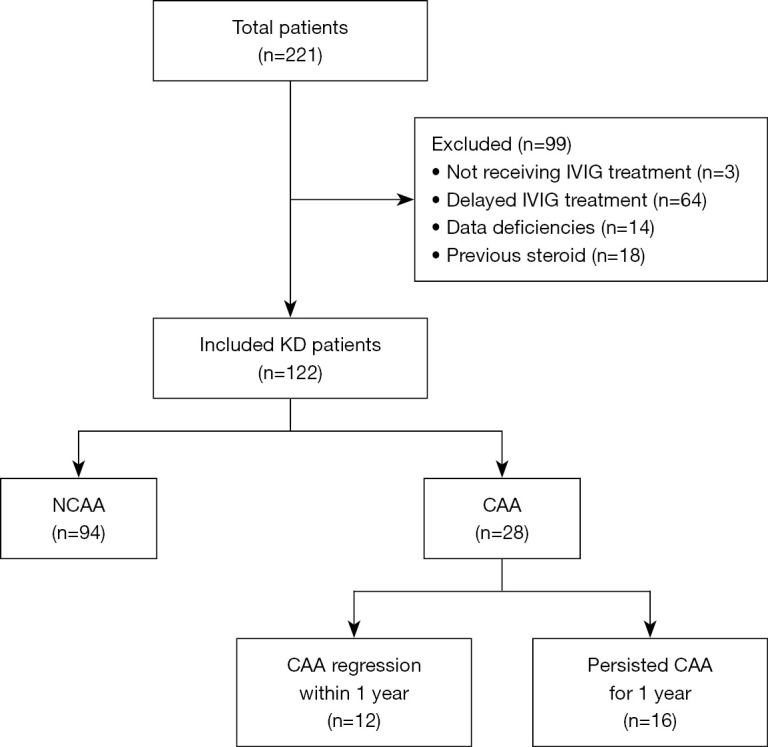
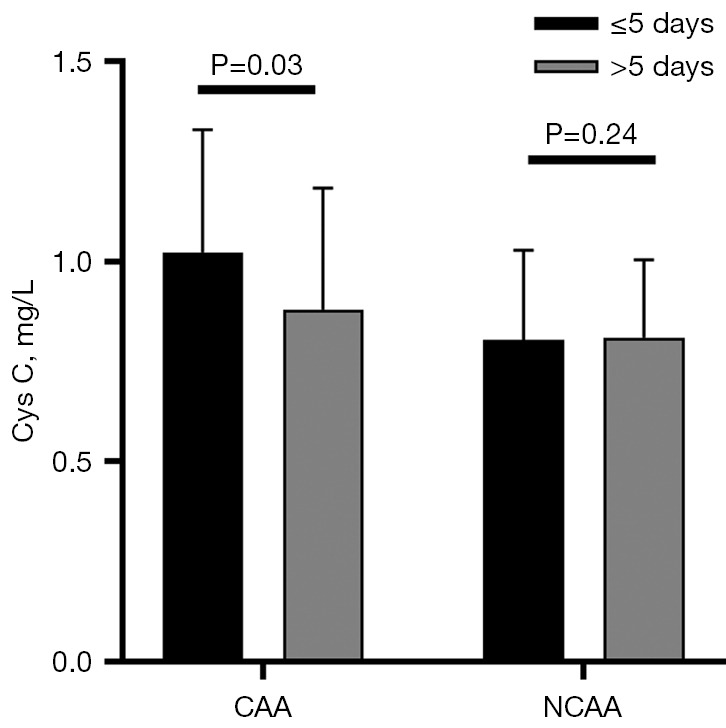
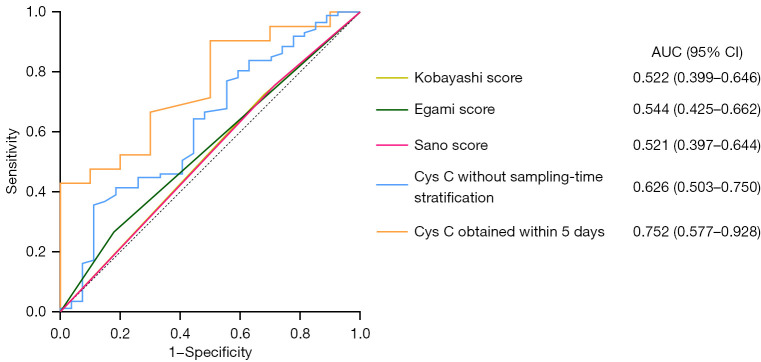
In this study, 28 patients (23.0%, 28/122) had CAA, including 12 who had coronary artery regression (9.8%, 12/122). The parameters with P<0.10 in the difference analysis, namely polymorphous exanthem, changes in the extremities, plateletocrit and Cys C before IVIG, prealbumin >107.2 mg/L and prognostic nutritional index >54.7 after IVIG, were included in multivariate logistic regression analysis. Finally, binary logistic regression analysis identified the pre-IVIG Cys C [odds ratio, 10.183; 95% confidence interval (CI): 1.158-89.525] as an independent risk factor for developing CAA among KD patients. In addition, the 0.71 Cys C cut-off value sampled within five days had a 100% sensitivity and a 42.9% specificity (area under the ROC curve =0.752, 95% CI: 0.577-0.928, P=0.03).
Higher pre-IVIG Cys C levels may be associated with increased CAA risk, but further large-scale prospective studies are needed to confirm its predictive utility. Furthermore, Cys C acquired within five days of disease onset may theoretically provide better prediction power for the CAA development in KD.
心血管疾病和肾脏疾病通过共同的生物学机制相互关联。然而,关于川崎病(KD)肾功能的研究仍然不足。本研究聚焦于KD的严重心脏后果——冠状动脉瘤(CAA),旨在探讨胱抑素C(Cys C)及其他常见实验室指标在静脉注射免疫球蛋白(IVIG)治疗前后对合并CAA的KD的预测价值。
在这项回顾性分析中,根据患者的冠状动脉状况对122例KD患者进行分类。比较KD患者的临床和实验室信息后,采用多因素逻辑回归分析确定其中CAA发生的独立危险因素。此外,通过受试者工作特征(ROC)曲线评估这些参数在KD患者CAA发生中的预测价值。
在本研究中,28例患者(23.0%,28/122)患有CAA,其中12例出现冠状动脉退缩(9.8%,12/122)。差异分析中P<0.10的参数,即多形性皮疹、四肢变化、IVIG治疗前的血小板压积和Cys C、IVIG治疗后前白蛋白>107.2 mg/L以及预后营养指数>54.7,被纳入多因素逻辑回归分析。最后,二元逻辑回归分析确定IVIG治疗前的Cys C[比值比,10.183;95%置信区间(CI):1.158 - 89.525]是KD患者发生CAA的独立危险因素。此外,发病五天内采集的Cys C临界值为0.71时,敏感性为100%,特异性为42.9%(ROC曲线下面积 = 0.752,95%CI:0.577 - 0.928,P = 0.03)。
IVIG治疗前较高的Cys C水平可能与CAA风险增加有关,但需要进一步的大规模前瞻性研究来证实其预测效用。此外,在疾病发作五天内获取的Cys C理论上可能为KD患者CAA的发生提供更好的预测能力。