Liu Yang, Wang Wanting, Wang Chaofan, Deng Jun, Hu Yu, Mei Heng, Luo Shanshan
Institute of Hematology, Union Hospital, Tongji Medical College, Huazhong University of Science and Technology, Wuhan, China.
Key Laboratory of Molecular Biological Targeted Therapies of the Ministry of Education, Wuhan, China.
Front Immunol. 2025 May 2;16:1572407. doi: 10.3389/fimmu.2025.1572407. eCollection 2025.
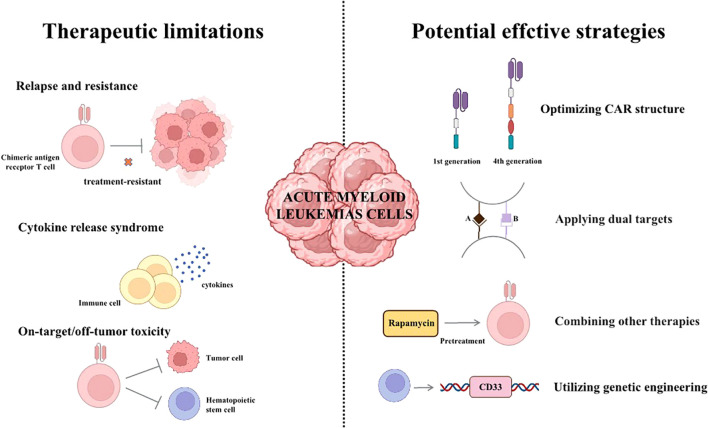
Acute myeloid leukemia (AML) is a heterogeneously primary hematopoietic neoplasm characterized by uncontrolled proliferation of immature myeloid cells, which is characterized with poor outcomes. Despite tremendous advances in the treatment paradigm of AML in the past several decades, the cure and prognosis remain unfavorable. More effective treatments are therefore needed to improve the clinical outcomes. Among newly emerging immunotherapies, chimeric antigen receptor (CAR)-T cell immunotherapy is an exceedingly promising approach that has remarkably improved the overall survival for patients with AML. However, current CAR-T cell therapy for AML faces numerous significant challenges such as the identification of truly AML-specific surface antigens, the on-target/off-tumor toxicity, and the immunosuppressive microenvironment of AML. In order to conquer these limitations, novel strategies to advance CAR-T therapy are urgently needed. In this comprehensive review, we summarize the current status of immunotherapy, especially CAR-T cell therapy, highlight the outcomes of current trials and the limitations of CAR-T immunotherapy, hopefully to provide novel insights into the future directions of CAR-T cells in AML.
急性髓系白血病(AML)是一种异质性原发性造血肿瘤,其特征为未成熟髓系细胞的不受控制增殖,预后较差。尽管在过去几十年中AML的治疗模式取得了巨大进展,但其治愈率和预后仍然不容乐观。因此,需要更有效的治疗方法来改善临床结局。在新出现的免疫疗法中,嵌合抗原受体(CAR)-T细胞免疫疗法是一种极具前景的方法,显著提高了AML患者的总生存率。然而,目前用于AML的CAR-T细胞疗法面临诸多重大挑战,如真正的AML特异性表面抗原的鉴定、靶向非肿瘤毒性以及AML的免疫抑制微环境。为了克服这些限制,迫切需要推进CAR-T疗法的新策略。在这篇全面综述中,我们总结了免疫疗法的现状,尤其是CAR-T细胞疗法,强调了当前试验的结果以及CAR-T免疫疗法的局限性,希望能为CAR-T细胞在AML中的未来发展方向提供新的见解。