Wu Min, Li Qianqian, Fang Min, Zhang Hong, Ding Yanhua
Department of Phase I Clinical Trial Unit, The First Hospital of Jilin University, Changchun, Jilin, 130021, China.
Qyuns Therapeutics Co., Ltd., Taizhou, Jiangsu, 318000, China.
BMC Pharmacol Toxicol. 2025 May 19;26(1):107. doi: 10.1186/s40360-025-00885-4.
To investigate the safety, pharmacokinetics, preliminary efficacy, pharmacodynamics, and immunogenicity of QX002N, an interleukin-17 A monoclonal antibody, in Chinese patients with active ankylosing spondylitis (AS).
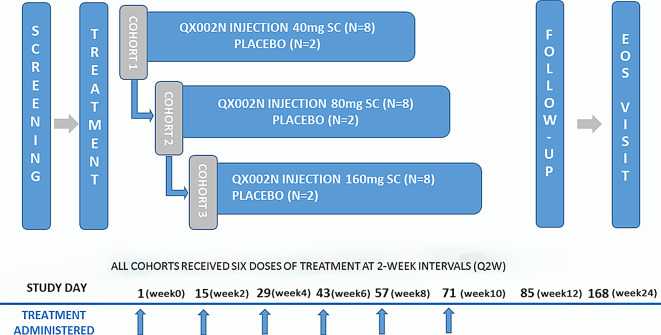
In this phase 1b, double-blind, placebo-controlled, multiple ascending dose study, eligible patients with active AS were randomized into three dose (40, 80, or 160 mg) cohorts, with a 4:1 ratio in each cohort to subcutaneously receive either QX002N or a placebo once every 2 weeks with six doses in total. All patients were followed for 14 weeks (98 days) after the last dose. The primary endpoints were the safety and pharmacokinetics of QX002N, and the secondary endpoints included its preliminary efficacy, pharmacodynamics, and immunogenicity.
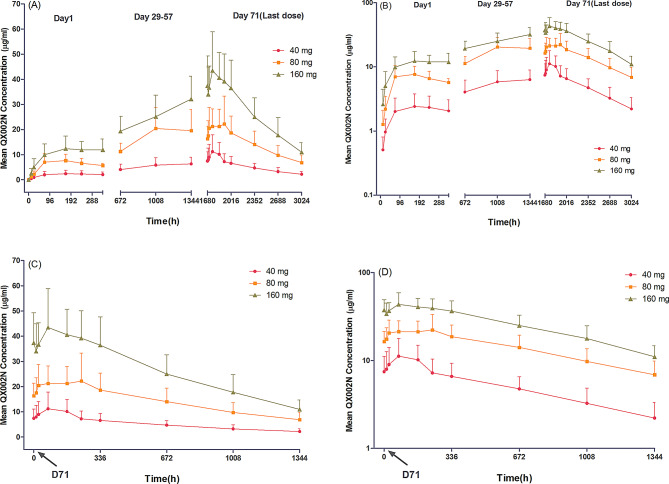
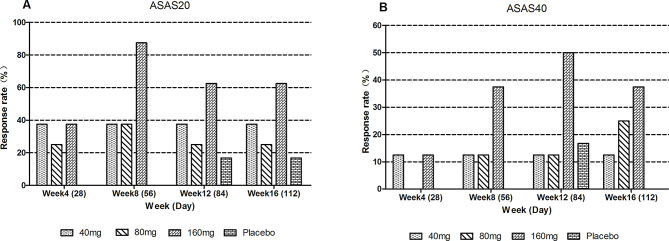
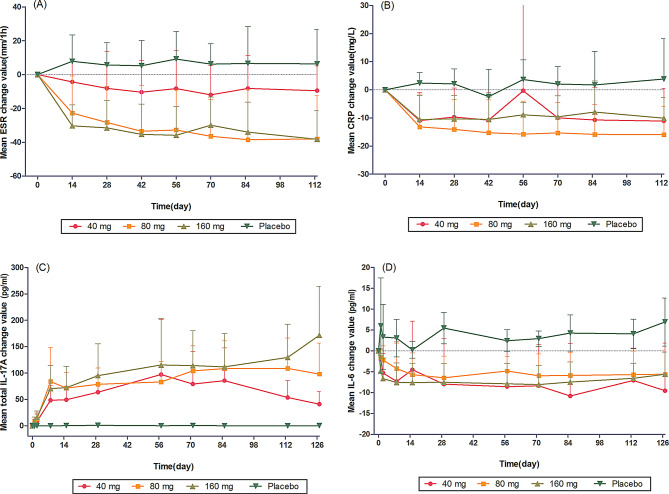
Thirty patients (n = 10 in each cohort) were included, with 24 receiving QX002N and 6 receiving a placebo. A total of 85 adverse drug reactions, predominantly Grade 1-2, were identified in 20 out of 24 patients (83.3%) who took QX002N. The exposure to QX002N increased proportionally with the dose escalating from 40 mg to 160 mg. Patients taking 160 mg QX002N achieved higher response rates (ASAS20: 87.6% at Week 8 [Day 56]); ASAS40: 50.0% at Week 12 [Day 78]), than those taking 40-mg or 80-mg QX002N. An increase in interleukin-17 A and a decrease in interleukin-6 levels in the serum, with decreases in the erythrocyte sedimentation rate and high-sensitivity C-reactive protein levels, were observed. Anti-drug antibodies were detected in only one of 24 patients taking QX002N.
Subcutaneous administration of QX002N demonstrates a favorable safety profile, with linear pharmacokinetic characteristics. Promising clinical responses in pharmacodynamics and preliminary efficacy have been observed. Immunogenicity does not appear to be a concern.
This study was registered with Chinadrugtrials.org.cn (CTR20201277), the data of registration was in 20 Jul, 2020.
研究白细胞介素-17A单克隆抗体QX002N在中国活动性强直性脊柱炎(AS)患者中的安全性、药代动力学、初步疗效、药效学及免疫原性。
在这项1b期、双盲、安慰剂对照、多剂量递增研究中,符合条件的活动性AS患者被随机分为三个剂量组(40、80或160mg),每组按4:1的比例皮下注射QX002N或安慰剂,每2周一次,共注射6次。末次给药后所有患者随访14周(98天)。主要终点为QX002N的安全性和药代动力学,次要终点包括其初步疗效、药效学及免疫原性。
共纳入30例患者(每组10例),其中24例接受QX002N治疗,6例接受安慰剂治疗。在接受QX002N治疗的24例患者中,有20例(83.3%)共出现85例药物不良反应,主要为1-2级。QX002N的暴露量随剂量从40mg递增至160mg而成比例增加。接受160mg QX002N治疗的患者在第8周(第56天)的ASAS20缓解率更高(87.6%);在第12周(第78天)的ASAS40缓解率更高(50.0%),高于接受40mg或80mg QX002N治疗的患者。观察到血清中白细胞介素-17A升高,白细胞介素-6水平降低,同时红细胞沉降率和高敏C反应蛋白水平降低。在接受QX002N治疗的24例患者中,仅1例检测到抗药抗体。
皮下注射QX002N显示出良好的安全性,药代动力学特征呈线性。在药效学和初步疗效方面观察到了有前景的临床反应。免疫原性似乎不是问题。
本研究已在中国药物临床试验注册中心(Chinadrugtrials.org.cn)注册(CTR20201277),注册数据于2020年7月20日发布。