Cross Lisa, Famà Angelo, Pagnottoni Paolo, Pecora Nicolò, Spelta Alessandro
Department of Economics and Management, University of Pavia, Pavia, 27100, Italy.
Department of Economics, University of Insubria, Varese, 21100, Italy.
Sci Rep. 2025 May 20;15(1):17541. doi: 10.1038/s41598-025-01885-4.
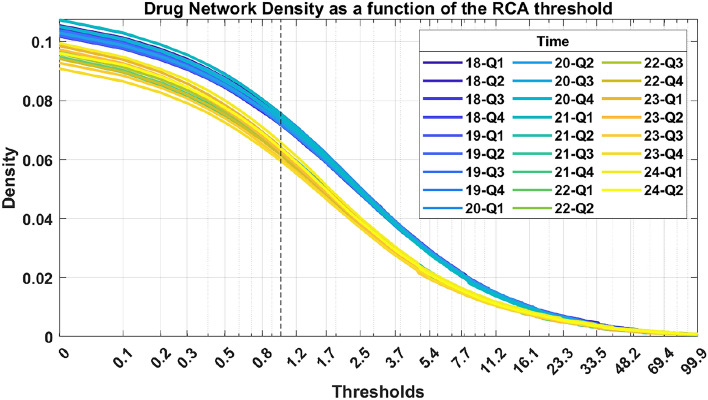
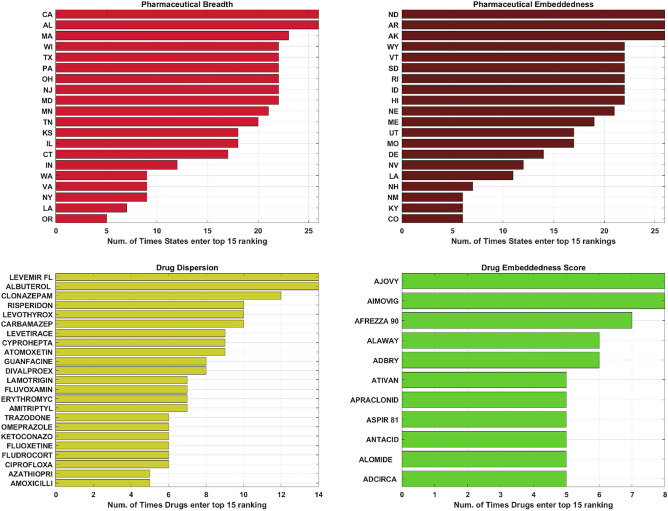
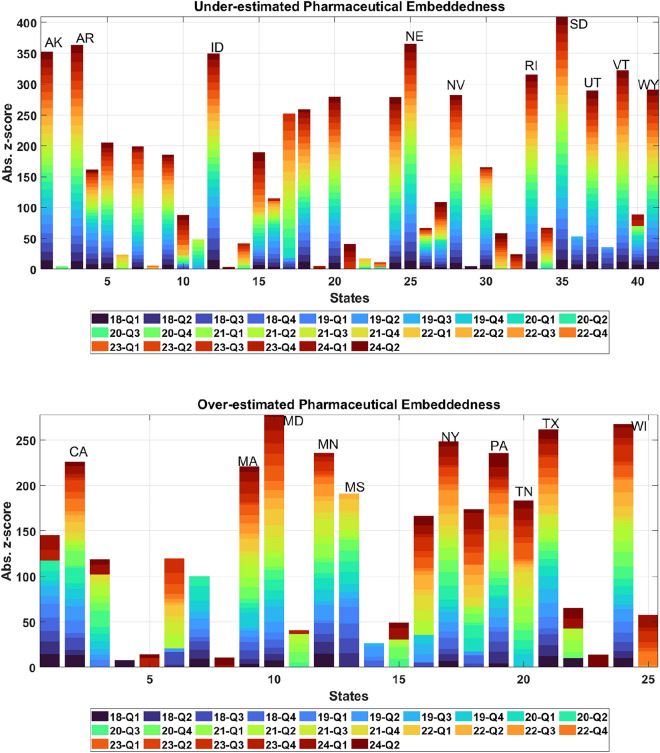
Understanding the complexity of pharmaceutical expenditures across U.S. states is critical for designing efficient healthcare policies and ensuring equitable drug access. This study applies network-based economic complexity methods to analyze state-level Medicaid drug spending, leveraging Medicaid State Drug Utilization Data (SDUD) from 2018 to 2024. Using Revealed Comparative Advantage (RCA) and the Method of Reflections, we quantify the sophistication of pharmaceutical consumption and identify structural inefficiencies in drug reimbursement policies. Our findings reveal substantial heterogeneity in pharmaceutical complexity across states, with highly diversified markets in states like California and Texas, while others, such as Wyoming and West Virginia, exhibit lower complexity due to restrictive formulary policies and healthcare infrastructure limitations. A 15% decline in network density over the study period suggests consolidation in reimbursement practices, influenced by regulatory interventions and cost-containment strategies. Additionally, Medicaid expansion states show a 20% increase in prescription utilization, particularly for antiviral and mental health medications. Null model comparisons highlight systematic deviations from expected expenditure patterns, with states like Arkansas and Nebraska showing lower-than-expected pharmaceutical embeddedness, whereas Massachusetts and California appear more integrated than network models predict. These findings suggest that state-specific policies, provider behavior, and market dynamics significantly shape pharmaceutical expenditures beyond structural network constraints, as well as they offer significant implications for policymakers and healthcare providers seeking to balance cost efficiency with equitable medication distribution.
了解美国各州药品支出的复杂性对于制定高效的医疗政策和确保公平的药品可及性至关重要。本研究应用基于网络的经济复杂性方法,利用2018年至2024年的医疗补助州药品利用数据(SDUD)来分析州一级的医疗补助药品支出。通过显示性比较优势(RCA)和反射法,我们量化了药品消费的复杂性,并识别了药品报销政策中的结构低效问题。我们的研究结果显示,各州在药品复杂性方面存在显著差异,加利福尼亚州和得克萨斯州等州的市场高度多元化,而怀俄明州和西弗吉尼亚州等其他州由于处方集政策限制和医疗基础设施限制,药品复杂性较低。在研究期间,网络密度下降了15%,这表明在监管干预和成本控制策略的影响下,报销做法出现了整合。此外,医疗补助扩大州的处方利用率提高了20%,特别是抗病毒和精神类药物。零模型比较突出了与预期支出模式的系统性偏差,阿肯色州和内布拉斯加州等州的药品嵌入性低于预期,而马萨诸塞州和加利福尼亚州的整合程度似乎高于网络模型的预测。这些研究结果表明,除了结构性网络限制之外,各州特定的政策、提供者行为和市场动态显著影响着药品支出,同时也为寻求在成本效率与公平药物分配之间取得平衡的政策制定者和医疗服务提供者提供了重要启示。