Rhee Jess, Iansavitchene Alla, Mannala Sonya, Graham M Elise, Rotenberg Brian
Department of Otolaryngology - Head and Neck Surgery, London Health Sciences Centre, London, Ontario, Canada.
Department of Library Services, London Health Sciences Centre, London, Ontario, Canada.
PLoS One. 2025 May 21;20(5):e0323643. doi: 10.1371/journal.pone.0323643. eCollection 2025.
Social media has contributed to a potentially unsafe trend of nighttime mouth taping for individuals with mouth breathing, sleep disordered breathing, or sleep apnea as a home remedy to treat these issues. This systematic review is aimed to highlight any potential benefits or harms with this practice.
A comprehensive librarian-designed literature search was performed using PRISMA guidelines. Using search terms, "mouth taping, adhesive mouthpiece, porous oral patch, surgical tape, breathing mouthpiece, sleep, microsleep, breath, breathing, or mouth breathing", MEDLINE, Embase, and Google Scholar were searched from February 1999 to February 2024. Covidence software was used for screening and data entry performed into a data collection sheet designed a priori.
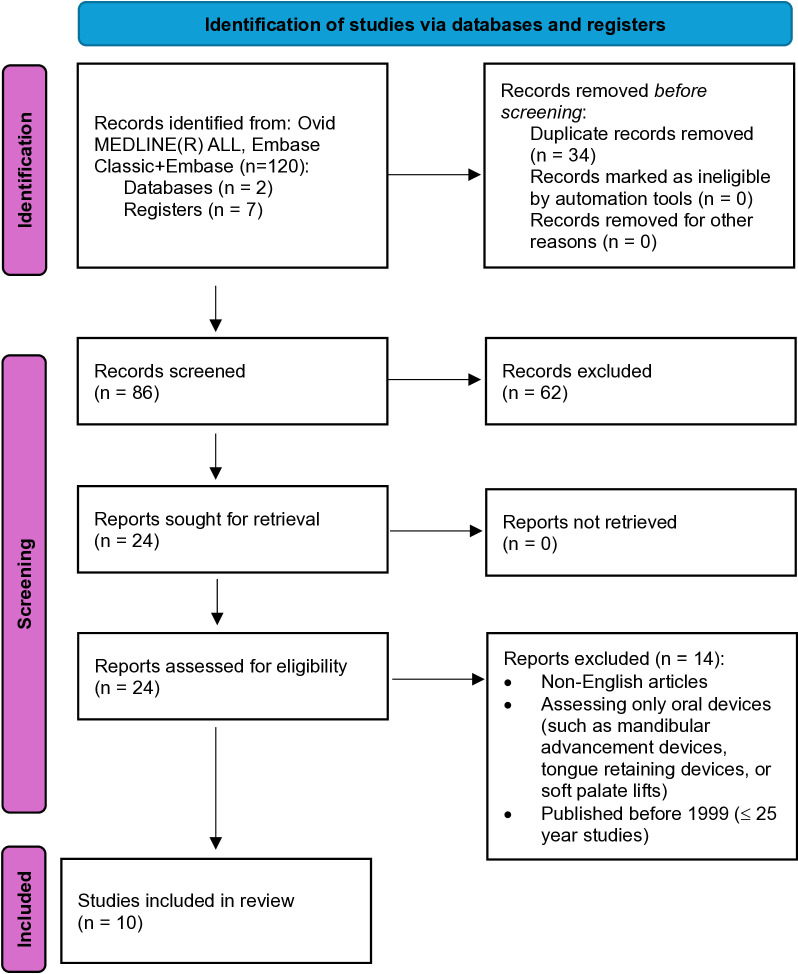
Covidence software was utilized to screen 120 articles. After 34 duplicates were removed, 86 articles were screened by two independent reviewers. Sixty-two were excluded. Twenty-four went on to full text review and 10 met inclusion criteria with a total of 213 patients. Two studies showed statistically significant improvement in established markers of sleep apnea such as apnea-hypopnea index (AHI) or oxygen desaturations. Other studies showed that mouth taping offered no differences and even discussed potential risks including asphyxiation in the presence of nasal obstruction. Many studies excluded anyone with nasal obstruction or pathology.
The social media trend of mouth taping for individuals with mouth breathing, sleep disordered breathing, or sleep apnea has been reviewed. Based on the data presented by these 10 different studies, it seems that there is a potentially serious risk of harm for individuals indiscriminately practicing this trend. Further studies are required to elucidate any clinical benefit this practice may have.
社交媒体促使一种潜在不安全的夜间用胶带贴住嘴巴的趋势出现,针对的是有口呼吸、睡眠呼吸紊乱或睡眠呼吸暂停问题的个体,作为一种治疗这些问题的家庭疗法。本系统评价旨在突出这种做法的任何潜在益处或危害。
按照PRISMA指南进行了由图书馆员设计的全面文献检索。使用检索词“嘴巴贴胶带、粘性口器、多孔口腔贴片、手术胶带、呼吸口器、睡眠、微睡眠、呼吸、呼吸或口呼吸”,检索了1999年2月至2024年2月期间的MEDLINE、Embase和谷歌学术。使用Covidence软件进行筛选,并将数据录入预先设计的数据收集表。
使用Covidence软件筛选了120篇文章。去除34篇重复文章后,由两名独立评审员筛选86篇文章。排除62篇。24篇进入全文评审,10篇符合纳入标准,共涉及213名患者。两项研究显示,睡眠呼吸暂停的既定指标如呼吸暂停低通气指数(AHI)或氧饱和度有统计学显著改善。其他研究表明,嘴巴贴胶带没有差异,甚至讨论了潜在风险,包括存在鼻塞时的窒息风险。许多研究排除了任何有鼻塞或病理问题的人。
对社交媒体上针对有口呼吸、睡眠呼吸紊乱或睡眠呼吸暂停个体的嘴巴贴胶带趋势进行了综述。根据这10项不同研究提供的数据,随意遵循这种趋势的个体似乎存在潜在的严重伤害风险。需要进一步研究以阐明这种做法可能具有的任何临床益处。