Department of Internal Medicine, Taipei City Hospital, Taipei, Taiwan; Institute of Clinical Medicine, National Yang-Ming Chiao Tung University, Taipei, Taiwan; Faculty of Medicine, School of Medicine, National Yang-Ming Chiao Tung University, Taipei, Taiwan; Center of Sleep Medicine, Taipei Veterans General Hospital, Taipei, Taiwan.
Institute of Clinical Medicine, National Yang-Ming Chiao Tung University, Taipei, Taiwan; Faculty of Medicine, School of Medicine, National Yang-Ming Chiao Tung University, Taipei, Taiwan; Center of Sleep Medicine, Taipei Veterans General Hospital, Taipei, Taiwan; Department of Chest Medicine, Taipei Veterans General Hospital, Taipei, Taiwan.
Biomed J. 2023 Jun;46(3):100536. doi: 10.1016/j.bj.2022.05.001. Epub 2022 May 10.
Mouth opening/breathing during sleep is common in patients with obstructive sleep apnea (OSA), which is probably associated with more water loss and higher risk for nocturnal ischemic heart attack. This study aimed to evaluate nocturnal changes in hematocrit/hemoglobin levels and estimated plasma volume loss in OSA patients and its relation to their OSA severity and mouth open/breathing.
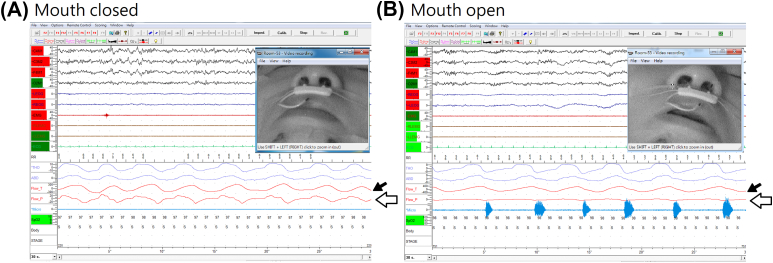
Sixty OSA patients and fifteen healthy controls were enrolled and underwent overnight polysomnography. Mouth status was evaluated via an infrared camera and nasal/mouth airflow. Hematocrit and hemoglobin levels in peripheral venous blood were measured before and after sleep to estimate the change of plasma volume.
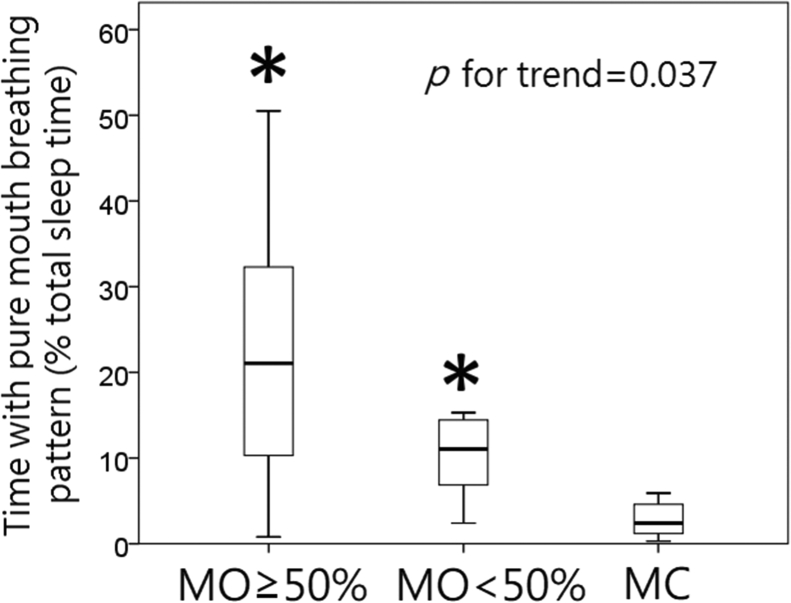
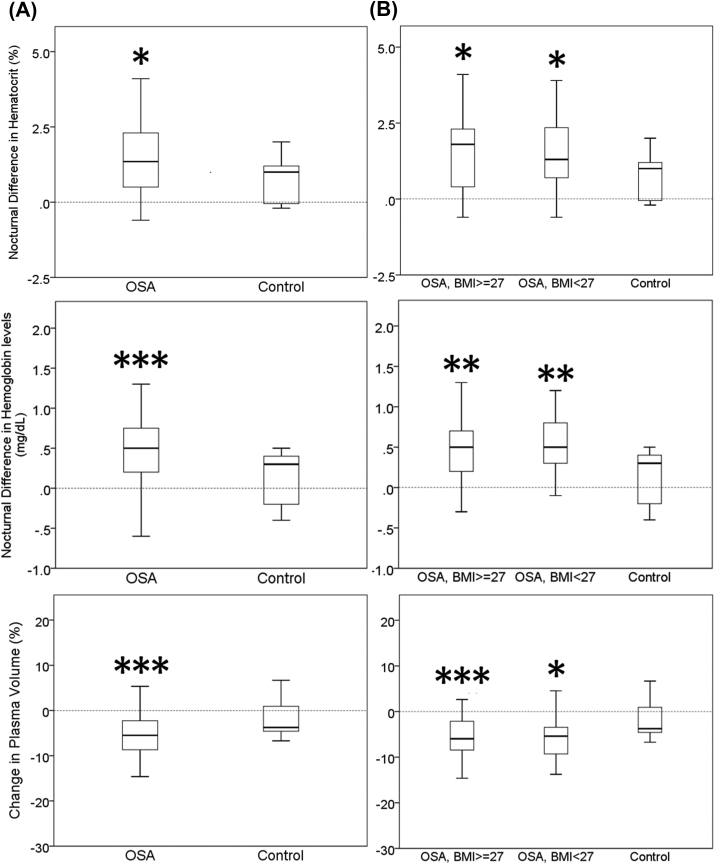
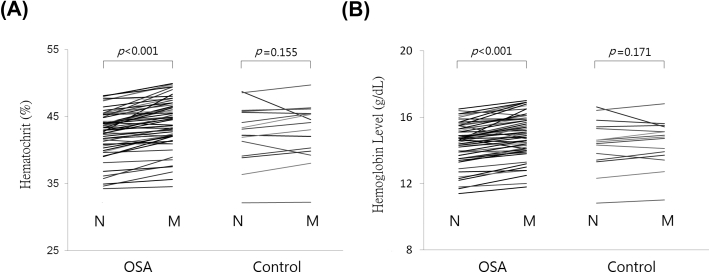
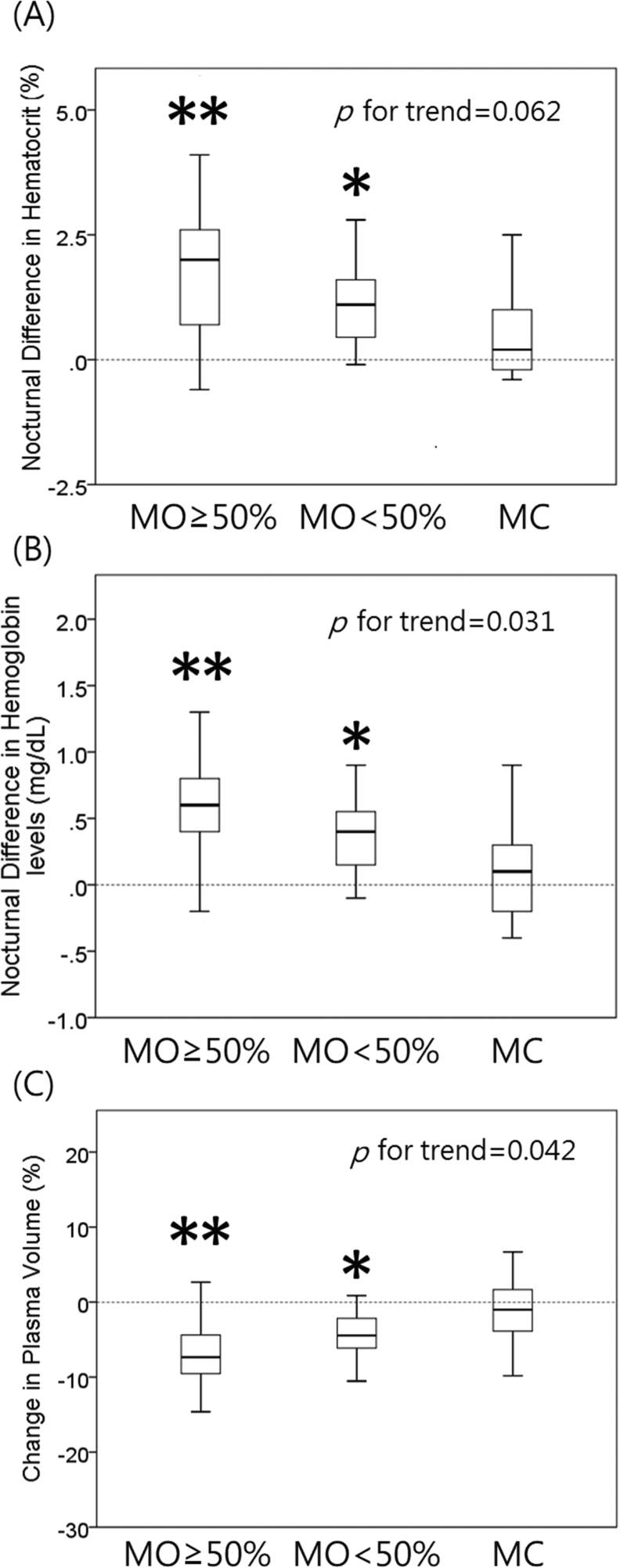
Compared to controls, OSA patients had a greater nocturnal increase in hematocrit (1.35% vs. 1.0%, p = 0.013), hemoglobin (0.50% vs. 0.30%, p = 0.002) and more estimated water loss (5.5% vs 3.7% of plasma volume, p < 0.013). The extent of increase was correlated to apnea-hypopnea index (AHI)_the marker of OSA severity (Spearman's ρ = 0.332, p = 0.004; ρ = 0.367, p = 0.001 for hematocrit, hemoglobin, respectively), which remained significant after serial multivariate adjustment. OSA patients had more sleep time with mouth open (96.7% vs 26.7% of total sleep time, p < 0.001) and time with complete mouth breathing (14.1% vs 2.7%, p < 0.001). The extent of mouth breathing was correlated to AHI (ρ=0.487, p < 0.001), nocturnal increase in hematocrit/hemoglobin levels (ρ = 0.236, p = 0.042; ρ = 0.304, p = 0.008, respectively) and estimated plasma volume loss (ρ = 0.262, p = 0.023).
OSA patients had a greater increase in hematocrit/hemoglobin levels after sleep, which is probably linked to more water loss and more sleep time with mouth open/breathing.
阻塞性睡眠呼吸暂停(OSA)患者在睡眠期间张口呼吸较为常见,这可能与更多的水分流失和夜间缺血性心脏病发作的风险增加有关。本研究旨在评估 OSA 患者夜间血细胞比容/血红蛋白水平的变化以及估计的血浆容量损失,并探讨其与 OSA 严重程度和张口呼吸的关系。
纳入 60 例 OSA 患者和 15 例健康对照者,并进行整夜多导睡眠监测。通过红外摄像机评估口腔状态,并监测鼻/口气流。在睡眠前后测量外周静脉血的血细胞比容和血红蛋白水平,以估计血浆容量的变化。
与对照组相比,OSA 患者夜间血细胞比容(1.35%比 1.0%,p=0.013)、血红蛋白(0.50%比 0.30%,p=0.002)和估计的水分损失(5.5%比 3.7%的血浆容量,p<0.013)增加更多。增加程度与呼吸暂停低通气指数(AHI)呈正相关(OSA 严重程度的标志物)(Spearman ρ=0.332,p=0.004;ρ=0.367,p=0.001 分别为血细胞比容和血红蛋白),经多次多元调整后仍具有统计学意义。OSA 患者有更多的睡眠时间口呼吸(96.7%比总睡眠时间的 26.7%,p<0.001)和完全口呼吸时间(14.1%比 2.7%,p<0.001)。张口呼吸程度与 AHI 呈正相关(ρ=0.487,p<0.001),与夜间血细胞比容/血红蛋白水平的增加呈正相关(ρ=0.236,p=0.042;ρ=0.304,p=0.008),与估计的血浆容量损失呈正相关(ρ=0.262,p=0.023)。
OSA 患者睡眠后血细胞比容/血红蛋白水平升高幅度更大,这可能与更多的水分流失和更多的张口呼吸睡眠时间有关。